The way forward, but is anybody listening?

It’s unfortunate that, even when there is agreement that unitary is the best and most cost effective way to provide local government service, politicians still waste time and energy protecting their individual power bases.
I’ve yet to fathom Eric Pickles’s reasoning for sticking his oar in as soon as he got in to office in 2010, and stopping those that were in train. Possibly pre-election whinging, from Conservative councillors in those areas, fearful that they would get the boot from the electorate, was the cause of this early interference, something that has continued at a pace.

Too much time and effort is wasted by politicians protecting their own interests under the pretence of championing the interests of those who elected them. The vast majority of taxpayers care little for which part of local government provides the services they need to access. What they do care about, is how much their council tax bill will be every April. Yet despite what should be blindingly obvious, lower tier politicians spend their trying to pass on the cost to the upper tier, or refusing to work with that upper tier, because they can nothing in it for them.

As far as the taxpayer is concerned, a saving in their council tax, is a saving in the council tax, no matter where it comes from. Put another way, if a district council works with their county council, to help that county council save money, then that is as much to the credit of those district councillors as it is the county councillors, if not more. Unfortunately many councillors at the district level can only see the numbers in their own budget and refuse to acknowledge any wider savings that are being made.

However, it’s not just a case of making everything unitary and all will be well in local government. I’ve no idea how well or badly local government is working within the East Riding of Yorkshire. However, given that it’s the largest unitary in England, is divided into 26 wards and has a total of 67 councillors (Lincolnshire County Council has 77 councillors, covering only county council services) it would be very interesting to know and I don’t mean just what the council and it’s politicians would like you to believe.

Would Lincolnshire work as one large unitary? Personally, I don’t believe that it would, but that’s just my opinion. I’m always willing to be persuaded differently based on evidence that unitary councils such as East Riding of Yorkshire Council is serving its rural council taxpayers well.

Copied from the Local Government Chronicle. From a series of articles written by a senior local government officer, who remains anonymous.

Inside Out: Unitary is strength
5 March, 2014

I have always believed unitary is strength when it comes to local government. I was really pleased when it was recently reported that Labour is looking to embrace it.

I was less pleased with the government’s response. They ‘played politics’ with it rather than responding to the issue.

Granted, the move to unitary councils has never been smooth.Councils disappear, people lose their power and influence, places can feel they lose their identity, and there are always transitional costs. However, the advantages when unitary government is established far outweigh the transitory downsides.

I have worked for a district that became a unitary council, a county unitary and a district unitary. One size does not fit all circumstances. It seems to be assumed these days that unitaries should always be based on counties. This is a disservice to the strength and professionalism of district councils and will be a barrier to change in some circumstances.

There are three secrets to make moving to unitary local government successful. First, the area covered needs to make sense to residents. My hometown was moved from Lancashire to Merseyside in 1974. I still address Christmas cards to my relatives using Lancashire, 40 years later. The boundaries of unitaries need to be determined locally.

Second, there needs to be strong national leadership. The whole of England needs to be covered by unitary government. Unless this is made clear, local vested interests will fight change and drive up costs.

Finally, it needs strong local leadership, seeking consensus on change and then managing the change well. There are savings and service improvements that can be unleashed by bringing together tiers of government, but they have to be realised. They don’t happen on their own.

Given the financial struggle matched with rising demand, no element of transformational change can be dismissed. My heart sinks when I think of yet more organisational change. But maybe it needs such a shake-up to unlock the other changes we need to embrace. Unitary is strength.
Labour has a double whammy in store for local government

20140301-142042.jpg

It seems that Labour is willing to throw local government in to further turmoil, should it regain power at the next general election. The Electoral Society has published a document written by a Labour lobby group, promoting proportional representation voting as the way to re-energise democracy in this country.

Labour is also revisiting the issue of two tier local government, something that will effect shire areas such as Lincolnshire. This would probably a good thing from the council taxpayers’ perspective, as it would remove some of the confusion and frustration they experience when dealing with two tier local government. However, it’s by no means clear that this is intended to make democracy more accessible and straightforward for the taxpayer, as opposed to just making it easier for Labour to gain power outside of their current urban strongholds.

Reading the document, it would appear that Labour are concerned about running out of the foot soldiers they need to get re-elected. As many of these foot soldiers come from those standing in local elections, the Party appears to have a cunning plan to create more Labour councillors (foot soldiers) across the country.

This sudden enthusiasm for PR could of course be intended as a sop to the Liberal Democrats, just in case Labour needs to go into coalition with them, to freeze out the Conservatives in 2015, if plan A, an outright majority, doesn’t come to pass.

Perhaps the Labour Party really does believe PR is the way forward and are seeking to collude with the LibDems to foist it on to the British public via the back door, or rather from the bottom up. Using local government as a guinea pig, they will impose it on to councils, already buckling under the weight of doing more than their bit to help reduce Labour’s deficit legacy. Looked at cynically, one could suggest that the extremely low turn out in local elections, makes councils an easy target for this experiment and that any outcry from existing councillors will gain little, if any, support from an apathetic public.

There are many reasons why we should be extremely wary of PR at the local government level. There are a plenty of examples of councils that are in a form of leadership limbo, due to being in no overall control, because no single group has the majority. Even when there is what might be called a controlling group there are examples of councils being controlled by single issue groups, rather then one with any particular political allegiance. Boston Borough Council had something called the Boston Bypass Party until 2011. In both cases, this effectively leaves a council with no political direction, or leadership and being run by its officers.

I would also suggest that PR will inevitably lead to the introduction of professional councillors. The PR system means that a councillor representing a particular minor group, gets allotted a seat in a division well away from where they are actually living. As such, they are likely to need a far greater level of administrative support and spend a much greater amount of time and effort dealing with issues. They will also claim a much higher level of expenses and ultimately, find themselves needing to become a ‘full time’ councillor.

The prospect is, that should Labour gain power, either totally, or in a coalition, all councils will become single tier across England. Additionally, in many areas the council will be in the political control of what is politely called, rainbow alliances, but could soon be more accurately be described as, ‘a herd of cats’.

The Labour Party position on unitaries

A senior shadow minister has hinted that Labour would revive unitary local government reorganisation.

Shadow chief secretary to the Treasury Chris Leslie said in a speech to the Social Market Foundation thinktank that the government should work with councils that were already promoting unitary schemes, such as Leicestershire and Warwickshire.

“The previous Labour government helped local government to make efficiency savings. So we gave local authorities powers to merge and change their boundaries and in 2009 a series of local authority reorganisations brought together district and county councils and created new unitary bodies,” he said.

“Other changes in Devon, Exeter and Norfolk were in the pipeline but this government stopped those in their tracks and are continuing to resist local authorities’ proposals to unitaries.”

The earlier generation of county unitaries had delivered savings per head through efficiencies of £46 per person a year in Cornwall, £52 in Central Bedfordshire, £66 in Shropshire and £91 in Northumberland, Mr Leslie (pictured) said.

He said: “The government and Whitehall should be doing more to empower councils, that see from the bottom up the benefits of collaboration and are actively debating whether to come together. This should also include small district councils that are facing the greatest financial pressures of all.”

Mr Leslie, who was a junior local government minister under Labour and ran the New Local Government Network thinktank before he returned to Parliament in 2010, said he and shadow communities and local government secretary Hilary Benn would “continue to explore the full range of options to support councils as they share services, pool budgets, and choose to collaborate and integrate further”.

Local government minister Brandon Lewis contrasted Mr Leslie’s speech with reported remarks in which Labour policy co-ordinator Jon Cruddas appeared to rule out reorganisation.

He said: “The Labour Party are in disarray on unitary local government restructuring, ruling it out one week and calling for it the next.

“By contrast, the coalition government is very clear that restructuring would be expensive, divisive and time-consuming, diverting time from improving frontline services and locally-led co-ordination.

“Labour is motivated by partisan politics, doing what they think is best for Labour self-interest rather than what’s best for the country.”

Mr Leslie also said that English local government was “enduring eye-watering reductions in revenue support grant which are threatening basic activities in social services, housing, environmental services, libraries and local voluntary bodies”.

Labour’s Local Government Innovation Taskforce would examine how to orientate services “around users rather than necessarily sticking with the old – and expensive – bureaucratic way of working”, he said.

Only complaining via the letters page, achieves very little

Its always a bit disappointing when the first time you find out that somebody has got a problem, is when it appears in the letters page of the local newspaper.  It’s doubly disappointing when the person making the complaint is known to you, because you have had dealings with them in the past and have actually been successful in resolving an issue for them.

Don’t get me wrong, I’m not seeking to be the best thing since sliced bread – never really understood what that means – and be the go to guy for everything and everyone, but I’m just a bit nonplussed as they say, that this gentleman didn’t at least given me a heads up on the issue, at the same time as writing to the newspaper.  All that said, I have actually been looking into the issue of drivers allegedly ignoring the pedestrian crossing on Wygate Park, over the last couple of months, following a comment made to me by a resident sometime ago.

OLYMPUS DIGITAL CAMERAThe comment was along the same lines as the letter in the press and although I have not witnessed any occurrences myself, it reminded me of my own concerns about this crossing.  Until the recent conversation, I thought it was just me and that I was somehow becoming less aware of such things and therefore needed to be on my guard when driving.  This is often a criticism of drivers of a certain age, so I had to consider it as a possible reason for my concerns, regarding this pedestrian crossing.  However, having heard these concerns from somebody of lesser years, I thought I’d do some further research.

For sometime now, I felt the crossing was somehow less obvious as you approach it in the car, than similar crossing in other locations – but only during the hours of daylight.  At night the opposite is true and I would defy anybody other than a blind person, somebody sleep driving, or somebody completely off their head on drink or drugs, not to see this crossing clearly.  Not only is it floodlit, it also has illuminated black and white posts, that work brilliantly in combo with the flashing yellow beacons that top them.

Unfortunately, during the hours of daylight, the beacons seem barely adequate and along with other surrounding issues, I wonder if this might be the cause of the alleged pedestrian near misses?  Does the background of nearby trees and branches make the beacons less visible than normal?  Is it the light units on top that leads a driver to see these as street lights, rather than the crossing illumination and warning beacons they actually are?  Could it the fact that the crossing actually sits on one of the traffic calming platforms, making the viewing angle from a driver’s perspective, shallower and the black and white crossing less obvious?

I’ve been in touch with the county highways department, asking all of these questions and they are of the opinion that there’s no problem with either the crossing, or its visibility.  As always, they are forced to look at getting the biggest bang for their ever decreasing buck, so they use the accident and incident figures for a given location, as a way of determining its priority.  In the case of this crossing, nobody has been run over yet and, thankfully, nobody has been killed, so it doesn’t even figure on the highways dept’s radar, when it comes to spending money on improvements.

I have made enquiries with a company that supplies beacons that have a ring of flashing LEDs around them, having seen how effective they are in other areas – Peterborough City seems to fit these as standard.  Unfortunately the cost, over £3000 per beacon (higher than standard, because of the integral flood light unit on top) makes funding any improvement from my ward budget almost impossible.  Just to make life a bit more difficult, county highways would still not sanction any changes, unless they received what’s called a commuted sum of £2,700, to cover the increased cost of future maintenance, or replacement due to accident damage.  Understandable, but nonetheless frustrating.

I really do hope that neither the letter writer nor myself, are proven right in our concerns and that the crossing continues to offer genuine safe passage to pedestrians crossing this increasingly busy road.

Labour making a grab for power from the bottom?

A letter in today’s edition of the Local Government First magazine, by a Cllr Cookson (Labour), advises all readers to prepare for Labour’s plans to impose proportional representation on to local government, once they are in power.
I believe that all non-Labour councillors should take this advice, but not for the reasons promoted in the Labour Party document.
An online search reveals that the Electoral Reform Society (not to be confused with the Electoral Commission) has decided to promote Labour’s viewpoint, by publicising the document on its website, suggesting that it might almost be viewed as more about the democratic process than actual politics.  Despite being in existence for over 100 years, the ERS has made little headway in their ambitions for proportional representation.  As such, it should come as no surprise to see them promote a political document supporting its introduction, all be it at the local government level initially.
It’s not actually my goal to argue for, or against the issue as such, but rather to advise all non-Labour councillors to take a look at this document, so that they can be on their guard should councillor Cookson’s Party ever return to power. Far from being a springboard to greater and more even local democratic representation for the electorate, it would appear that the main purpose for seeking any change, is to increase the numbers of Labour Party foot soldiers embedded in local government.
The document unashamedly states, ‘…..the effects of introducing a more proportional system for local elections are more likely to unite the party…….’. Admittedly, in its forward, the document does suggest that all parties (hence the lowercase reference to ‘the party’ I assume) could benefit in some way from such a change, but it is difficult not to see a far less magnanimous reasoning behind this proposal.
On the face of it, this looks like it could be a win, win situation for us all, especially the electorate.  However, my question is a simple one, if it’s that good and the document works hard to suggest that it is, why use local government as your guinea pigs?  Put another way, why not do unto yourselves first, as you would do to others? I also have a concern about the norm for local government becoming ‘no overall control’, if this were to happen.  So be warned fellow non-Labour councillors; they appear to have a cunning plan.

Affordable is clearly a dirty word when it comes to housing numbers

Given recent comments made by various government ministers, one could be forgiven for thinking that the housing needs this government is promoting, are not exactly in line with those of the general population and that some form of hidden agenda is in play.

The link a the bottom of this page, is to an item about yet another council falling foul of the NPPF, whilst attempting to produce a Local Plan for their area.   In particular, it details the difficulties involved in identifying the actual housing needs of an area, and the tensions that exist between the open market and the needs of those who can’t afford to buy, but are still in need of somewhere to live.  Before the introduction of the NPPF, this latter group were catered for, in part at least,  by a requirement to provide a percentage of affordable housing within all large scale housing developments.

The NPPF introduced a seemingly sensible requirement to consider the financial viability of any proposed development, when determining a planning application.  This measure being designed to reduce the numbers of stalled developments, where permission had been given, but the developer couldn’t start building because the numbers did add up financially.  However, far from being the common sense requirement we all assumed it to be, it has very quickly become a get out of gaol free card for the developers.  Many of the volume house builders sort to cash in on the past housing boom by buying land at inflated costs, spurred on by the widespread belief that the housing price bubble would never stop inflating, let alone burst.  This now misguided view, was further fuelled by the ease with which people could obtain a mortgage, even when it was obvious that they would not be able to maintain the payments if interest rates were to increase.

Despite the house price crash, David Cameron has fallen for the line fed to him by  George Osbourne and pinned virtually all of his hopes for financial recovery, on a return of a market driven boom in house building – will they never learn?  This means that any developer required to provide affordable housing is able to wriggle out of doing so, by playing the viability card, this despite a significant national decline in the provision of affordable housing as illustrated in the graph.  Affordable housingAny local authority that has the temerity to continue to insist on the provision of affordable housing, is likely to be put back in its box by Eric Pickles’s equivalent of the KGB, the Planning Inspectorate.  Graph taken from document:  https://www.gov.uk/government/publications/affordable-housing-supply-in-england-2012-to-2013

The ministerial comments referred to, hide a thinly veiled distaste for affordable housing in principle.  They also display a fundamentally flawed belief that everybody, no matter how modest their means,  should aspire to home ownership and that in doing so, they will become worthy members of society.  Is this the naive vision from the out of touch and privileged elite now entrusted to run our country?  Is it a more calculated strategy, designed to support their own financial interests and those of their associates?  Or, is it a demonstration of an ingrained distrust of anybody who doesn’t aspire to home ownership and a belief that they are somehow lesser people?

Having strangled off the financial support provided by the Homes and Communities Agency for social housing, regularly refused to relax the borrowing limits on local authorities thereby preventing them from accessing the funds required to build more council houses and now given developers carte blanche to reject the requirement to provide affordable housing, one can only assume that, once again, the market has won and it’s to hell with those who can’t make the cut.

http://andrewlainton.wordpress.com/2014/01/01/assessing-objective-need-after-the-west-dorset-decision-bombshell/

As forecast, first public comment was a negative

Spalding Common

Spalding Common

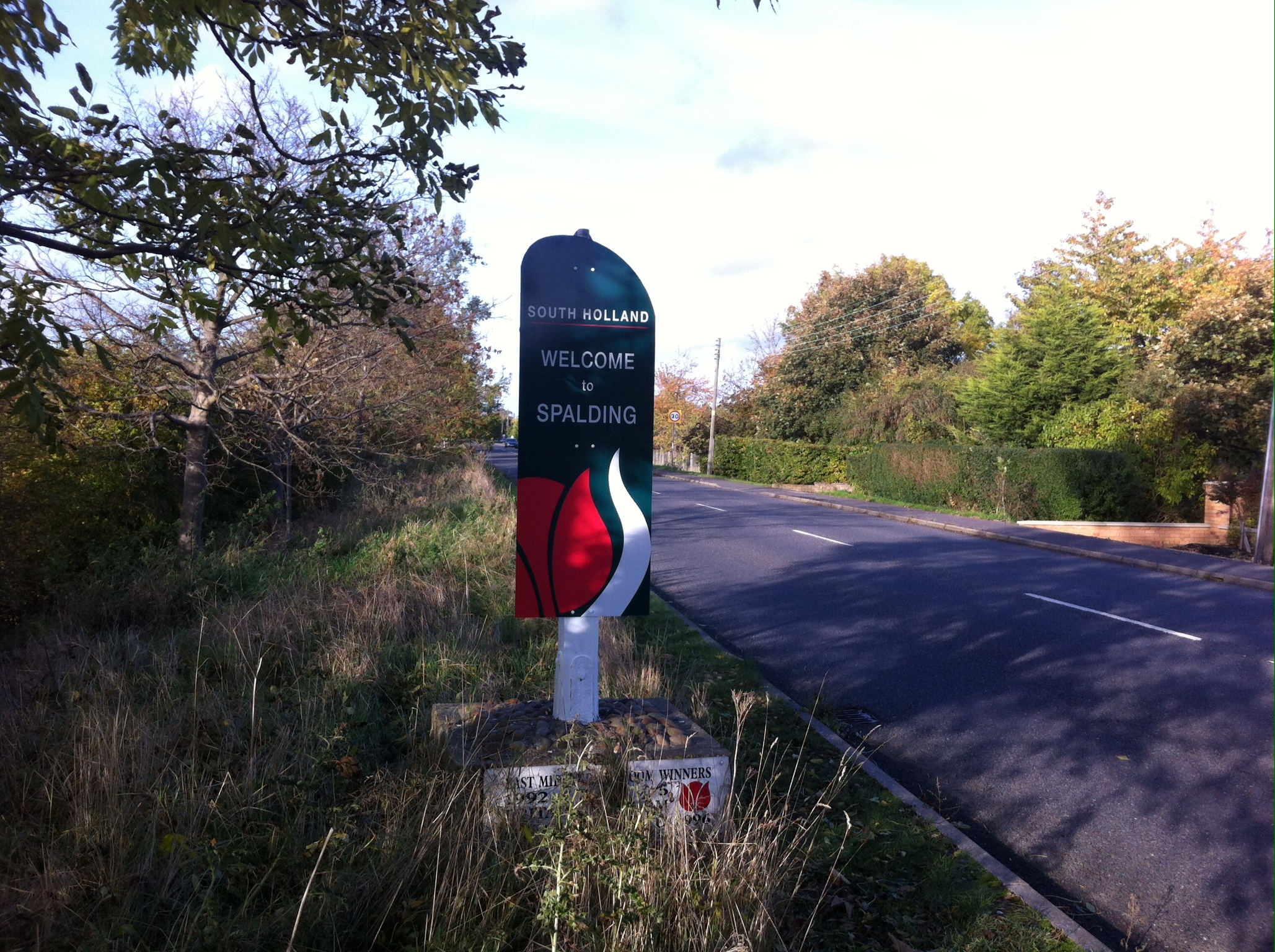
I had a bet with the blokes putting up the first one, about what the tone of the first public comment would be, regarding the new Welcome to Spalding signs. Being a fully paid up member of the cynical B’s club, I bet on it being critical, negative and tinged with an element of spite – and I was right! Pay up guys.
I suppose we should be thankful that at least somebody has not only noticed them, but has taken the time to put pen to paper, given the lack of interest displayed by many when it comes to local issues – apart from planning applications that is.
The writer of today’s letter in the Spalding Guardian, is a regular contributor to the page.  He obviously missed the postage stamp sized story on these signs, the first time around, or I would have expected to see his critical appraisal published back then.
No, the signs are not made of Perspex (a trade name for acrylic) Mr Sadd, they are aluminium, with the image printed on – durable vinyl material, designed for this use.
The signs are as temporary as you want them to be Rodney. If you can find the several thousands of pounds, probably as much as £10,000 would be my guess, to commission, design, manufacture and install something similar to the wooden signs that Spalding once had, I’m sure we would all be very pleased to see these signs replaced.
My guess is, that there isn’t anybody out there already writing the cheque for this work and that these signs will remain in place for at least as long as the embarrassing ‘lollipops’ that they replaced – come on prove me wrong for once, I dare you. That’s not an invitation to go and nick them by the way.

Look at all the stuff you can do online with SHDC

Just go to: http://www.sholland.gov.uk/doitonline/

Abandoned Vehicles Report an abandoned vehicle.
More information: Abandoned Vehicles – Information
 
Animal Fouling Report dog fouling.
More information: Dog Fouling | Dog Warden Service
 
Dead Animal Notification Notify us of a dead animal on the highway or publicly owned land.
More information:: Dead Animal Notification – Information
 
Flytipping Report flytipping.
More information: Flytipping – Information
 
Footway Lighting Report a fault with a footway light. Street lighting faults should be reported to Lincolnshire County Council.
More information: Street Lighting
 
Graffiti Report an instance of graffiti.
More information: Graffiti – Information
 
Street Cleaning Report a road that is in need of sweeping due to accumulation of leaves, litter, etc.
More information: Street Cleaning – Information
 
Litter Bin – Report Report an issue regarding a street litter bin (e.g. if a bin has been damaged or needs emptying).
More information: Street Litter Bins
 
Litter Bin – Request Request a litter bin for your street.
More information: Street Litter Bins
 
Benefits and Couuncil Tax Support
Housing Benefits Calculator and Claim form Fill out this form to see whether you may be entitled to Housing Benefit and to submit a claim if you wish. You can also use this on-line calculator and application form to apply for Council Tax Support (if applicable)
More information: Claiming Housing Benefit
 
Local Housing Allowance Calculator Calculate the possible amount of Housing Benefit available.
More information: Housing Benefit – Local Housing Allowance
 
Council Tax Support Calculator Use this calculator to see what your new entitlement might be under the Council Tax Support Scheme. Please note this Calculation should be used as a guide only.  
Refuse & Recycling
My Collections Find out your recycling and refuse collections days.
More information: Refuse and Recycling Collections
 
Missed Recycling Collection Report a missed recycling collection.
More information: Missed Recycling Information
 
Missed Refuse Collection Report a missed refuse collection.
More information: Missed Refuse Information
 
Business
Business Inspection Request Request a business inspection.
More information: Food business – food safety inspection |Health and Safety at work
 
Industrial Unit Enquiry Express an interest in one of our industrial units.
More information: Commercial Property Lettings Advice and Allocation
 
Tenancy
Communal Repairs Report a problem on your estate or in your block.
More information: Services and communal areas
 
Leisure Event Bookings
Exhibition Booking at Ayscoughfee Book an exhibition at the Geest Gallery, Ayscoughfee Hall Museum.
More information: Ayscoughfee Hall Museum – Geest Gallery
 
Football Pitch Bookings Make a provisional football pitch booking.
Sir Halley Stewart Playing Field
Castle Playing Field
Monks House Lane
Fishpond Lane
 
Open Space Event Bookings Check availability and provide details of your proposed event.
Spalding Town Centre
Sir Halley Stewart Playing Field
Ayscoughfee Gardens
Castle Playing Field
 
Wedding at Ayscoughfee Check availability and provide details of your proposed event.
More information: Ayscoughfee Hall and Gardens – Wedding
 
Environmental
Dangerous Structures Notification Notify us of what appear to be potentially dangerous buildings, structures, or parts of a building.
More information: Dangerous Structures Notification – Information | Open and Derelict Properties
 
Markets – Cleaning Report an issue regarding market cleaning.
More information: Markets – Cleaning – Information
 
Noise Pollution Report an issue with Noise Pollution.
More information: Noise Pollution Information
 
Public Conveniences Report an issue regarding a public toilet.
More information: Public Conveniences – Information
 
Stray Dogs Report a stray dog.
More information: Stray Dogs – Information | Dog Warden Service
 
Parking
Parking Fine Appeal Appeal against a parking fine.
More information: Excess Charge Dispute
 
Parking Season Ticket Apply to go on the waiting list for a quarterly parking season ticket.
More information: Car Park Season Tickets
 
Miscellaneous
Consultation Sign Up We welcome all feedback so if you would be interested in receiving surveys or taking part in any form of consultation on Council matters, then please complete the form opposite.  
eAlerts Sign up for email alerts about job vacancies.  
E-billing Interest Register your interest in the forthcoming council tax/business rates e-billing service.  
My Lincolnshire What is My Lincolnshire?  


‘Jolly Roger’, I think I’ll get myself a flag for that

http://www.spaldingtoday.co.uk/news/opinion/letters/travellers-site-now-he-s-riding-roughshod-over-gedney-1-5489965

Normally, I would be able to say, ‘another day, another letter’, but in this case this letter appeared on the same day as the previous one!

This one immediately starts off on the wrong foot, by suggesting that my comments were made ‘in the paper’. No, the paper was only reporting on comments made by me, during a meeting of the SHDC Planning Committee, something I often do as the committee chairman.

The writer then goes on to harangue me for reminding the committee that, like it not, gipsies and travellers are treated differently by the planning system. Grabbing my statement by the throat and giving it a damned good shaking, the writer manages to create a rabid froth of rhetoric, claiming that I was part of some sort of cabinet led conspiracy. Apparently, this conspiracy had its origins with the £1m+ Travellers’ site at Holbeach and has now turned its attentions to Gedney, where it is about to somehow ride roughshod over the place.

just for accuracy, assuming that the writer is referring to the planning application H06-0145-13, for only two plots for one family and not a Holbeach sized site, then we’ve already ‘ridden roughshod’ over the village and have now returned to our dark lair in Priory Road.

Oh well, at least I’ve got yet another printable nickname out of this one, ‘Jolly Roger’. I think I might be able to get some sort of flag for that. It can then be hoisted outside Priory Rd on those days my fellow conspirators and I are out and about riding roughshod over other areas of the district.

This reply belongs in the toilet

http://www.spaldingtoday.co.uk/news/opinion/letters/public-toilets-one-of-the-most-stupid-replies-i-ve-ever-read-1-5489989

Having tried numerous times to log in to the newspaper website, so that I can respond to this letter, I’ve given up and resorted to my blog page. Although very few, if any, will read this compared to the letters page of the local paper, it will at least get it off of my chest and if nothing else, this website does let me log-in!

In truth, Mr Turps letter is so lacking in substance and so full of bile, it’s almost impossible to come up with a newspaper response, that isn’t equally bile ridden. However, as this is my blog and I can say pretty much what I like, bile ridden included, so here goes.

From the outset, I really didn’t get the, ‘the most stupid replies’ bit. Clearly this gentleman started off unhappy with my response and went on to build up a head of steam to the point of becoming slightly irrational in his arguments.

He offered some clearly insincere regret, for the verbal and sometimes physical abuse the staff suffer, by saying, “which, if true, is very regrettable”. He then goes to display a clear lack of understanding of what the problem is, by claiming that it’s all about ‘the management’ and finishes by telling me to ‘get out of the way’. Out of the way of what, to allow what to happen exactly?.

If it’s about anything, other than the totally unacceptable behaviour of a minority of users, it’s about closer supervision of the task and that will always be a major challenge with such a small street cleansing team, that is trying its best.

In conclusion, Mr Turps’s letter is, “One of the most stupid replies I’ve ever read!”.

Planning and highways spending slashed

Copied from Local Government Chronicle on line
29 August, 2013 | By Ruth Keeling

Planning and highways have seen the largest reductions in spending, according to the latest local government financial data published on Thursday.

Expenditure on planning services fell by 13.2% between 2011-12 and 2012-13 while spending on highways and transport services fell by 9.5% over the same period.

The cut in spending on services linked to growth, a number one priority for the government, contrasts with much smaller cuts in social care spending and increases in spending on housing benefit costs.

The LGA has previously warned that the combination of growing demand for social care services and significant funding cuts would mean spending in other areas, such as planning and highways, would be squeezed harder and harder.

Social care spending fell by just 0.2%. However that masked a different story for children’s social care, where spending increased by 2.8%, and adult social care, where spending fell by 1.4%.

Other areas of increased spending were housing benefit costs, which increased by almost 5%.

Although education spending fell by 7.7%, government statisticians warned that comparisons should not be made over the two years because the reduction was caused by academies leaving local authority control.

While total revenue expenditure fell by 5% between 2011-12 and 2012-13, the reduction was just 0.2% once changes to education responsibilities and funding were removed from the comparison.

The figures also show that councils increased their reserve levels by £1.7bn, not including a £0.9bn addition to the Greater London Authority’s reserves.

However, there were a quarter of councils which did not add to reserves and ended the year with less in the bank.