Advice for the newly elected

I’ve just been looking through the handbook being prepared for newly elected members following the district council elections on 5th May.  No,  I’m not such a sado that I can’t find anything better to do on a public holiday, I just happen to be a member of the group that was consulted on the content and have been asked for feedback by the 3rd May.  See, we’re not telling porkies when we say we have to do work when everybody else is relaxing and watching Coronation St and East Enders on the tele!

Even though we asked for it to be kept as brief and straightforward as possible, I asked them not to include the council’s constitution in it, as even the abridged version is something like 40 double-sided pages long, there’s still 72 pages for new members to plough through.   Page 47 has one of the best bits of advice I’ve come across and pretty much sums up the role of the elected member when it comes to being a councillor.

Ask if you don’t know  We often don’t ask the questions that needs to be asked because we’re worried about looking stupid. But part of the privilege of being a councillor is being expected to ask obvious questions; you are asking them on behalf of people who are not in the corridors of power. Challenge jargon when you hear it, and don’t use it even when you get used to it.

The only caveat I would put on this, is the need to either remember the answer you’re given, or to at least make a note of it and, unless you are in a different meeting with a different audience, avoid asking the same question again and again.

Apart from the fact that the repetition makes a meeting last longer than it needs to, it also demonstrates to those who heard the question asked and answered previously (especially if it’s the same officer or chairman), that you either didn’t pay attention the first time, weren’t really interested in the answer in the first place or, worse still, that you’re a few votes short of a majority (that’s council speak for being a dummy!). 

Opposition is awake, but not with it!

It’s seldom a good idea to offer your opponent any free publicity.  However when they make inaccurate, ill-informed and in one case, a statement that would be libellous if it were made about a individual and not the council, they must be challenged.

I don’t know the person in question and none of my comments are based on an opinion of him as a person.  They only relate to the glaring inaccuracies in his election leaflet and seek to challenge the vague promises he has made – these are detailed in the italics below, with my responses in bold text.

All of his typographical and grammatical errors have been retained, to ensure that I cannot be accused of changing or censoring his words.

“………. I am your Independent candidate for the Woolram Wygate Ward.” 

The name of the ward is Spalding Wygate!

“The next few years will see more housing constructed towards the end of Woolram Wygate / Monks House Lane and this has an opportunity for great things, I would work with the developer to ensure maximum community benefit.”

The new development will be taking place on land at the Monks House Lane end of Wygate Park, nowhere near Woolram Wygate.

Negotiations regarding community benefits such as a very large area of open space, a community centre, along with land and money for a new primary school, all took place back in 2001.

“In addition there are large sums of money coming into the council from housing developments and the power station. Previous sums which should have been used to transform Spalding have been used to support the general workings of the council.”

“This must stop— money claimed for Spalding should be spent on facilities for all effected by the development”.

There are NO ‘large sums’ of money coming in from housing development.  All the benefits to come from development will be within the area being developed i.e. community centre, play equipment, large public open space area.

The money to be paid by the power station once built, apart from £100,000 for Pinchbeck parish council, has been identified for specific purposes within Spalding.

It is illegal to spend a financial contribution from a developer on anything other than what was detailed in the legal agreement.

The underlined accusation is particularly disturbing.  Not only is it completely WRONG, it appears to make an unfounded accusation of fraud against the district council.

“Those of you near the railway will have noticed night works to prepare the track for freight. These have the potential to cause massive disruption to traffic and an obvious potential risk for emergency vehicle access. I would work with the train companies to ensure this disruption is kept to a minimum.”

Concerns regarding the impact on Spalding are the subject of long term and detailed discussions with both the rail operator and the county council.  We have also raised our concerns with central government, assisted by our local Conservative MP, Mr John Hayes.

“I believe that the council needs change in order to properly represent local views and not be influenced by party politics and government directives.”

Low levels of council tax and weekly refuse and recycling collections are both Conservative Party policies we are proud to promote in South Holland.

Government directives are the basis for almost everything local government does and cannot be ignored whatever the council’s political colour.

“With building land becoming so scarce the green belt between Pinchbeck and Spalding must be preserved.”

Building land is NOT scarce in South Holland and we have a more than ample supply as detailed in the South Holland Adopted Local Plan.

The land between Pinchbeck and Spalding is not designated as Green Belt, a term used to protect green areas around cities from urban sprawl.  In Lincolnshire we call it open countryside.

Parishing Spalding  “There has been talk for many years regarding this issue. I support any measure that gives people more say in their neighbourhood and believe the small initial additional cost would reap huge rewards”.

As well as the so called ‘small initial cost’ (potentially £25,000 to £50,000), setting up a town council for Spalding would require a large increase in the ANNUAL precept charged to the residents, in order to provide ongoing administration, staffing and accommodation for the town council. 

No hint is given as to what these ‘huge rewards’ will be.

“Parish councils can apply for grant and lottery funding for major projects which the council legally cannot.  In addition the new localism bill will allow parish councils to challenge for existing service, resulting in an overall cost saving and improved efficiency.”

“The potential savings would protect us all form additional council tax rises and ensure that all services were run at maximum efficiency”

The district council is NOT prohibited from applying for grant funding from appropriate sources and assists many local organisations in doing this.

Any town council wishing to take over a council service would have to increase its resources to manage that service properly.  Much of the cost would simply transfer from the district council tax to a town council tax. 

“Many of you have children at the pri­mary school, I would welcome any form of partnership working with the school board and governors to ensure it gets the help it deserves”

School board AND governors? Or does he actually mean the Board of Governors?  The primary school already controls its own budget.  Given that its other funding is provided by the County Council, what exactly is the help it deserves from the district council?

“Ensuring the Green space between Pinchbeck and Spalding”

Ensuring it’s what?  This area is already protected by the development boundaries detailed in the South Holland Local Plan.

“Work with train operators to ensure minimal disruption to the level crossing”.

The train operators do not suffer any ‘disruption to the level crossing’.  It is the traffic crossing the level crossing that is disrupted when the gates are closed to allow a train to pass.  We are actively working with the county council to seek a long term solution to the planned increase in rail traffic through Spalding.
Opposition, what opposition?

I am very probably tempting fate with this entry and the skies will open tomorrow and a veritable avalanche of opposition campaigning will fall on my head! 

That are now only 17 days to go until polling day and there’s still no sign or sound of the opposition.  That of course, from my point of view, could be seen as a good thing. 

The flip side of my current good fortune is that the voters of Spalding Wygate don’t get a chance to hear how somebody else might think that they could do a better job of representing them than I have over the last 12 years.  They could also find themselves wondering what the point of voting was, when they have no way of comparing the candidates.  There is of course always the protest vote, or as one non-admirer put it, ‘I wouldn’t vote for you, even if the other bloke was a house brick!’ (I think he was upset about a planning application).

The other disappointment is, that if the opposition is what they call a paper candidate and has no intention of mounting any sort of election campaign, then he has given the electorate the false hope that they might be given an opportunity to make a choice.  Added to that, he’s also cost local taxpayer unneccesary expense, by requiring the district council to open a polling station in Spalding Wygate on 5th May.  Fingers crossed I’m right!!  Don’t forget to vote YES to Conservative and NO to AV on 5th May by the way!

To read more about the Spalding Wygate ward and the Conservative group go to:   http://southhollanddcconservativegroup.co.uk/3818/welcome

Wind turbine flicker is a problem

Even the Daily Telegraph finds it difficult to resist the occasional Sun newspaper type pun when the opportunity presents itself.  In this case, ‘Flicker of hope for the wind turbine victims’ might seem slightly flippant given the impact on peoples’ lives this issue has.

However, not wishing to be churlish about this rare attempt at humour, I hope what they’ve reported is accurate and can be used as a guide for those of us wrestling with the issue of wind turbine development.

The Department for Energy and Climate Change (DECC), commissioned a report that has come back with recommendation regarding the flicker caused by the rotation of turbine blades when the sun is low in the sky, especially in the winter months, which is often a time of the strongest winds.

Of course a report is one thing, the government updating their guidance is another thing altogether and we can all think of at least one or two government commissioned reports that were the subject of great fanfares of publicity, but then disappeared without trace.

The report recommends that wind turbines should not be located closer than 10 times the diameter of the turbine rotor disc, to a dwelling or office building.  Unfortunately, they also suggest a tolerance level where turbines can be put closer, with a distance of 500 meters as long, as long as the flicker doesn’t last for more than 30 minutes a day!  I suppose that makes some sense, given that the sun (or rather the Earth) is constantly moving, the flicker should at least move away from those being ‘flickered’ after a short period of time.  However, 30 minutes could feel a lot longer if you aren’t actually able to leave the room affected, as might happen in a workplace.

Here in the very flat lands of the Lincolnshire Fens, people are also concerned about the visual impact and unfortunately this recommendation won’t really help us with that issue.  Unlike many other parts of the country, turbines are visible over much greater distances and even when you do the numbers on turbine with a diameter of 80 meters (800 meters clearance) a turbine of that size will still be very visible to the local community.  In the case of the Fens, I also wonder if 10 times the diameter is actually enough.

Disappointing litter pick

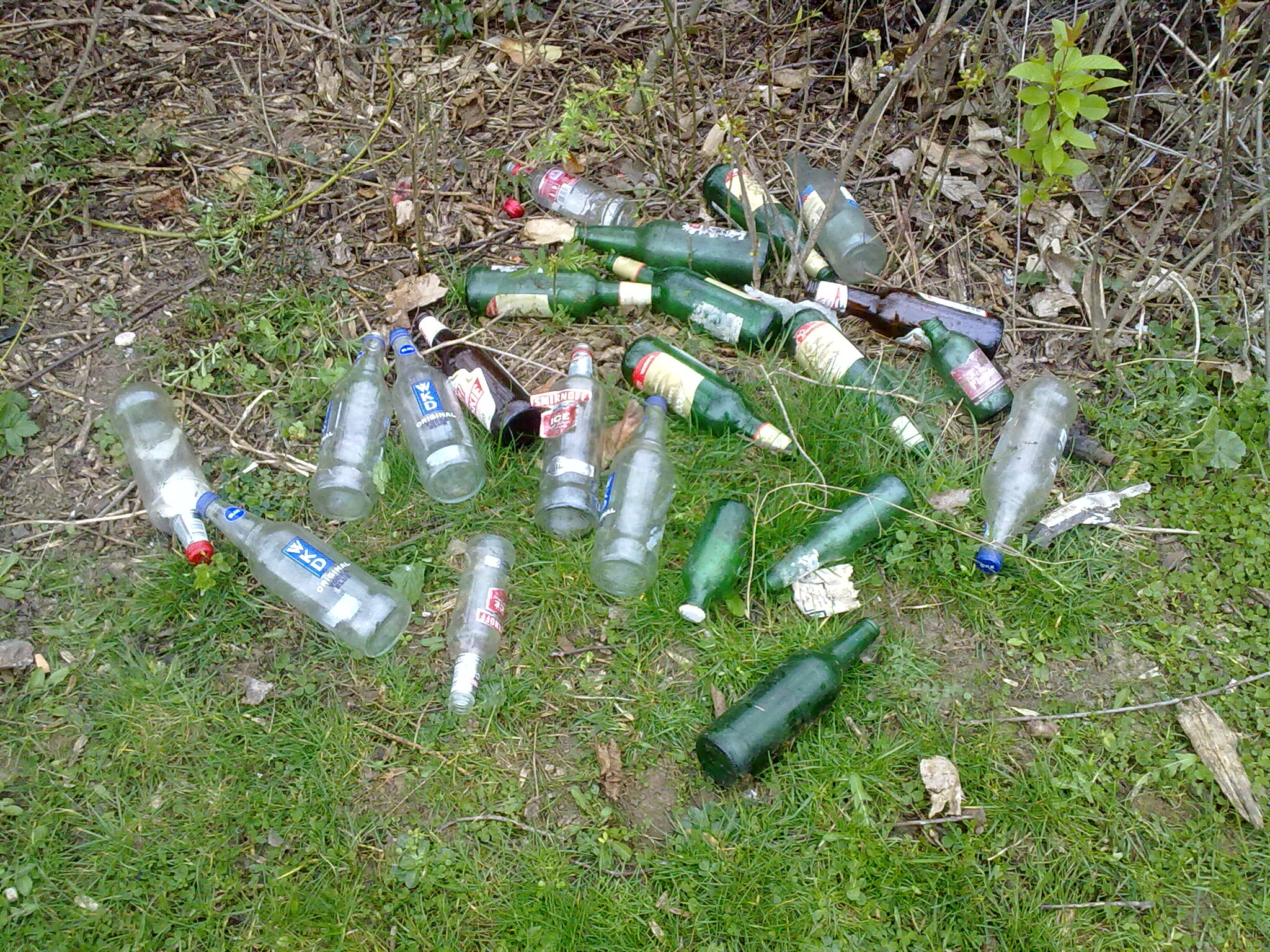
Disappointing because it needed doing again and because of the huge amount of disgarded alcohol bottles in one very small corner of the open space at Claudette Avenue.  

Disgarded bottles in the play park at Claudette Ave

The bottles are yet to be cleared as they need a bit more than a plastic bag – bring on the wheel barrow tomorrow morning.  
I’ve already collected three large bags of other rubbish and have only covered one side of the road from Wintergold to just past the Claudette Ave open space.
Sunday morning will also be spent clearing a large deposit of household refuse that looks as though somebody couldn’t be bothered to wait for the weekly (not fortnightly) refuse collection and just threw it over their garden fence – unbelievable!
I also need to organise a dedicated cleanup of one corner of the open space at Claudette Ave due to the large amount of rubbish that has been dumped there.  Again, I find it unbelievable that people who live in our community find it acceptable to soil it in this way – messing on your own doorstep and all that!
Anybody who would like to help with litter picks please get in touch.  
More Spalding Wygate ward news at: