Is Right to Buy a state sponsored gentrification programme?

It’s probably a bit late to ask this question, given that this scheme has been in place for 30 years now.

That said, the proof must already be there, especially in London where working class areas, that were a foreign land for those with means, are now fashionable and sort after locations for the young professionals, earning big money.

Exposing social housing to the open market , in high demand areas, where demand is the through roof and prices constantly rising, inevitably means the original tenant, very soon becomes the ex-owner.

It might seem like a a very worthy ambition, giving everybody currently sitting at the bottom of the pile and trapped in social housing – as certain people view it – a chance to own their own home.  However, assuming that hat  was even the original intention and it wasn’t just about killing off the bulk of social housing as we knew it, it’s also had the effect of depopulating our city centre of those of modest means, otherwise known as the working classes.

So all those people who used to empty the bins, sweep the streets, dig up the roads, drive the delivery van, serve in the local shops and do the thousand and one other menial, but vital jobs that keep a city running, now live a journey away from their workplace.

in some cases that journey may mean up to an hour spent on a bus, or train, travelling in from a remote housing estate where everybody else is doing exactly the same thing.  The effect of this, is that nobody actually knows who their neighbours are anymore and therefore certainly little, or no sense of community, because there’s so little actual time spent in the company of those who live near us.

Back in what used to be the social housing areas that haven’t been flattened and turned into expensive apartment blocks for the upwardly mobile, the housing has been gutted, extended and beautified, to make it desirable and more importantly, significantly more expensive than it was.  Again, just like the workers they displaced, the lack of community will be clear, but this will be by choice in most cases, because their social lives take them elsewhere and opportunities more diverse.

Job done.  All those rundown, poorly maintained sink estates cleared out from our city centres And that ‘unpleasant’ working class riff raff removed to where it belongs, when it not actually doing the work that needs doing.

The added bonus is, those who grabbed the social housing as soon as the first tenants where starting to sell, can now maximise their returns, over and over again, by renting to the high earners who need to live close to the city centres.

If Right to Buy was really about getting those of modest means on to the housing ladder, it was a fatally flawed concept.  It depopulated our cities of the ordinary working class people, by selling off the only type of housing they could ever have afforded to live in.  If that was always the intention, shame on you Margret Thatcher.

The Housing should have been retained and those who wanted to buy their own property should have offered equivalent grant funding to purchase their own home elsewhere.  This could have been in a privately built, or publically funding housing developement, such as in the new towns.

It was claimed that this would have forced people to move out of houses, or places they’d been in for many years and possibly spent money on.  This is complete nonsense and just a smoke screen used by government to justify to the orignal scheme.

Why should social housing tenants have been given that benefit on top of the massive discounts they received for the ‘equity’ they’d supposedly built up?  How was they were any more entitle than somebody forced to rent a property in the private sector, where the end of lease meant the most you were likely to get back was your deposit if you were lucky?


No wonder the public get so confused by recycling messages

All the plastic you can and cannot recycle

Share this with Email Share this with Facebook Share this with Twitter Share this with Whatsapp

Index image

Most people are trying their best to recycle plastic – but the many different ways in which recycling is collected by different councils across the UK has left them confused.

What can be recycled and what can’t? We are putting more plastic in the recycling than ever before – but pictures of sea life tangled in all manner of waste plastic mean the pressure is on to do more.

The government is now considering changing the way plastic is recycled in England. In the rest of the UK the strategy for recycling is a devolved issue.

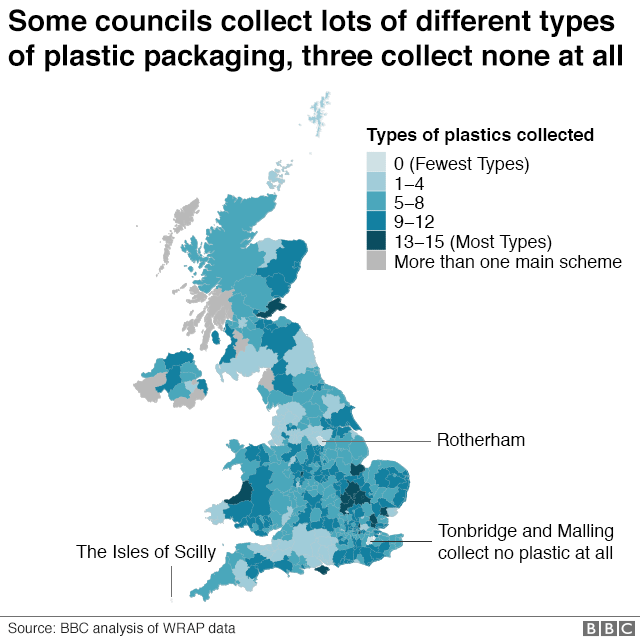
Different Councils collect different types of plastic packaging

Each council collects their plastic recycling differently. BBC analysis shows there are 39 different sets of rules for what can be put in plastic recycling collections:

  • Most collect bottles
  • Others collect pots, tubs and trays
  • Some collect a much wider range

https://news.files.bbci.co.uk/include/newsspec/20116-recycling-plastics/english/app/amp#amp=1

Around the UK, all four nations are hoping to improve their recycling rates. The review by the government may change the target for recycling in England, but currently the aim is that 50% of waste will be recycled by 2020.

Scotland has a target to recycle 70% of waste by 2025 as does Wales. Northern Ireland has a proposal that 60% of municipal waste is recycled by 2020.

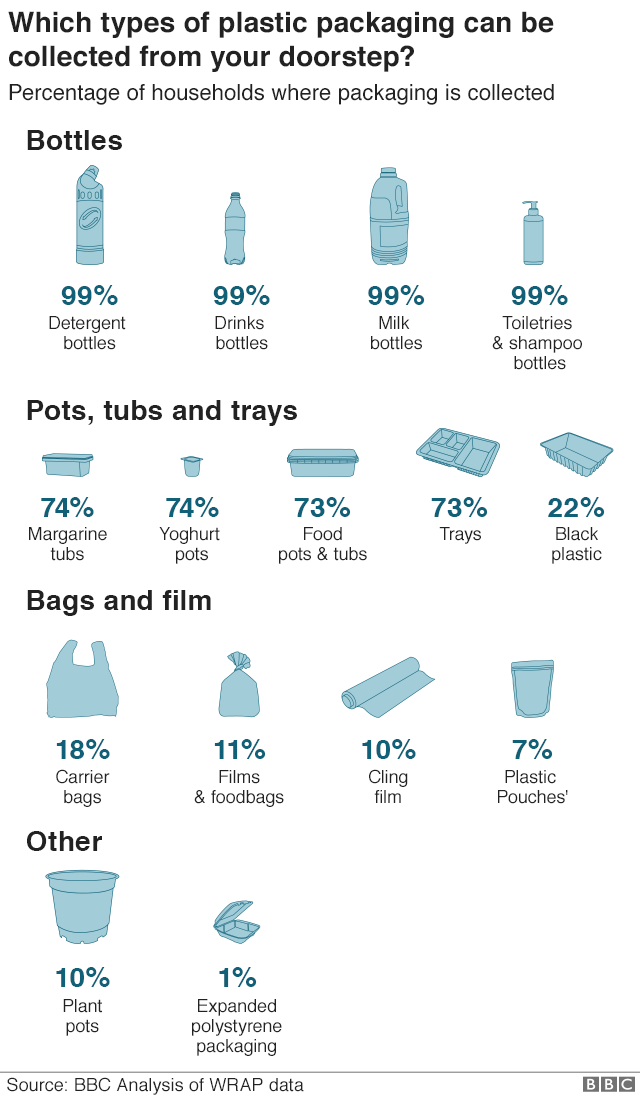
99% of households have bottles collected from the doorstep. 75% for pots tubs and trays. Only a fifth of households can put black plastic trays in their recycling. Only 18% can put carrier bags in their recycling. 10% cling film and only 1% can put expanded polystyrene packaging.

Waste plastic is collected is different ways too:

  • Some local authorities collect all their recycling in one bin
  • Others ask households to separate their plastics from the rest of their recycling

Councils also employ many different companies to collect and sort their plastics.

And having different recycling schemes in different areas – for example, in some areas you can recycle margarine tubs and in other areas you cannot – makes labelling difficult.

Most people in Britain regularly recycle plastic but almost half have had disagreements at home about what type they can put in which bin, a ComRes poll for the BBC suggests.

And more than a quarter have these disagreements at least once a month.

What to expect from the government’s review?

Of all the things we recycle, plastic is the most complicated. It comes in a profusion of very different types.

Many products carry labels about recycling but some do not. And the labels themselves can be a problem.

Your eye might fall on a recycling symbol but miss the very small print saying the item will not actually be collected from your home.

If you see the phrase “widely recycled” on a packet or carton, it means many councils will take it but not necessarily all of them.

Each of the UK’s local authorities has come to its own decisions about what to accept and what to refuse:

  • In Reading, a yoghurt pot can be thrown into recycling
  • In Manchester it cannot
  • Swindon has plans to join the small band of councils recycling no plastic at all

The government realises the arrangements can be confusing, even irritating. And in England it’s undertaking a review of the whole recycling system.

  • Ministers could order manufacturers to use only the types of plastic that are easiest to recycle – but might that lead to higher prices?
  • They could insist on labels that everyone can see and understand – but how would that work on tiny pots and bottles?
  • A more controversial idea is to get councils to harmonise their plastic recycling systems – but that risks provoking an uproar over local democracy

The desire to boost plastic recycling rates is clear. But every option comes with challenges. The word is, we’ll see the government’s plans in November.

Plastic can often become too contaminated for recycling and have to be sent to landfill or incinerated instead. This happens for several reasons:

  • People are confused about what goes in which bin
  • People are not always very careful about what they put in
  • The plastic is contaminated with food waste
  • In areas where all recycling is collected in one bin, one type of waste can contaminate another

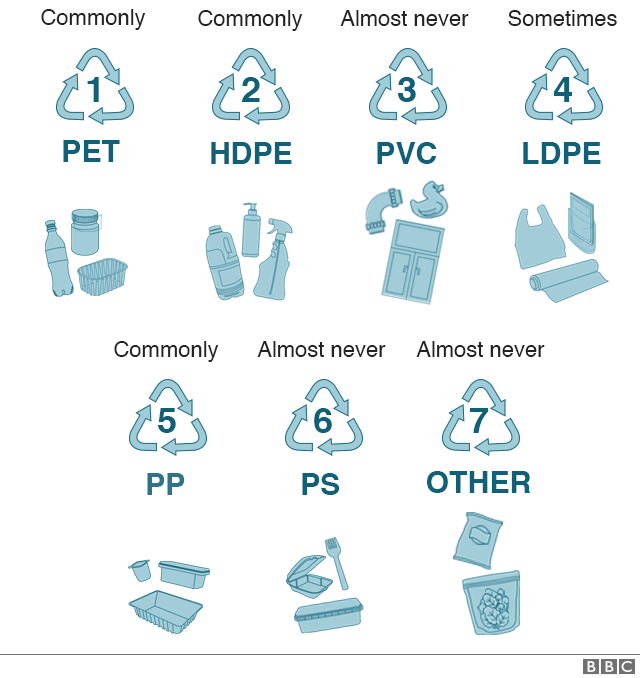
Plastic packaging is made from seven different types

There are seven different types of plastic, PET, HDPE, PVC, LDPE, PP, PS and the rest are put in an other category
  • Bottles are mainly made of PET and HDPE and these are easy to collect and recycle
  • Most trays are made from polypropylene and this is pretty easy to recycle too but not all councils have access to the right facilities
  • LDPE, used to make some carrier bags and cling film, is easy to process but more difficult to sort and can often be contaminated with food
  • Polystyrene, used to make some yoghurt pots and plastic cutlery, is not widely recycled
  • PVC makes up small amount of packaging but can contaminate other plastic recycling
  • Biscuit wrappers and meat trays can be made from a mixture of many different types of plastic, making them the most difficult type of packaging to recycle
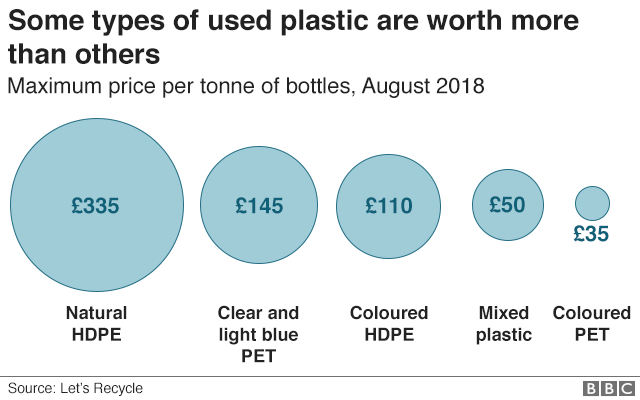
Some plastic is worth more than others. Clear PET and natural HDPE used to make a lot of bottles are worth the most. Coloured plastic still has a price but is worth less because you cannot remove the colour from the plastic.

All plastic can be recycled – but it is not always economical to do so.

  • Bottles attract the best prices, especially clear ones, which is why almost all councils recycle them
  • Coloured plastic is less desirable because the colour cannot be removed, restricting its reuse
  • Polystyrene is almost never recycled because there is no market for it
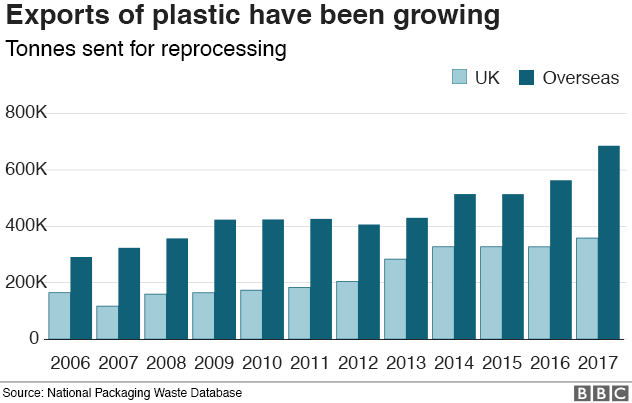
The amount of plastic sent for reprocessing has been growing. The real growth has been in plastic sent abroad for recycling which now accounts for a two thirds of all the plastic recycling we collect in England.

Most bottles will be sent for reprocessing in this country.

But plastic that is less valuable – about two-thirds collected for recycling – goes overseas and this figure has been rising.

Earlier this year, the National Audit Office reported the plastic sent abroad could be highly contaminated, meaning it may not be reprocessed and could end up in landfill or contributing to pollution.

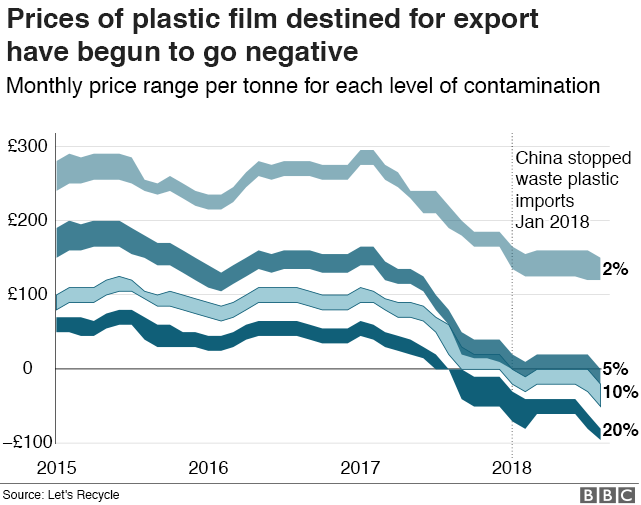
Prices of plastic film destined for export have fallen below zero. A tonne of plastic film with 20% contamination is almost -£100.

Some countries are refusing to take any more of our waste.

  • China and Thailand have banned waste imports
  • Malaysia is considering banning imports of waste plastic

These bans are having an effect on the prices paid for waste plastic.

And this year the prices of the more contaminated plastics have fallen below zero, meaning companies are now expecting to be paid to take them away.

Design: Debie Loizou. Development: Eleanor Keane.

Yesterday’s headlines hid the reality that Westminster still doesn’t trust, let alone believe in local government

So it seems the Daily Telegraph was actually paraphrasing Theresa May’s speech and using the term council housing, to mean social housing.
The £2 billion headline will be money for the housing associations to put very nicely into the hands of private developers via the various deals and conjurings that go on once a section 106 affordable housing obligation is in play.
A wasteful and time consuming process at the best of times, £2 billion will soon disappear as each sides legal teams dance around the various council and housing association offices.
Why not take a holistic approach to our national disgrace of failing to provide decent housing for those in the most need?
The introduction of land value capture, would allow councils to aquire land at a sensible price, thereby making the most of any share of the £2billion on offer.  This, combined with greater borrowing flexiblity, would offer a far greater return for the money available and more certainty of delivery.  It would also ensure that this desperately needed housing, was being managed by those who best understand their communities.
Inside Housing

LGA warns May’s focus on associations ‘misses the point’ about council-led building

The Conservative head of the Local Government Association (LGA) has hit back after Theresa May suggested councils are not able to build at the same scale as housing associations.

Lord Gary Porter, chair of the LGA (picture: Tom Campbell)

Lord Gary Porter, chair of the LGA (picture: Tom Campbell)
Sharelines

Councils hit back after May comments #ukhousing


In a landmark speech to the National Housing Summit today, the prime minister said she wants housing associations to lead on creating “large-scale, high-quality developments” because the sector can “achieve things neither private developers nor local authorities are capable of doing”.

She pointed to the Thamesmead Estate in south east London, which is currently being regenerated by Peabody after two councils had “problems dealing with the unique challenges and opportunities” of the project.

But Lord Gary Porter, chair of the LGA and leader of South Holland District Council, said Ms May’s comment “misses the point about why we are not able to build at scale”.


READ MORE

Councils’ temporary accommodation spend nears £1bn
No appeals for councils excluded from £1bn borrowing programme
On the naughty step with Lord Gary Porter

“Since RSLs [registered social landlords] took over building social housing they’ve built around 40,000 a year, we have never got to the numbers we need to have as a country,” he told Inside Housing.

“That’s not to blame the RSLs, it’s because we have not been part of that mix as councils.

“And what we need to do is get the Treasury to get off our backs. I don’t need more money, I just need freedom so I can spend my money.

“Let me deal with Right to Buy in the way that works for my area and then get Housing Revenue Account debt off the government balance sheet because there’s no need for it to be there – and then job’s a good’un and we can start fixing the housing crisis before the end of parliament.”

However, Mr Porter did also praise the prime minister for emphasising the value of social housing.

In her speech, Mrs May said the rise of social housing “brought about the end of the slums and tenements, a recognition that all of us, whoever we are and whatever our circumstances, deserve a decent place to call our own”.

In a statement, the LGA said: “Councils have always been proud of their housing and tenants and the positive recognition of social housing by the prime minister today must be shared by all.”

The government has offered councils £1bn of additonal borrowing headroom to build new homes, but this is limited to areas where there is a large gap between private and social rents. It will not be available until April 2019.

Councils have long called for caps on the amount they can borrow to be lifted to allow them to build new social housing at scale.

More on Theresa May’s NHF speech

More on Theresa May's NHF speech

All our coverage of Theresa May’s historic speech on 19 September, 2018, in one place:

Orr: ‘penny has dropped’ for government on housing The outgoing chief executive of the National Housing Federation gives his take on May’s speech

LGA warns May’s focus on associations ’misses the point’ about council-led building Reaction to the announcements from Lord Gary Porter, chair of the Local Government Association

Sector leaders hail ‘huge significance’ of May’s NHF speechHousing figures welcome the Prime Minister’s speech to the National Housing Federation’s annual conference in London

May’s speech shows a significant change in attitude towards the sector When was the last time a Conservative prime minister made a speech more favourable to social housing?, asks Jules Birch

In full: Theresa May’s speech to the National Housing Summit The full text of the Prime Minister’s historic speech

Theresa May throws support behind housing associations in landmark speech Read more about Theresa May’s speech which signalled a change in tone from the government towards housing associations

May’s new £2bn funding will not be available until 2022 Homes England clarifies the timescale for allocation of the new money promised by the Prime Minister

Morning Briefing: Labour hits back at May’s £2bn housing pledgeShadow housing secretary John Healey says May’s pledges are not enough

May to announce £2bn for strategic partnerships with associations at NHF conference The details released overnight ahead of the speech

May: Be proud of council houses

Despite years of trying to undermine, even eliminate social housing from the housing landscape of the United Kingdom, they have finally had to accept that it has a vital role to play in providing decent housing for those in need.

I sincerely hope that this is not just a sound bite, designed to placate those who have been seeking to remind the Conservatives of their duty to work in the interests of the whole nation, not just those with the right background and connections.

It would appear that Lord Porter of Spalding’s constant pressure on the Conservative government, has finally paid dividends.

Gary Porter, Leader of South Holland District Council, has never been backwards at coming forwards as they say, when it comes to the subject of housing.  His passion for council housing and ensuring that councils are able to replace the stock lost to the ‘well meaning’ but flawed, Right to Buy process, is we’ll documented.  I also agree with his belief that councils should retain ownership of their housing stock and add to it as the needs of their local community grows.

Why councils cannot be viewed in the same way as the private sector when it comes to providing rental properties, escapes me.  It is no doubt tied to the origin of the money that built the original Council housing stock coming from central government.  Since that time, the Treasury has never missed an opportunity to remind local government that it still somehow ‘owes’ the Treasury that money.

So now, in an apparent change of heart, a new lump of money no doubt with even more strings attached, is to be made available to councils to replenish their housing stock.  However, if the government make it as difficult as they often do when providing financing, the housing is likely to take many years to become a reality.  Meanwhile, councils are just getting on with it.

Copied from Daily Telegraph Wednesday 19 September 2018

LEAD STORY

Tories break from Thatcher’s philosophy of home ownership with promise of £2bn to be spent on social housing

THERESA MAY will today signal a major shift in Conservative policy on council housing by insisting that people should feel “proud” of living in a state-funded home.

In a speech on housing policy, the Prime Minister will pledge to spend an extra £2 billion on social housing and will say that politicians and society should stop “looking down” on those who live in council homes.

Since Margaret Thatcher’s revolutionary right-to-buy housing policy of the Eighties, a central tenet of Conservative policy has been encouraging home ownership and appealing to the working classes who aspired to buy their council-owned properties.

However, in the wake of the financial crisis, which led to a drop in home ownership, the Prime Minister will today seek to change the language used by senior Tories about council homes.

“For many people, a certain stigma still clings to social housing,” she will say. “Some residents feel marginalised and overlooked, and are ashamed to share the fact that their home belongs to a housing association or local authority.

“And on the outside, many people in society – including too many politicians – continue to look down on social housing and, by extension, the people who call it their home.

“We should never see social housing as something that need simply be ‘good enough’, nor think that the people who live in it should be grateful for their safety net and expect no better.”

She added: “I want to see social housing that is so good people are proud to call it their home.” Mrs May’s remarks signal a change in tone for the Conservatives, a generation after Lady Thatcher spoke about the pride of home ownership and its benefit to inner-city estates.

However, the comments mark a risky approach, as the Conservatives have traditionally relied on the support of home owners, or those aspiring to own homes, for electoral victory.

Mrs May will make her speech hours before she travels to Salzburg for an EU summit at which she is expected to plead with European leaders to accept her vision for Brexit.

Her speech is also designed to offer a domestic agenda to poorer areas of the country that voted Leave. It is part of a policy programme, including energy price caps, that involves more intervention in markets ministers do not 
believe are functioning properly.

Downing Street insisted Mrs May was not trying to dilute Lady Thatcher’s right-to-buy legacy, and that it remained her “personal mission” to get more people on to the housing ladder. However, she believes social housing is essential in fixing the housing crisis.

Mrs May will address the National Housing Federation Summit, the trade body for housing associations, and will urge it to get on with building high-quality homes the Government has 
already agreed to fund.

She will announce an extra £2 billion in funding over the next 10 years to give housing associations “the certainty they need” to break ground on tens of thousands of affordable homes.

So far eight associations have been given a total of £600 million to build almost 15,000 affordable homes, but Mrs May wants more to follow suit.

A call for chaos on the high street

Copied from Sunday Telegraph Business section – 9th September 2018

If somebody who wants open a new business on the high street can’t afford to apply for a change of use planning application and wait UP TO 8 weeks, then that business is probably going to fail not long after opening.

Then there’s the matter of an inappropriate use opening up next to an existing business, just because that vacant unit was available and has a willing owner.  Who picks up the pieces when the two businesses clash?  The local council of course.

RETAIL

Retailers and landlords: rip up planning laws to save high street

A COALITION of retailers, landlords, councils and pubs has called for planning laws to be torn up so that abandoned shops can be turned into cafes, galleries, gyms and other businesses that could help rejuvenate Britain’s decimated high streets.

Empty units in the middle of towns and villages are often hard to let because it can be difficult and expensive to get permission to change their use. For example, a unit used as a hairdresser’s needs permission to be changed into a nail bar.

“At present, it can take about eight weeks and cost about £500,” said the British Property Federation, which represents shops’ landlords. It wants to change the rules to keep up to date with modern shopping habits, as online sales take retail business away from high streets.

This makes it crucial those selling “experiences” can move into empty units once used for retail.

The landlords’ call to chop back planning rules was joined by other groups who said the move could revitalise high streets. The proposals came in responses to an inquiry by the housing, communities and local government select committee.

“Traditional shop uses have become increasingly blurred, as coffee shops also become mini-libraries, and independent gyms house cafes. Although businesses have adapted to challenges, planning laws have not,” said the Federation of Small Businesses. “Planning conditions seek to regulate every type of floor space, from sale space to a gym floor. These strict regulations and planning conditions drastically reduce businesses flexibility and adaptability, reducing their ability to compete.”

The British Retail Consortium agreed, calling for regulators to “ease of change of use [rules].”

The Booksellers’ Association said it wants “simply less red tape”. It wants more creative use of empty space to bring shoppers back to the high street, including “use of empty shops to promote arts activities and artisan crafts”.

Business Improvement Districts (BIDs), said “transforming the fortunes of high streets is eminently possible”.

“High quality visitor experiences” help as does a recognition that “far more than just ‘shopping’ is allowing some town centres and their high streets to change and thrive,” said British BIDs.

The Local Government Association said it is time to recognise “a contraction in retail floor space” may be needed to help high streets survive.

The Ministry for Housing, Communities and Local Government said high streets should specialise if they want to thrive. “Examples include Ludlow’s reputation as a centre for ‘slow food’, Norwich’s coordinated approach to its medieval heritage and the ‘alternative’ identity created in Stokes Croft, Bristol.”

Is this the day when it all starts to go wrong – again?

What a sad irony it would be, if yet another Conservative Party leader and only our second ever woman Prime Minster, suffered an ignominious departure, because she ignored the signs.

Copied from Daily Telegraph 7th July 2018

In a bid to appear pragmatic, Mrs May is losing the power battle with the EU

If Britain stood firm and said Brexit means Brexit, Brussels would be forced to deal with the situation

The Government has now found a policy on the Brexit negotiations. It unearthed it, apparently, in the cool, panelled rooms of Chequers last night. The instant wisdom is that it is a victory for the “pragmatists”.

In British – in particular, English – public culture, anyone claiming to be a pragmatist tends to win the advantage. A pragmatist is supposed to be an open-minded person who sees the facts as they are. The opposite of a pragmatist is an “ideologue” and/or a “fanatic”. Who, outside the wilder reaches of Isil or Momentum, wants to be one of them?

In recent weeks, Remainer activists have skilfully grabbed the pragmatic label. Leavers are presented as the raving ideologues. Trying to avoid cheap jibes about how poor, wild-eyed Tony Blair, noisy Anna Soubry and preposterous Lord Hailsham seem strikingly unpragmatic, I would like to investigate what this supposed pragmatism really is.

It goes wider than the Brexit issue. Essentially, it is the default position of those who have power in this country. In the 1970s, pragmatists coalesced round the idea that Britain must have a prices-and-incomes policy and a tripartite structure of government, business and unions to prevent inflation and economic collapse. This was espoused, with fanatical moderation, by the then Prime Minister, Ted Heath. People who opposed this view were dismissed as crazy “monetarists” on the one hand, or union “wreckers” on the other. The pragmatists prevailed. We duly had rampant inflation and came close to economic collapse.

At the end of the 1980s, having had a thin time under Margaret Thatcher, pragmatic forces at last got back together and insisted that Britain must join the Exchange Rate Mechanism (ERM) of the European Monetary System. By semi-fixing our exchange rate with that of other European currencies, they said, we could impose the financial and economic disciplines we seemed not to be able to manage for ourselves. We joined. The pragmatists’ policy forced extreme rigidity upon our economy. After less than two years of punitive interest rates, and consequent austerity and business closures, the pound came tumbling out of the ERM on September 16 1992, and stayed out. Britain’s economic recovery began the next day and lasted until Gordon Brown’s premiership 15 years later.

In 2016, the pragmatists were unprepared for the EU referendum. They resented the very idea that voters should decide an issue that they considered far too complicated for them. Since they assumed that voters must dislike the EU only out of ignorance, their sole tactic was to frighten them about what they might lose. Despite (because of?) their disproportionate power in politics, big business, central banks, Whitehall and academia, they failed.

Two years on, they are trying essentially the same thing. You cannot blame a company such as Airbus or Jaguar Land Rover for asking the Government what on earth it is doing. All of us want to know that.

But all such companies’ claims about what they might lose from a “disorderly” Brexit assume no possible gains. They do not factor in the exchange rate. They equate a short-term problem with long-term disaster. They concentrate on (and exaggerate) what we might lose in exports to the EU, which make up 12 per cent of our GDP, rather than the opportunities our greater freedom might gain for the other 88 per cent. They equate comfortable arrangements they have made for themselves in Brussels with the general good. They present their fears for their own comforts as things that should frighten the rest of us. This is not impartial calculation, but vested interest getting all hot and bothered under its vest.

A true pragmatist thinks hard about the reality behind appearances. The Remainer pragmatists do not. They like the status quo. They do not try to imagine why so many of the rest of us don’t. In this sense, although they are full of information, they are impervious to the facts, which is a most unpragmatic state of mind.

They are also, did they but know it, in thrall to a powerful ideology. It goes back to Plato. It holds that rightly guided, educated people – “people like us”, as our pragmatists might put it – must run things. Its modern form is bureaucracy in the literal meaning of that word – power held by the bureau, rather than the elected representatives of the people.

National solidarity and representative democracy are based on the idea that all citizens have an equal right to choose their rulers. If they live under a system, such as the EU, which frustrates that right, they become profoundly alienated. People trying to reverse the referendum result, or empty it of meaning, may think they are applying common sense, but they are enforcing this anti-democratic bureaucratic ideology and increasing that alienation. If you do not understand why that matters, you are as unpragmatic as the ancien régime before the French Revolution, and may suffer the same fate. In the meantime, as the constituencies are starting to tell MPs, you lose the next election.

As the scene moves back to talks with Brussels, we shall all be reminded that the least pragmatic players in this whole, long story are the people with whom our pragmatists keep telling us to make a deal – the EU Commission. Two years of arguing with her own colleagues have brought Mrs May no closer to grappling with this, the most dogmatic body in the Western world.

No British pragmatist has even tried to explain why the pre-emptive cringes advocated, incredibly, as our opening bid in the trade talks will induce Michel Barnier to make the deal with Britain that has so far eluded us. Why should he be impressed by the “common rule book for all goods” that Mrs May seeks? He already has one: it is called the customs union. If he thinks she is weak, he will beat her down yet further. She has admitted in advance that her latest plan makes it impossible for post-Brexit Britain to make a trade deal with the US: that’s a funny triumph for pragmatism.

The true pragmatist’s approach to these negotiations should be based on an estimate of power. If they are structured – as Mrs May seeks – to obtain special favours for Britain, they will fail, because the power of favour rests with the Commission. What have we done to make it help us? If, on the other hand, Britain says it is leaving anyway, in letter and spirit, because that is what the referendum decided, then it cannot be stopped. Faced with that reality, the EU and Commission are forced to consider how to make the best of this – for them – bad job.

Compare the high Commission rhetoric about the inviolable sanctity of the open border with Northern Ireland with the new war of words about closing borders between Germany, Austria and Italy – contrary to the EU’s own Schengen rules – because of the migration crisis. The former is a goody-goody game; the latter is serious. Theoretical talk is quickly crowded out when reality becomes unavoidable.

In all this time, Mrs May has never got serious in our power battle with the EU. She shrinks from it. So she is gradually, pragmatically, losing.

Follow Charles Moore on twitter @CharlesHMoore; read more at telegraph.co.uk/opinion
Are we ready to scrap democracy when it comes to local services and just pay as you go?

Interesting comment piece lifted from today’s Times (thank you).  It only discusses refuse collections, but should it be applied to every service we receive?  If the public just paid the going rate for the services they receive, with the private sector running things for profit, there would be no need for any political involvement.

Just as you now complain to ‘the company’ when the service isn’t up to scratch, you would then complain to the organisation that runs the refuse collection service, or whatever other service it is.  What response you get, is of course another matter.  After all, the person on the other end of the phone is in a ‘job’, not elected to a seat you can either vote to keep them in, or not.

However, the bigger problem for me with this proposal, is the same as happens whenever you outsource any public facing service – loss of flexibility and control.  Once the private sector get their hands on the contract,mother customer can so easily become the lamb to slaughter when it comes to changing circumstances.  Anything that’s not in the contract comes with a price tag.  There’s nothings wrong with that in itself, after all they are running a business not a charity.

So as long as the public understand that’s how things work and there’s very little politicians can do about it without increasing the budget for the contract, it’s fine.  Unfortunately, the public seldom do and the politicians are therefore get the flak.  The alternative of course, is that the contract ends up being more costly than it needed to be, just to build in the contingency funds needed to cover for the unknown and offer the desired flexibility.  What follows of course is the potential for the contractor to exploit that flexibility whenever the opportunity arises, more often than not to their own ends.

I take particular issue with one of the commentators suggestion.  That having taken away the ability to provide the service to a standard that is universal and consistent for the local community, the council’s role would then become that of enforcer against those who refused to conform to the new arrangement and in fact chose to save money by not disposing of their rubbish often enough.

If nothing else, two things are clear. This gentleman has never been a councillor, he’s a business man first and first foremost with little, or no understanding of the public service ethic.

Dump the idea of council-controlled bin collection, it’s time to privatise

Share

Save

Pundits and politicians have been seeking to interpret the results of last week’s local elections. This has increasingly involved contorted meta-analyses whereby the challenge is not so much to look at the electoral outcomes themselves, but to compare the tallies with the degree of optimism or pessimism expressed by each party before polling day.

“Expectations management” has therefore become a necessary tool in the armoury of every spin doctor. If your party’s result is mediocre, but you persuaded people it would be pathetic, this is notched up as an electoral triumph. The consequence is that no one seems to agree objectively on who did well and who did badly or what Thursday’s poll means for the national political picture.

In one area, however, there has been an unbreakable consensus. The central explanatory force for many of the results was, apparently, the quality of local refuse collection. “Bin collection is fundamental,” Tom Brake, a Lib Dem MP, asserted in a television interview to knowing nods from his fellow panellists. “This was about bins not Brexit,” insisted Anna Soubry, a Tory MP, without challenge from the BBC’s interviewer. If the English electorate really did cast their ballots in an attempt to optimise the efficiency of the emptying of dustbins, they have acted in a rational, albeit rather narrow, fashion. Our local councils do not have any direct influence on whether we stay in a customs union with the EU, but they are responsible for picking up our rubbish.

What we should be asking is whether we really need refuse collection to continue to be a competence of municipal government at all or whether we can rely on the open market providing a better service. We don’t troop down to a church or school hall every four years to vote on how our council should provide us with an electricity supply or a telephone connection, so why should we entrust them with picking up our bins?

Perhaps this core responsibility of local government has been with us so long that we have become inured against questioning it. The Public Health Act 1875 first made it a legal obligation for councils to empty bins. In 1936, this statutory duty was strengthened to insist collections must be weekly. That specific requirement was relaxed in 1974 and the frequency with which our bins are emptied has continued to be a highly charged campaigning issue. Latest figures show that about 1 million households, and over 2.5 million residents, are forced to accept rubbish collections only every three or four weeks. The proportion of homes receiving weekly collections has fallen by more than a third since the turn of the decade. Many will point to the squeeze on local government financing, but surely improved technologies should be enabling councils to achieve more with less?

On the face of it, there are some credible reasons for refuse collection to be run by the public sector. First, it has the standard features of a natural monopoly. If a dumpster is travelling around a particular district anyway, then the associated costs of picking up all of the rubbish, rather than just from a proportion of residences, is fairly minimal. Second, there are obvious negative externality effects in play. Typically, I don’t much care how my neighbours arrange their household budgets, but if they do start to save money by allowing stinking refuse to pile up in their front garden, then my quality of life is impacted. The key question is whether new technologies and more imaginative public policy can overcome these inbuilt problems and allow a competitive market to solve the problem of collecting and disposing of household waste. The evidence is that they can.

About ten years ago, before the explosion of the gig economy, a research report by the neoliberal Adam Smith Institute concluded that moving to a privatised “pay as you throw” approach would have widespread benefits. Rather than relying on their council tax to pay for local government bin collections, households would pay privately in broad proportion to the waste they generate and the frequency with which it is collected. The report concluded that the impact on incentives would lead to an increase in recycling by 50 per cent, a reduction in the need for landfill of about 16 per cent, a cut in carbon emissions of millions of tonnes a year and a reduction in average bills. With the enhanced ability to transmit and collect data that we now have in 2018, these improvements would be likely to be even greater today.

New technologies could also help overcome fears that some people might be tempted to save money by fly tipping or allowing enormous amounts of refuse to build up before arranging a collection. Households could be charged with a specific minimal legal duty akin to the requirement for drivers to have basic motor insurance. It would be far easier to spot which homes had gone for many weeks without their rubbish being picked up than it would have been a decade or two ago. Councils might still be charged with carrying out appropriate enforcement processes, but this doesn’t mean they should be in control of the practicalities of collecting waste.

In a world in which we can book a taxi or order a takeaway meal and expect delivery within a matter of minutes, we can surely find a way to unleash the forces of the market to find cheaper and smarter ways to handle waste collection and disposal.

Politicians of all stripes have been insisting that a key driver of last Thursday’s vote was the electorate’s approach to “bread and butter issues”. The catchphrase is, of course, a misnomer. Fortunately, our bread and butter are provided through market mechanisms and not by local government bureaucracies. In a more rational world, we would be treating bin collections in the same way.

Mark Littlewood is director-general of the Institute of Economic Affairs. Twitter: @MarkJLittlewood

Government offers free advice on neighbourhood planning

This one will probably bring a sinking feeling to some council planning policy departments, because it does require the commitment of resources.  Therefore, the more neighbourhood plans you have in a given local plan area, the more challenging it can be for the LPA.

Housing minister Dominic Raab has announced that communities across England will be able to get free access to expert advice and guidance to help make their neighbourhood vision a reality.

The free help will include financial support and the latest planning expertise from trained professionals, to guide them through the process of preparing a neighbourhood plan.

Some 2,300 communities across England have started the process of neighbourhood planning, with 530 plans approved in local referendums.

These plans will give local people a say in the development of their area, including where homes, schools and businesses should be built, and the infrastructure needed to support them.

Raab said: “Neighbourhood plans are a powerful tool to help communities shape their local area, making sure the right homes are built in the right places. It’s vital that communities have the right support and advice available to help deliver a plan that meets their own ambitious aspirations.”

Previous government support has helped around seven out of 10 of these communities progress their plans, with 365 neighbourhood plans finalised using support provided by the government.

The maximum grant available has been increased by £2,000 to £17,000, helping communities to access more resources to develop a plan for their area.

Community groups can find out more information about how to apply for funding on the neighbourhood planning website.

20 March 2018
Prithvi Pandya, The Planner

Ministers’ ‘out of sight, out of mind’ attitude to councils must end

Copied from LG online
8 MARCH, 2018 BY NICK GOLDING

COMMENT
All too often the government’s attitude to local government can be categorised as “out of sight, out of mind”. The shadow of Brexit’s cloak of doom obscures most things right now.

However, local government made a high-profile sortie to the front of the collective ministerial consciousness earlier this week – when Sajid Javid and Theresa May lambasted the sector for its apparent failure to ensure homes get built.

While some councils do block too many new homes, scores of headlines relating to “nimby councils” were not a fair reflection of where culpability lies for failure to address the housing crisis. “Land-banking developers” and “ineffective ministers” surely merit far harsher headlines.

In her showpiece housing speech, the prime minister legitimately espoused the benefits of homeownership among the (relatively) young. However, she has become increasingly blind to the plight of more vulnerable younger people. Many have basic unmet needs as a result of austerity.

Warning more top-tier councils could follow Northamptonshire
LGC analysis shows an astonishing 63% of area reviews of special educational needs and disabilities provision undertaken in the past year have uncovered weaknesses. It is not that councils do not regard these services as important, but they simply lack the proper resources to offer the service levels they desire. SEND services, like a myriad of other areas of council provision, are deteriorating due to funding cuts – but the government continues to look the other way.

Ministers need to be a willing to accept responsibility for the tough stuff as they are willing to dole out the blame.

Evidence of the scale of local government’s financial crisis comes today as the National Audit Office reports on the sector’s financial health. The spending watchdog reveals that more than a fifth of top-tier councils are running through their reserves at such a rate that they are set to follow Northamptonshire CC in issuing a section 114 notice within the next five years. Authorities are in an impossible situation, buffeted by rising demand for services on one side and reduced funding on the other.

Councils’ plight is growing ever greater, as is the government’s inability to appreciate the scale of the challenge. In response to the NAO review, a government spokesman trotted out all the usual lines about the recent finance settlement striking “a balance between relieving growing pressure on local government and ensuring hard-pressed taxpayers do not face excessive bills” and how councils are getting “a real-terms increase in resources over the next two years”. The NAO’s research suggests a far more negative picture.

We need more straight-talking honesty from our ministers. They need to be as willing to accept the responsibility for the tough stuff – the devastating impact on services of austerity – as they are willing to dole out the blame.

In something of a breath of fresh air, Ministry of Housing, Communities & Local Government minister Heather Wheeler this week said she would resign if rough sleeping worsens. If her ministerial colleagues are so certain they’re getting the balance right on council funding, they should make similar commitments to resign in the event of a spate of Northamptonshires.

National Planning Policy Framework revisions due any day now – here we go again?

Legal landscape: Let’s hope the revised NPPF can provide much-needed clarity
By Ian Graves

A revised National Planning Policy Framework could bring clarity to planning, says Ian Graves, but he fears government will avoid difficult decisions about green belt and neighbourhood planning.

Six years since the introduction of the National Planning Policy Framework (NPPF), which saw 1,300 pages of planning regulations condensed into just 65, the government has confirmed its intention to publish a consultation draft of the revised framework this spring. The review will be welcomed by planners, developers and local authorities.

A lot has changed since 2012 and it’s time for national planning policy to catch up. The proposals in last year’s white paper Fixing Our Broken Housing Market, the written ministerial statements on small sites and housing land supply, and the growth of neighbourhood planning all need to be integrated into the framework.

The revised NPPF will no doubt also be a key tool in the government’s efforts to fulfil its pledge to deliver a million new homes by 2022. This is the chance for the government to have its say on contentious issues surrounding the interpretation of the current NPPF. Is the presumption in favour of sustainable development really intended to be a ‘golden thread’ running through the whole of the framework, or just paragraph 14? What are “relevant policies for the supply of housing”?

Interpretation has thus far been left to the courts, but it is now time for the government to let us know its views and intentions. The hope is that doing so will bring much-needed clarity – although, of course, some may say that a revised document will merely bring another round of arguments about what those new policies really mean.

“Many of the most sustainable locations for new homes to be built are in fact within green belt land”

A major change is likely to be the introduction of a standard methodology for the calculation of objectively assessed housing need, following the government’s consultation late last year.

The adoption of a standard method will introduce a new level of predictability, transparency and certainty to the process, which many will see as desirable. Certainly, the current system whereby individual local authorities can choose how to estimate housing need isn’t working.

However, many commentators have suggested that the method proposed by the government will lead to large regional disparities in objectively assessed need, with big increases in the South East and reductions in some parts of the North.

It also doesn’t appear that local authorities will be obliged to plan for the full figure arising from the new methodology, with the indication being that some sort of cap on any increase in housing numbers over that in the current plan is likely.

One issue that seems unlikely to be addressed is the contradiction in policy between the focus on increasing the numbers of houses being built and the supposed ‘strong focus’ on maintaining protection for the green belt. There seems little acknowledgement from ministers that a more sensible policy on the green belt is necessary if the housing crisis is to be tackled.

Many of the local authorities experiencing the greatest demand for housing also find themselves constrained by large areas of green belt. Many of the most sustainable locations for homes to be built are in fact within green belt.

The answer should lie in a sensible reappraisal of the function and purpose of the green belt, together with a limited release of suitable land for development. Sadly, politics seems to have trumped economics on this issue.

Similarly, the contradiction between the expansion neighbourhood planning and the imperative to increase housing numbers is also set to deepen. Although the government claims that neighbourhood development plans boost housing supply, many in the development industry are sceptical.

Those with direct experience often find that the effect is to stymie rather than encourage the building of homes. Continuing to increase the importance of neighbourhood plans is likely to exacerbate that effect.

We can only hope that the government chooses to take the bull by the horns and address some of these long-standing issues. An update to national policy is sorely needed. The development industry will be watching and waiting with interest.

Ian Graves is a legal director in the planning team at law firm Shakespeare Martineau