Wygate Park build-out – showing that it’s not actually blind at all

Image


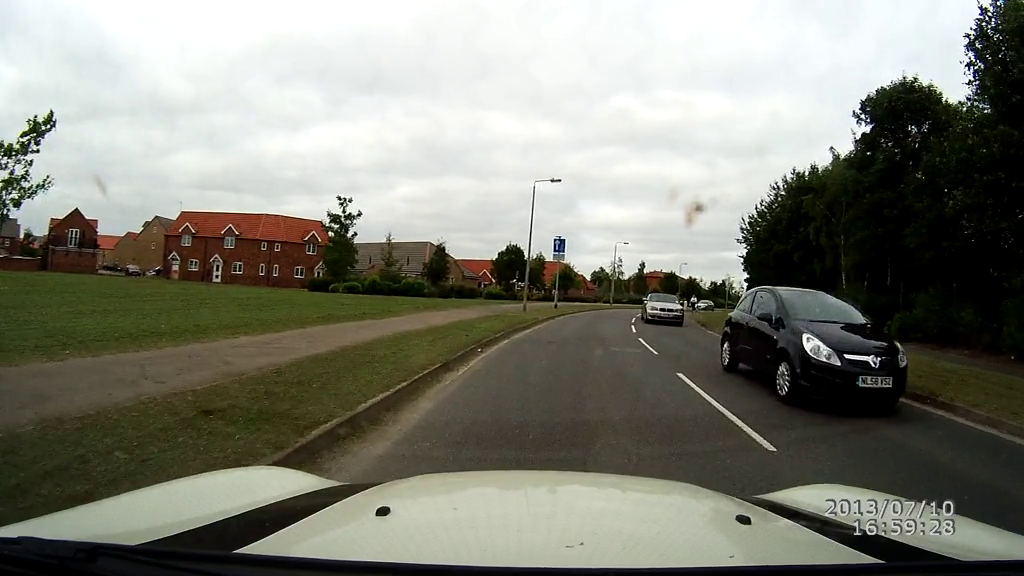
The build-out near the Co-op shop area is visible in the distance.  Even though oncoming drivers are on the other side of the road, my approaching car will still be visible to them IF they are looking ahead and IF they have approached at the appropriate speed.  A give way sign / line means, ‘be prepared to stop!’


Image


It could be argued that, if the trees and bushes on the right are not pruned fully, the view for drivers approaching the build-out, is obscured and they will not be able to see my car for a brief period.  However, this only becomes a problem if they have approached the build-out at such a speed, as to need to brake hard and pull back on to their side of the road, as my car comes in to view.  This issue would of course be made worse, if a car in my position was also exceeding the 30 mph speed limit, as some do.

The fact of the matter is, that the build-out is designed to work in both directions.  Not only should it cause the on coming car to slow, so that the driver has time to see if it is safe to drive on, it should also cause a car in my position to slow, having seen a car driving around the build-out. 


Image

Image

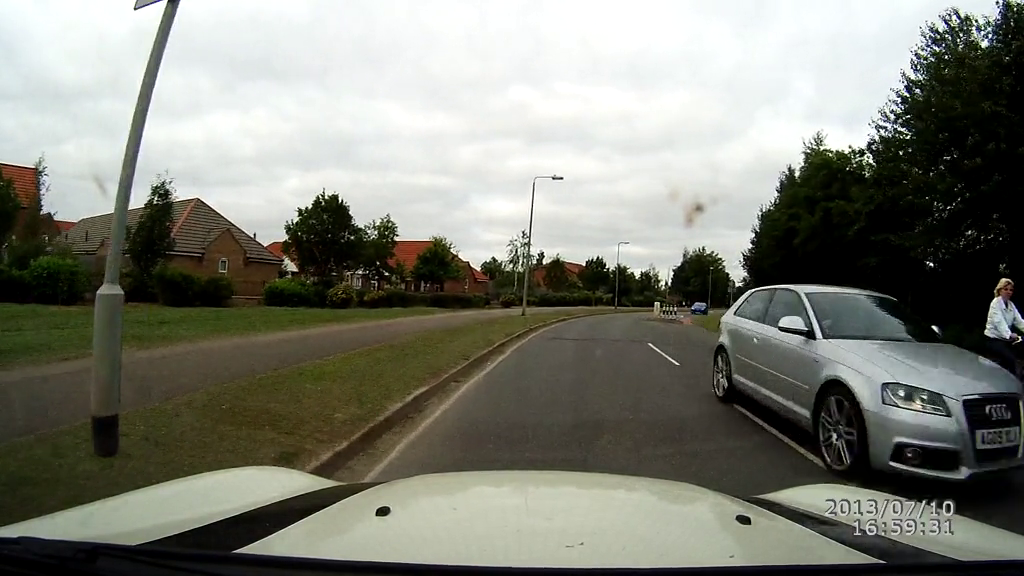
As I’m approaching build-out, a car is approaching at speed and even though they must see me if they are looking ahead, they show no inclination to slow down and speed past the build-out.  Also notice the cyclist just passing through the build-out cycle path – you’ll see why in the next shot.

Image

Having forced their way through, the car driver continues on in the same unsafe manner, dangerously overtaking the cyclist.  Clearly build-outs don’t work when people are this ignorant. 


Why has Wygate Park got those useless buildouts?

The title doesn’t reflect my view by the way, but is a question sometimes asked of me by residents and drivers using the road named Wygate Park.  As an aside, I think that’s a terrible name for the road, as it seems to cause no end of confusion for people, even those who have lived around this area for sometime.  

As well as being the name used to describe the area of new development that was created off of the long established Woolram Wygate, Wygate Park partially shares its name with another long established road off of Woolram Wygate, Wygate Road.  Is it any wonder that people get confused dot com?  Anyway, I digress, back to the subject of this entry, the ‘cursed’ buildouts.

These buildouts were installed in response to the increasing concerns of certain residents and the councillors representing the newly formed Spalding Wygate ward, on South Holland District Council.  I have the honour of being one of those councillors and I make no apology for being partly responsible for this less than perfect traffic calming scheme.  Now for a bit of ancient history, as what was told to me, in days gone by.

Long before I even knew there was such a place as Spalding, let alone an area called Wygate Park, the chap who was the other district councillor for this area, was taking a very active interest in all things political.  Prior to becoming a district councillor, he had had a conversation with a member of the county council’s highways team responsible for planning, along with the developers, the roads in, around and through Wygate Park.  Apparently, the road now called Wygate Park was seen as a golden opportunity to create a defacto western relief road for Spalding and all at the expense of the private sector.  

When I first moved to Spalding, having been posted back from Cyprus by the RAF, I was baffled by both the width and straightness of a road supposedly intended to serve a totally residential area.  I very quickly came to realise that, once finished and opened all the way through to Monks House Lane –  we were living off of what was believed to be the largest cul-de-sac in England at the time, 540 houses with only one road in and out – speeding would quickly become an issue.

Incidentally, despite my concerns, a recent survey by the Lincolnshire Road Safety Partnership, suggests that the average speed on this road is actually 24 mph!  Not for the first time has this exact same figure been quoted to me following a traffic speed survey on another road, something I find slightly suspicious.

Once I became a district councillor, I made a point of voicing my concerns about the design of this road, as often as possible. Hindsight is a wonderful thing I know, but who in their right mind would plan a housing development the size of Wygate Park, on the wrong side of an archaic level crossing and then stick the equivalent of the A1 through the middle of it?  

To make matters worse and possibly because the county council had realised the potential for speeding on such a straight, wide and open-sided road, some totally useless, but very expensive block paviour platforms were added, supposedly as some form of – you’ve guessed it – traffic calming!  

Not only are these platforms useless as a traffic calming measure – I’ve yet to see anybody slow down for them – they also generate an inordinate amount of tyre noise, as cars enter and and exit them at speed.  I can only describe it as a sort of cracking sound. Having mounted a platform, often at speeds in excess of 30mph (notwithstanding the survey!) a loud buzzing noise can be heard again, from the cars’ tyres as they speed across the joints in the block paving.

So, with all these negatives in mind and having seen the impact a busy, fast moving road can have when it’s carved through a residential area, I was determined to do something about it, which brings us nicely back to the buildouts.

With all due respect to the very genuine concerns some drivers have for their own safety whilst negotiating these buildout, it’s not the buildouts that are at fault, its the drivers.  Taking the one near to the Co-op shop, just along from Mariette Way first.  I regularly hear drivers complaining that it is dangerous, because you can’t see what’s coming the other way until you are on the wrong side of the road – sorry folks, you’re wrong.

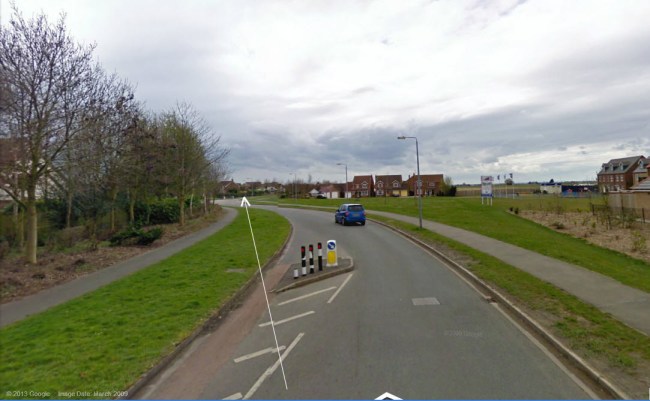
In the image below, using Google Maps street view, I’ve captured, as best I can, the view a driver sees as they approach the buildout.  As you can see from the white line on the photo, by looking well ahead, you can see all the way along the right hand side of the road towards the pedestrian refuge near Claudette Ave and beyond.  This of course is the same side oncoming drivers will be on as you approach this buildout.  IF a driver approaches the buildout at the right speed AND if the driver takes note of the give way sign and line, then he or she will have plenty of time to stop and wait until the road is clear ahead.  

However, if the driver approaches the buildout with the clear intention of not stopping, come hell or high water, then they will of course find themselves making a split second decision – should I stop, or should I go.  Now, because their approach speed was completely inappropriate, they will either find themselves slamming on the brakes, whilst at the same over shooting the give way line, leading to the need for an extreme piece of steering when they move off again or, actually needing to go even faster to get around the buildout, before then throwing the car back on to their side of the road, in order to avoid the on-coming vehicle!  Of course, had they chosen the right approach speed in the first place, all this drama and stress could have been avoided.        

Of course you might be tempted to ask, ‘but what about the bloke coming the other way, what if they’re speeding, I’ve still got a problem.  Not so; if you are driving at the right speed and looking far enough ahead, you will easily be able to assess the road conditions and respond accordingly.   
   

Image     

Pause for the insertion of an extract from a driving tips website, that reminds us of how we were all taught to negotiate a give way sign, all those years ago.

How to approach a give way sign

Approach a give way junction using theMirror Signal Manoeuvre routine (MSM), or better still the MSPSL routine.

This is expected by the driving examinerduring the driving test. To establish whether you need to stop or proceed without stopping, you must assess whether the junction is open or closed.

A closed junction restricts your view of the road and traffic on the road you intend on joining, and open junction is clear to see and determine whether you must stop or proceed. See junctions for further information and a full explanation on open and closed junctions.

Difference between give way and stop sign

Both give way and stop signs are regulatory order signs. The difference between give way and stop signs however is at a stop sign, a motorist must legally stop just before the stop line before proceeding. This is often due to the area that the motorist intends on entering is highly hazardous.

Give way rules are different in that the driver must give way to traffic ahead but do not need to stop if it is determined that it is safe to proceed without doing so.

The same situation applies at the other end towards Monks House Lane, although I will confess, this buildout is slightly trickier, because you can’t see quite as far, especially when the the driver that doesn’t know what the speedo is actually for, is coming the other way.

Image

In summary, those of you who fear for your life every time you enter Wygate Park and have to negotiate one of these buildouts, should think back to when you were learning to drive and try to remember the simple rule – a give way sign means, be prepared to stop.  

The problem with us all these days, is that we’re all in too much of hurry and far too ready to push our way through, even when the traffic lights are on red – but that’s a rant for another day. 

I’m sorry if this all sounds incredibly patronising and superior, but this is my blog page and if I can’t be an annoying know it all here, where can I be? 

If I happened across a blog written by a moron….

If I happened across a blog written by a moron, that contained a personal attack on me, I’d probably respond to it something like this.

I’d suggest that they didn’t ramble on and on, like somebody just back from a binge drin20130922-232829.jpgking session and lacking the brains to go to bed and sleep it off instead of scrawling on their blog page. I’d also suggest that they read more carefully what they are ranting about before going off half cocked, like a spoilt child that’s just been told they can’t have a sweetie.

Finally, I’d tell them that, if they want to keep banging on about something written months ago, all of the above applies and that they shouldn’t think themselves so important that everything that was written all those months ago, was only about them.

Oh, and if I happened to try to find out a bit more about the writer of the blog and took a look at their profile, I’d be very suspicious if I found that it actually contained 1010754.largeabsolutely nothing about them, or anything else come to that. I’d also have to wonder what they had to hide and ask how they expect to be taken seriously, when they hide themselves from their readership.

Of course I’d only respond like this if I happened to come across such a blog entry.

E20130922-232534.jpgven then, I might think twice about bothering, especially if the site was saturated with tacky adverts, designed to make money and not really communicate with local people at all.

Likewise, if the site was just a regurgitation (vomit for short) of other people’s stuff, this would clearly show that the owner had a lack of original thought, so it wouldn’t be worth reading in the first place, so I’d probably never bother reading it and wouldn’t have to respond like this after all.

20130922-232158.jpg

‘Jolly Roger’, I think I’ll get myself a flag for that

http://www.spaldingtoday.co.uk/news/opinion/letters/travellers-site-now-he-s-riding-roughshod-over-gedney-1-5489965

Normally, I would be able to say, ‘another day, another letter’, but in this case this letter appeared on the same day as the previous one!

This one immediately starts off on the wrong foot, by suggesting that my comments were made ‘in the paper’. No, the paper was only reporting on comments made by me, during a meeting of the SHDC Planning Committee, something I often do as the committee chairman.

The writer then goes on to harangue me for reminding the committee that, like it not, gipsies and travellers are treated differently by the planning system. Grabbing my statement by the throat and giving it a damned good shaking, the writer manages to create a rabid froth of rhetoric, claiming that I was part of some sort of cabinet led conspiracy. Apparently, this conspiracy had its origins with the £1m+ Travellers’ site at Holbeach and has now turned its attentions to Gedney, where it is about to somehow ride roughshod over the place.

just for accuracy, assuming that the writer is referring to the planning application H06-0145-13, for only two plots for one family and not a Holbeach sized site, then we’ve already ‘ridden roughshod’ over the village and have now returned to our dark lair in Priory Road.

Oh well, at least I’ve got yet another printable nickname out of this one, ‘Jolly Roger’. I think I might be able to get some sort of flag for that. It can then be hoisted outside Priory Rd on those days my fellow conspirators and I are out and about riding roughshod over other areas of the district.

This reply belongs in the toilet

http://www.spaldingtoday.co.uk/news/opinion/letters/public-toilets-one-of-the-most-stupid-replies-i-ve-ever-read-1-5489989

Having tried numerous times to log in to the newspaper website, so that I can respond to this letter, I’ve given up and resorted to my blog page. Although very few, if any, will read this compared to the letters page of the local paper, it will at least get it off of my chest and if nothing else, this website does let me log-in!

In truth, Mr Turps letter is so lacking in substance and so full of bile, it’s almost impossible to come up with a newspaper response, that isn’t equally bile ridden. However, as this is my blog and I can say pretty much what I like, bile ridden included, so here goes.

From the outset, I really didn’t get the, ‘the most stupid replies’ bit. Clearly this gentleman started off unhappy with my response and went on to build up a head of steam to the point of becoming slightly irrational in his arguments.

He offered some clearly insincere regret, for the verbal and sometimes physical abuse the staff suffer, by saying, “which, if true, is very regrettable”. He then goes to display a clear lack of understanding of what the problem is, by claiming that it’s all about ‘the management’ and finishes by telling me to ‘get out of the way’. Out of the way of what, to allow what to happen exactly?.

If it’s about anything, other than the totally unacceptable behaviour of a minority of users, it’s about closer supervision of the task and that will always be a major challenge with such a small street cleansing team, that is trying its best.

In conclusion, Mr Turps’s letter is, “One of the most stupid replies I’ve ever read!”.

Planning and highways spending slashed

Copied from Local Government Chronicle on line
29 August, 2013 | By Ruth Keeling

Planning and highways have seen the largest reductions in spending, according to the latest local government financial data published on Thursday.

Expenditure on planning services fell by 13.2% between 2011-12 and 2012-13 while spending on highways and transport services fell by 9.5% over the same period.

The cut in spending on services linked to growth, a number one priority for the government, contrasts with much smaller cuts in social care spending and increases in spending on housing benefit costs.

The LGA has previously warned that the combination of growing demand for social care services and significant funding cuts would mean spending in other areas, such as planning and highways, would be squeezed harder and harder.

Social care spending fell by just 0.2%. However that masked a different story for children’s social care, where spending increased by 2.8%, and adult social care, where spending fell by 1.4%.

Other areas of increased spending were housing benefit costs, which increased by almost 5%.

Although education spending fell by 7.7%, government statisticians warned that comparisons should not be made over the two years because the reduction was caused by academies leaving local authority control.

While total revenue expenditure fell by 5% between 2011-12 and 2012-13, the reduction was just 0.2% once changes to education responsibilities and funding were removed from the comparison.

The figures also show that councils increased their reserve levels by £1.7bn, not including a £0.9bn addition to the Greater London Authority’s reserves.

However, there were a quarter of councils which did not add to reserves and ended the year with less in the bank.

Treasury rent control threatens house building

Yet another way for this government to milk the local government cash cow.

Copied from LGC online
22 August 2013 | By Keith Cooper

Some of the most ambitious council housing building programmes for decades have been put into jeopardy by the surprise Treasury plan to seize control of local authority rent levels.

Officials have been warned by the Chartered Institute of Housing that the shake-up of ‘social rent’ policy unveiled during the spending period announcement will pull £1.2bn out of council housing budgets over the next decade.

The policy will cut short an arrangement that allowed councils to align rents with those charged by housing associations and undermines key assumptions in their 30-year housing budget plans.

LGC understands ministers are preparing to take a hard line on enforcing the rent policy as the Treasury is concerned that councils will refuse to comply. This includes the option of central regulation of council rents for the refuseniks.

CIH analysis predicts that the authority hardest hit by the policy will see £300m stripped out of its housing revenue account, a budget councils have only controlled since April last year. Until then the HRA had been in the Treasury’s hands.

Croydon LBC, which is hoping to build almost 2,000 homes a year, has calculated that the changes could suck £254.8m out of its HRA. Such a loss would force it to “fundamentally review” its business plan, according to Richard Simpson, its director of finance and assets.

Camden LBC has warned that the new policy could substantially heighten the risk of its 1,100 house building programme. Its £400m plan to refurbish existing stock might also have to be put back, a spokeswoman said. Investment decisions would become “more difficult and risky”, she added. “The potential loss of revenue has been estimated at £75m over a 10 year period.”

The threat of centrally imposed rent controls comes at time when councils have just begun gearing up for large-scale house building schemes.

Camden and Croydon’s house building plans would dwarf the tiny numbers of new local authority homes built during the past two decades.

Reliable evidence of the new rent policy’s impact has only just emerged, following detailed analysis of the proposals by the Chartered Institute of Housing and consultancy Sector.

Abigail Davies, assistant director of policy and practice at the institute, said the changes would over 10 years cost around 125 authorities £1.2bn in ‘net present value’.

This takes into account economic projections and is understood to be the most accurate representation of the impact to date.

The hardest hit authorities are in London and the southeast, with around 24 authorities losing more than £10m each, according to the CIH. “There are some councils which will be very severely affected,” Ms Davies said.

Sector’s analysis of the government’s new ‘rent guarantee’ suggests that it could see £250m pulled out of many councils’ housing budgets.

The guarantee expects all social landlords to increase rents by the consumer price index +1% for 10 years from 2015-16. Until now, councils assumed rents would rise by the retail price index +0.5% for three decades, as government policy papers had indicated.

Ian Green, a manager at Sector, said it was acting for several concerned councils.

“The worry for local authorities is that at the end of 10 years, the government will change it to CPI only,” he added. “If they do that, it will have a substantial impact.”

Ms Davies urged ministers not to undermine council housing investment so soon after local authorities had regained control of their budgets.

A spokeswoman for the DCLG described the new rent policy as a “fair deal for tenants and landlords”.

Explainer
The Treasury’s new social rent policy has two key elements. The first cuts short ‘rent convergence policy’ one year early. Introduced by the previous Labour administration, this had allowed councils to bring their rent levels into line with those of highercost housing associations. Without the extra year, most authorities will be left out of pocket.

The second change is a new ‘rent formula’ which states that social rents should increase by CPI +1% for 10 years from 2015-16. Both policies could save the exchequer £1bn between 2015-16 and 2017-18, a sum which depends on whether councils will toe the policy line.

“The main uncertainty [about the savings] is the behavioural response from local authority landlords,” Treasury documents say. The DCLG is therefore considering rent regulation.

Minimum room size standards – if you can afford it.

This extract from the DCLG press release, really gives me the willies, as my old dad used to say. I don’t have a problem with making sure homes work for older people – as I will be one, sooner than I wish to admit – and disabled people, so they should be. What I don’t like and what makes me both suspicious and, as usual, extremely cynical, is the bit in bold. How can one local authority have different room size needs, compared to another? Are there any secret pockets of pygmies or giants DCLG know about and we don’t?

Or is this DCLG speaking out of both sides of their collective mouths? They give you an opportunity to make an improvement in your policies, but only if you are willing to invest in proving that it is justified for your particular area? This is of course standard practice in Local Plan preparation. Producing the evidence required to justify NOT providing enough housing land, being the most obvious one. Gypsy and Traveller sites, leisure, public open space requirements and road infrastructure, are all evidence based requirements that are totally appropriate, as somebody has to pay for them and they should not be required just for the sake of it – but room sizes, really?

This statement is clearly designed to con people into thinking that DCLG are, to quote Eric Pickles, “on the side of hard working taxpayers”, whilst at the same time discouraging cash strapped councils from actually doing the evidence gathering required. If DCLG were genuine in their wish to see our rabbits hutch homes consigned to history, they would simple produce a national standard to be applied in the same as the building regulations are. Score another one for the vested interests of the planning industry me thinks.

The Department for Communities and Local Government (DCLG) said the administration was inviting views on “minimum space and access standards that would allow councils to seek bigger homes to meet local needs, including those of older and disabled people”.

Parking ticket protest in a vulture costume

Only in Britain, or arguably in England more so, could a citizen achieve such unintended(?) irony whilst protesting against the state. Priceless.

A motorist given a parking ticket returned days later dressed in a vulture costume to protest.
Roger Wallis, 58, bought a mask on the internet and made the rest of his outfit.
He then walked around the car park, in Havant, Hants, for five hours. He said: “I put a lot of effort into making the costume because it is important to look the part. There is no point going down there looking like a prat.”

John Redwood MP sings, ‘I like to be in America’

http://www.thecommentator.com/article/4040/bbc_s_propagandistic_obsession_with_german_economy_ignores_anglo_american_prowess

How disappointing to see a seasoned MP such as John Redwood, not content with just falling over himself to kiss the collective backsides of the good ol’ US of A, despite their major involvement in the world wide recession and the crap we inherit from them, such as gang culture, reality TV shows, skyscrapers, fast food – the list goes on and on, he then adopts the practices of the playground, by ignoring the comparisons being made between the UK and Germany and saying, ‘well Norway and Switzerland are better than all of them, so there!’.
I didn’t find it to be a wholesale endorsement of the German way of doing things, just a reasonable comparison of the differences between the two countries, both good and bad. Yes, the Germans are more productive, but they haven’t had any pay increases above inflation for 20 years. Excellent child care facilities cost a fraction of the cost of lower quality facilities here, but German women feel obliged to be stay at home mums, with little or no career prospects. Workers are more committed to their company and its success, because they share in the profits and work as a team – there’s no but to that one!
The Germans don’t seem to have a problem with private rented properties as being the most effective way to house the masses, rather than encouraging people to saddle themselves with a lifetime of debt.
Hands up all those who’d like to be American… Can you hold them up a bit higher, I can’t see any hands from here.