Our way of recycling should be safe – for now

Copied from Local Government Chronicle
Be aware of new recycling regulations
11 March, 2014 | By Andrew Bird

The Department for Environment, Food & Rural Affairs recently published the long-awaited materials recovery facility regulations and a summary of responses from last year’s consultation.

The regulations aim to drive up the quality of both materials entering such facilities and the output of materials sold on for reprocessing.

A mandatory code of practice will come into effect this autumn, requiring all facilities processing more than 1,000 tonnes of material to sample and report on inputs and the various materials streams resulting from sorting and separation.

While I think the regulations could have gone further, I welcome their introduction.

They will serve to increase confidence in the purchasing of materials from MRFs by reprocessors, supporting the move towards a more circular economy.

The regulations will be enforced by the Environment Agency and Natural Resources Wales through one pre-arranged inspection and one unannounced inspection each year.

So what will the code mean for councils?

It should enable them and waste companies to demonstrate greater transparency and provide mechanisms which help reassure residents that the efforts they put into recycling result in high-quality materials.

It will also help reassure that the commingling of recycling collections can deliver high-quality materials, and help to provide a more robust monitoring framework to assess whether commingled collections meet the requirements of the revised Waste Framework Directive, or TEEP.

So what is TEEP?

In essence it refers to it being technically, environmentally and economically practicable to collect each material separately.

Technically practicable means that separate collection may be implemented through systems developed and proven to function in practice.

Environmentally practicable means the added value of ecological benefits justifies possible negative environmental effects of separate collection.

Economically practicable refers to separate collections that do not cause excessive costs in comparison with the treatment of a non-separated waste stream, taking into account the added value of recovery and recycling and the principle of proportionality.

If you are not currently aware of the implications of the revised Waste Framework directive and its implications for your authority, you need to consider them urgently, and particularly if you are considering changes to the way you collect materials for recycling.

Here are the articles pertinent to Waste Collection Authorities:

Article 4 – Waste hierarchy

Article 10 – Recovery. Paragraph 2 – first mention of waste needing to be collected separately to facilitate or improve recovery if it is TEEP.

Article 11 – Re-use and recycling – about promoting re-use of products and high-quality recycling

Article 13 – Protection of human health and the environment

Article 15 – Responsibility for waste management

If you are unaware of the implications of the revised directive and its implications for your authority, you need to consider them urgently, particularly if you are changing the way you collect materials for recycling.

These requirements come into force in 2015, so decisions taken now and in the future need to be robust.

Andrew Bird, chair, Local Authority Recycling Advisory Committee
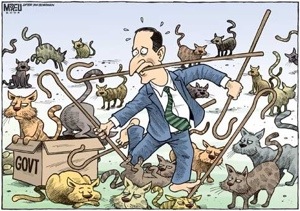
Could you ever get 66.6% of 4.5 million people to agree to anything?

Copied from Local Government Chronicle online
Lib Dems offer councils devolution route
10 March, 2014 | By Mark Smulian

The Liberals want to try to reintroduce regional government for some reason, despite it being a failed experiment under Labour. The danger for Lincolnshire, with a total population of less than 800,000, is that it could end up with regional government by default. The suggestion is that every local authority, would have to achieve a vote of two thirds in favour, but two thirds of what? Also, how would it work if you got a patchwork quilt of councils, where neighbouring authorities voted differently?

General elections average a turnout of over 70%. Local government elections are often lucky to get more than a 30% turnout. The elections for the Police and crime Commisioners, that took place in 2011, averaged a miserable turnout of 15%. Would you be happy to end up back in a regional government arrangement, based on a 15% turnout?

The Liberal Democrats would offer English councils a ‘devolution on demand’ mechanism, the party’s spring conference has decided.

Delegates meeting in York at the weekend voted for the idea, defeating a large minority who preferred a move to devolution throughout England based on the old regional development agency boundaries.

Under the Lib Dem plan, a council or councils comprising at least one million inhabitants would be able to apply for a range of devolved powers similar to those enjoyed by Wales.

Such a change would require a two-thirds majority vote by each local authority involved.

Supporters of the idea argued that this would allow those parts of England that wanted devolution – such Cornwall and major northern conurbations – to go ahead, while areas with little enthusiasm would not have devolution foisted on them.

But opponents argued that assembling the required two-thirds majorities would be difficult, and that even if they could, there would be an untidy patchwork of devolved areas potentially with, for example, a devolved county surrounding a city that was not without devolved status.

Policy working group chair Dinti Batstone said devolution on demand would work better than uniform regional government, citing voters’ rejection of this in the north-east referendum in 2004.

“England does not want a Prescott-style top-down devolution approach,” she said.

Calling for restoration of the old region as a tier of government, Leeds party member Mick Taylor said: “This resolution calls for devolution to a mishmash of collections of local authorities. Are we going to have the NHS devolved in some places but not others?”

He also complained that the paper did not confer automatic tax raising powers on the devolved areas.

The paper offered immediate devolution to Cornwall because of its cultural identity, and further powers to London building on its already semi-devolved status.

It also called for the use of the single transferable vote system for all English local elections, as used in Scotland.

As an interim measure the party would devolve more powers to city deal and growth deal areas.

Answering questions from party members at an earlier session, deputy prime minister Nick Clegg made clear his support for decentralising power further in England.

He said: “City deals have been a really important innovation. I want that approach extended to across the whole country to other cities, to urban and rural areas.”

Is LGA whistling in the wind, because it’s a ‘European’ report?

Copied from Local Government Chronicle online
LGA demands more power for England
7 March, 2014 | By Marino Donati

The LGA is calling for greater devolution of powers to English councils after a European report concluded that local authorities in Wales and Scotland were better off.

The report from the Council of Europe, Local and Regional Democracy in the United Kingdom, expressed concern about “the financial resources of local authorities, their limited taxing powers and their dependence on government grants”.

It concluded: “Despite significant cuts, in Wales and Scotland local authorities are (still) better off financially than their English counterparts, but lacking diversity of local finances is a concern also there.”

The report said that “ambiguities” around the lack of recognition of the right to local self-government in the law beyond the general powers granted by the Localism Act 2011, also needed to be addressed.

It recommended the UK government reduce the financial burden on local authorities from budget cuts. It also called for better consultation arrangements for local government for “taking into account the necessity or opportunity for local authorities to consult their local population”.

LGA chairman Sir Merrick Cockell (Con) said that English councils were being “short changed” and called for the current model for the financing and running of local government to change.

He said: “Devolution of decision-making and tax-raising powers to local areas is needed to help save money and improve services and English communities need to be given the same significant say over everything from health services to public transport as they do across the border in Scotland, Wales and Northern Ireland.

“Our European counterparts also identified the urgent need for a fair and equitable distribution of public money across the United Kingdom, The 34-year-old Barnett Formula is short changing English communities by as much as £4.1bn a year and a needs-based model is needed for a fairer deal.”

The report also raised concern about councils’ ability to meet international obligations. It said: “A fundamental question in relation to Article 9 of the Charter [European Charter of Local Self-Government] is whether local government will have adequate (own) financial resources and whether these are commensurate with its functions.”

The Council of Europe regularly reports on the state of local and regional democracy in the EU’s member states. Its local government arm, the Congress, is responsible for the monitoring of local democracy in member states by assessing the application of the European Charter of Local Self-Government, which was adopted in 1985 and ratified by the UK in 1998.

Responding to the report, local government minister Brandon Lewis said: “The coalition government has delivered a fair settlement to every part of the country – north and south, rural and urban, metropolitan and shire. We have given councils new financial flexibilities, such as the local retention of business rates and scrapped top-down interfering quangos.”

Another hidden tax on the council taxpayer is set to increase

Copied from Local Government Chronicle online
LGA calls on chancellor to freeze landfill tax
7 March, 2014 | By Chris Smith

The chancellor has been urged to freeze the landfill tax as part of this month’s budget by council leaders.

Ahead of George Osbourne’s keynote speech on 19 March, the LGA claimed landfill tax had achieved its purpose and warned any increase would punish hard-pressed families.

Mr Osborne was urged to keep landfill tax at its present rate of £72 per tonne and to redistribute revenue to local taxpayers.

The tax, paid by businesses, is set to increase to £80 per tonne in April and the money raised goes into central government funding.

The LGA warned the costs would be passed by on to residents and claimed each household would pay £30 towards landfill tax in 2014-15.

Mike Jones (Con), chair of the LGA’s environment and housing board, said: “Instead of using the receipts from the tax to boost recycling technologies and reward residents for the gains made in recycling levels, the Treasury has held on to receipts. We need a clear indication from the chancellor that this tax will be frozen at its present rate, with the money raised from it returned to taxpayers and invested in growth.”

The way forward, but is anybody listening?

It’s unfortunate that, even when there is agreement that unitary is the best and most cost effective way to provide local government service, politicians still waste time and energy protecting their individual power bases.
I’ve yet to fathom Eric Pickles’s reasoning for sticking his oar in as soon as he got in to office in 2010, and stopping those that were in train. Possibly pre-election whinging, from Conservative councillors in those areas, fearful that they would get the boot from the electorate, was the cause of this early interference, something that has continued at a pace.

Too much time and effort is wasted by politicians protecting their own interests under the pretence of championing the interests of those who elected them. The vast majority of taxpayers care little for which part of local government provides the services they need to access. What they do care about, is how much their council tax bill will be every April. Yet despite what should be blindingly obvious, lower tier politicians spend their trying to pass on the cost to the upper tier, or refusing to work with that upper tier, because they can nothing in it for them.

As far as the taxpayer is concerned, a saving in their council tax, is a saving in the council tax, no matter where it comes from. Put another way, if a district council works with their county council, to help that county council save money, then that is as much to the credit of those district councillors as it is the county councillors, if not more. Unfortunately many councillors at the district level can only see the numbers in their own budget and refuse to acknowledge any wider savings that are being made.

However, it’s not just a case of making everything unitary and all will be well in local government. I’ve no idea how well or badly local government is working within the East Riding of Yorkshire. However, given that it’s the largest unitary in England, is divided into 26 wards and has a total of 67 councillors (Lincolnshire County Council has 77 councillors, covering only county council services) it would be very interesting to know and I don’t mean just what the council and it’s politicians would like you to believe.

Would Lincolnshire work as one large unitary? Personally, I don’t believe that it would, but that’s just my opinion. I’m always willing to be persuaded differently based on evidence that unitary councils such as East Riding of Yorkshire Council is serving its rural council taxpayers well.

Copied from the Local Government Chronicle. From a series of articles written by a senior local government officer, who remains anonymous.

Inside Out: Unitary is strength
5 March, 2014

I have always believed unitary is strength when it comes to local government. I was really pleased when it was recently reported that Labour is looking to embrace it.

I was less pleased with the government’s response. They ‘played politics’ with it rather than responding to the issue.

Granted, the move to unitary councils has never been smooth.Councils disappear, people lose their power and influence, places can feel they lose their identity, and there are always transitional costs. However, the advantages when unitary government is established far outweigh the transitory downsides.

I have worked for a district that became a unitary council, a county unitary and a district unitary. One size does not fit all circumstances. It seems to be assumed these days that unitaries should always be based on counties. This is a disservice to the strength and professionalism of district councils and will be a barrier to change in some circumstances.

There are three secrets to make moving to unitary local government successful. First, the area covered needs to make sense to residents. My hometown was moved from Lancashire to Merseyside in 1974. I still address Christmas cards to my relatives using Lancashire, 40 years later. The boundaries of unitaries need to be determined locally.

Second, there needs to be strong national leadership. The whole of England needs to be covered by unitary government. Unless this is made clear, local vested interests will fight change and drive up costs.

Finally, it needs strong local leadership, seeking consensus on change and then managing the change well. There are savings and service improvements that can be unleashed by bringing together tiers of government, but they have to be realised. They don’t happen on their own.

Given the financial struggle matched with rising demand, no element of transformational change can be dismissed. My heart sinks when I think of yet more organisational change. But maybe it needs such a shake-up to unlock the other changes we need to embrace. Unitary is strength.

Mr Localism offers yet more of his loud mouth ‘guidance’

Copied from the Local Government Chronicle online
Pickles set to move on publicity powers
6 March, 2014 | By Chris Smith

The communities secretary is preparing to step in and use new powers to try to prevent councils from publishing newspapers more than four times a year.

Five London councils are at the top of Eric Pickles’ hit list when he acquires new powers next month, LGC understands.

When the Local Audit and Accountability Act 2014 comes into force on 4 April, it will allow Mr Pickles to direct councils to comply with his 2011 publicity code, which states that councils should not publish more frequently than quarterly.

According to the most recent figures held by the LGA, 41 councils in England currently publish a newspaper more than four times a year. But Mr Pickles is understood to be focusing on five London boroughs: Tower Hamlets, Hackney, Greenwich, Newham and Waltham Forest LBCs.

Highest on the list is Tower Hamlets LBC, whose weekly publication East End Life, was named by Mr Pickles in Parliament as the worst offender in publishing frequency.

However, the legislation does not give Mr Pickles any powers of enforcement or intervention, so it is unclear what would happen if a council that had been issued with a direction chose not to follow it. It is thought that any legal challenge would need to be brought by residents or campaigners. The councils involved estimate legal costs of pursuing a case would be between £50,000 and £100,000.

The Taxpayers’ Alliance warned of potential court challenges but stopped short of committing to pursue a test case. Chief executive Jonathan Isaby said: “Those council leaders choosing to ignore the guidance are exposing themselves and their local authorities to legal action.”

The councils involved say that newspaper closures would lead to an increase in advertising charges from local paper owners. They also say increased costs would contravene the publicity code’s demand to be cost effective. They also say that the reach of their communication would be limited.

Hackney LBC said its review of costs for Hackney Today found that to produce a quarterly newsletter and place statutory advertising in a local newspaper would be more expensive than continuing fortnightly publication. The findings were supported by the council’s district auditor.

Hackney mayor Jules Pipe (Lab) said: “I have repeatedly told the secretary of state and his colleagues, both in writing and in person, that we will cease fortnightly production of Hackney Today as soon as he ends the costly and outdated requirement on councils to place statutory advertising in a local newspaper.”

A Greenwich RBC spokesman defended its publication, Greenwich Time: “The paper is published on a weekly basis to inform residents about local services and to promote social housing available through our choice-based lettings scheme. It has also reduced expenditure on advertising costs by approximately £1.5m per annum which we have passed back to our residents in the form of successive council tax freezes.”

A Department for Communities & Local Government spokesman said: “Ministers have been clear that they intend to take action to defend the independent free press from unfair municipal competition and stop any abuse of taxpayers’ money.”

The Local Audit and Accountability Act 2014

This received Royal Assent on 30 January and comes into force on 4 April. It enables the communities secretary to direct one or more councils to comply with all or part of the publicity code. He must first write to a council informing them of his proposed direction.

Councils have 14 days to make their representations about the proposed direction. After the 14 days the secretary of state may make the direction.

Labour has a double whammy in store for local government

20140301-142042.jpg

It seems that Labour is willing to throw local government in to further turmoil, should it regain power at the next general election. The Electoral Society has published a document written by a Labour lobby group, promoting proportional representation voting as the way to re-energise democracy in this country.

Labour is also revisiting the issue of two tier local government, something that will effect shire areas such as Lincolnshire. This would probably a good thing from the council taxpayers’ perspective, as it would remove some of the confusion and frustration they experience when dealing with two tier local government. However, it’s by no means clear that this is intended to make democracy more accessible and straightforward for the taxpayer, as opposed to just making it easier for Labour to gain power outside of their current urban strongholds.

Reading the document, it would appear that Labour are concerned about running out of the foot soldiers they need to get re-elected. As many of these foot soldiers come from those standing in local elections, the Party appears to have a cunning plan to create more Labour councillors (foot soldiers) across the country.

This sudden enthusiasm for PR could of course be intended as a sop to the Liberal Democrats, just in case Labour needs to go into coalition with them, to freeze out the Conservatives in 2015, if plan A, an outright majority, doesn’t come to pass.

Perhaps the Labour Party really does believe PR is the way forward and are seeking to collude with the LibDems to foist it on to the British public via the back door, or rather from the bottom up. Using local government as a guinea pig, they will impose it on to councils, already buckling under the weight of doing more than their bit to help reduce Labour’s deficit legacy. Looked at cynically, one could suggest that the extremely low turn out in local elections, makes councils an easy target for this experiment and that any outcry from existing councillors will gain little, if any, support from an apathetic public.

There are many reasons why we should be extremely wary of PR at the local government level. There are a plenty of examples of councils that are in a form of leadership limbo, due to being in no overall control, because no single group has the majority. Even when there is what might be called a controlling group there are examples of councils being controlled by single issue groups, rather then one with any particular political allegiance. Boston Borough Council had something called the Boston Bypass Party until 2011. In both cases, this effectively leaves a council with no political direction, or leadership and being run by its officers.

I would also suggest that PR will inevitably lead to the introduction of professional councillors. The PR system means that a councillor representing a particular minor group, gets allotted a seat in a division well away from where they are actually living. As such, they are likely to need a far greater level of administrative support and spend a much greater amount of time and effort dealing with issues. They will also claim a much higher level of expenses and ultimately, find themselves needing to become a ‘full time’ councillor.

The prospect is, that should Labour gain power, either totally, or in a coalition, all councils will become single tier across England. Additionally, in many areas the council will be in the political control of what is politely called, rainbow alliances, but could soon be more accurately be described as, ‘a herd of cats’.

The Labour Party position on unitaries

A senior shadow minister has hinted that Labour would revive unitary local government reorganisation.

Shadow chief secretary to the Treasury Chris Leslie said in a speech to the Social Market Foundation thinktank that the government should work with councils that were already promoting unitary schemes, such as Leicestershire and Warwickshire.

“The previous Labour government helped local government to make efficiency savings. So we gave local authorities powers to merge and change their boundaries and in 2009 a series of local authority reorganisations brought together district and county councils and created new unitary bodies,” he said.

“Other changes in Devon, Exeter and Norfolk were in the pipeline but this government stopped those in their tracks and are continuing to resist local authorities’ proposals to unitaries.”

The earlier generation of county unitaries had delivered savings per head through efficiencies of £46 per person a year in Cornwall, £52 in Central Bedfordshire, £66 in Shropshire and £91 in Northumberland, Mr Leslie (pictured) said.

He said: “The government and Whitehall should be doing more to empower councils, that see from the bottom up the benefits of collaboration and are actively debating whether to come together. This should also include small district councils that are facing the greatest financial pressures of all.”

Mr Leslie, who was a junior local government minister under Labour and ran the New Local Government Network thinktank before he returned to Parliament in 2010, said he and shadow communities and local government secretary Hilary Benn would “continue to explore the full range of options to support councils as they share services, pool budgets, and choose to collaborate and integrate further”.

Local government minister Brandon Lewis contrasted Mr Leslie’s speech with reported remarks in which Labour policy co-ordinator Jon Cruddas appeared to rule out reorganisation.

He said: “The Labour Party are in disarray on unitary local government restructuring, ruling it out one week and calling for it the next.

“By contrast, the coalition government is very clear that restructuring would be expensive, divisive and time-consuming, diverting time from improving frontline services and locally-led co-ordination.

“Labour is motivated by partisan politics, doing what they think is best for Labour self-interest rather than what’s best for the country.”

Mr Leslie also said that English local government was “enduring eye-watering reductions in revenue support grant which are threatening basic activities in social services, housing, environmental services, libraries and local voluntary bodies”.

Labour’s Local Government Innovation Taskforce would examine how to orientate services “around users rather than necessarily sticking with the old – and expensive – bureaucratic way of working”, he said.

DCLG showing just how petty and obsessive Pickles is

Copied from Local Government Chronicle online
DCLG accused of ‘silliness’ over combined authority names
21 February, 2014 | By Kaye Wiggins

Councils forming combined authorities have accused the Department for Communities & Local Government of “silliness” and “kindergarten games” after being told they cannot use the word “region” in their names.

At least three of the four areas setting up the new authorities are embroiled in a row with the department, which has suggested changing their formal names before they are established on 1 April.

Roger Stone (Lab), leader of Rotherham MBC, said councils in the Sheffield city region had been asked to rename themselves as the Sheffield, Rotherham, Barnsley and Doncaster combined authority.

“I think it’s because Eric Pickles doesn’t like the word region, because it sounds too European,” he said.

“We’re insisting it be called the Sheffield city region because that’s what we all agreed on from the start of negotiations. And the DCLG’s alternative name would leave out North East Derbyshire, Chesterfield, Bolsover and Bassetlaw, which are all part of the combined authority.

“At the moment it’s like a tennis ball going back and forth. We’re insisting on the city region but DCLG wants it changed. It’s childish. It’s kindergarten games.”

Graham Burgess, chief executive of Wirral MBC, said the Liverpool city region was in a similar situation. DCLG officials have suggested a name change to the Halton, Knowsley, Liverpool, St Helens, Sefton and Wirral combined authority (HKLSSWCA).

“All six areas agreed on the name Liverpool City Region, but DCLG has refused to let us use the word region,” he said.

“So much for localism.”

Paul Watson (Lab), leader of Sunderland City Council, said he had been told DCLG officials wanted to prevent his area from using the name North East combined authority.

“They want to call it the Northumberland, Durham and Tyne and Wear combined authority which is a bit of a mouthful,” he said.

“It’s just silliness. I just want us to be left to get along with actually doing the work rather than having to spend time thinking about acronyms.”

A DCLG spokesman said: “A number of responses to the consultation requested a change of name, which is why we changed the legal name. If the new combined authority wants to use something snappier as shorthand, that’s a matter for them.”

READERS’ COMMENTS (1)

Roger | 24-Feb-2014 9:48 am
‘Silliness’, I think they are being far too polite when describing yet another stupid and petty diktat from Pickles and his minions.
Unsuitable or offensive?

Only complaining via the letters page, achieves very little

Its always a bit disappointing when the first time you find out that somebody has got a problem, is when it appears in the letters page of the local newspaper.  It’s doubly disappointing when the person making the complaint is known to you, because you have had dealings with them in the past and have actually been successful in resolving an issue for them.

Don’t get me wrong, I’m not seeking to be the best thing since sliced bread – never really understood what that means – and be the go to guy for everything and everyone, but I’m just a bit nonplussed as they say, that this gentleman didn’t at least given me a heads up on the issue, at the same time as writing to the newspaper.  All that said, I have actually been looking into the issue of drivers allegedly ignoring the pedestrian crossing on Wygate Park, over the last couple of months, following a comment made to me by a resident sometime ago.

OLYMPUS DIGITAL CAMERAThe comment was along the same lines as the letter in the press and although I have not witnessed any occurrences myself, it reminded me of my own concerns about this crossing.  Until the recent conversation, I thought it was just me and that I was somehow becoming less aware of such things and therefore needed to be on my guard when driving.  This is often a criticism of drivers of a certain age, so I had to consider it as a possible reason for my concerns, regarding this pedestrian crossing.  However, having heard these concerns from somebody of lesser years, I thought I’d do some further research.

For sometime now, I felt the crossing was somehow less obvious as you approach it in the car, than similar crossing in other locations – but only during the hours of daylight.  At night the opposite is true and I would defy anybody other than a blind person, somebody sleep driving, or somebody completely off their head on drink or drugs, not to see this crossing clearly.  Not only is it floodlit, it also has illuminated black and white posts, that work brilliantly in combo with the flashing yellow beacons that top them.

Unfortunately, during the hours of daylight, the beacons seem barely adequate and along with other surrounding issues, I wonder if this might be the cause of the alleged pedestrian near misses?  Does the background of nearby trees and branches make the beacons less visible than normal?  Is it the light units on top that leads a driver to see these as street lights, rather than the crossing illumination and warning beacons they actually are?  Could it the fact that the crossing actually sits on one of the traffic calming platforms, making the viewing angle from a driver’s perspective, shallower and the black and white crossing less obvious?

I’ve been in touch with the county highways department, asking all of these questions and they are of the opinion that there’s no problem with either the crossing, or its visibility.  As always, they are forced to look at getting the biggest bang for their ever decreasing buck, so they use the accident and incident figures for a given location, as a way of determining its priority.  In the case of this crossing, nobody has been run over yet and, thankfully, nobody has been killed, so it doesn’t even figure on the highways dept’s radar, when it comes to spending money on improvements.

I have made enquiries with a company that supplies beacons that have a ring of flashing LEDs around them, having seen how effective they are in other areas – Peterborough City seems to fit these as standard.  Unfortunately the cost, over £3000 per beacon (higher than standard, because of the integral flood light unit on top) makes funding any improvement from my ward budget almost impossible.  Just to make life a bit more difficult, county highways would still not sanction any changes, unless they received what’s called a commuted sum of £2,700, to cover the increased cost of future maintenance, or replacement due to accident damage.  Understandable, but nonetheless frustrating.

I really do hope that neither the letter writer nor myself, are proven right in our concerns and that the crossing continues to offer genuine safe passage to pedestrians crossing this increasingly busy road.

Eric Pickles finally outed at last as a force for bad – sort of

Peter Oborne, writings in today’s Sunday Telegraph, are music to my ears, if that’s actually possible – writings, ears?    His contribution to an article looking at the issues around the recent widespread flooding, focusses on the political dimension and in particular, the hamfisted and spiteful involvement of one, Eric Pickles MP.

In my opinion, the position of the local council leader, Mike Fisher (behind Pickles wearing glasses, says everything there is to say about Eric Pickles relationship with local government.
Photo with thanks to Croydon Advertiser

No sooner was Eric Pickles put in charge of dealing with the flooding incidents that were impacting a number of areas in the south of England, than he started apportioning blame and apologising for the supposed shortcomings and failures of the ‘blameworthy’.

Having honed his talents for spite and bile on belittling and criticising local government, he had now set about the Environment Agency, for failing to prevent the flooding of thousands of homes and businesses.  By inference, according to Peter Oborne, Pickles was also back stabbing a government colleague, Owen Paterson, laid low by a sight threatening detached retina that required urgent surgery, the cause of Pickles appointment, along with Lord Smith of Finsbury, Chairman of the EA.

For those of us involved in local government, this was very much par for the course with Eric Pickles, especially if there was a reporter’s microphone, or TV crew in sight.  However, and morale to anybody suffering from Pickles’s non-stop spite, is that his big mouthed, brute force handling of his new role, has seen him outed as no more the the “blundering Whitehall meddler” we all knew him to be.

      Disappointingly, Peter Oborne suggests that, up until this point, Eric Pickles was actually considered to be a safe pair of hands,           this despite his unchecked assault on local government, as Secretary of State for Communities and Local Government.  So, unless Owen Paterson and Lord Smith confront David Cameron and tell him in no uncertain terms, it’s him or us, it would seem that local government is stuck with this loud mouthed lout, until May 2015.