Category Archives: Environment
Labour’s plan sounds like that of every fleeting Tory minister from last 14 years
In depth: ‘It’s not just about political will – there are economic headwinds’
Labour has an “incredibly steep mountain to climb”, says Robert, but it’s a challenge Reeves is sure she can meet, announcing plans to turn the government’s 1.5m houses pledge into reality. This includes the return of compulsory housebuilding targets for local councils, a policy that was scrapped under the previous government. But the main way that Labour is saying it will hit its target is through planning reform. “In other words, they will be loosening restrictions on building on parts of the green belt and speeding up planning decisions,” Robert says.
Building on the green belt, which covers about 13% of England, has met fierce opposition in the past – with nimbyism blocking previous attempts to loosen the rules. To allay fears, Keir Starmer said Labour would prioritise building on brownfield sites and “poor quality” and “ugly” parts of the green belt, dubbed “grey belt”. There is no official designation or proper demarcation of what the grey belt is, but some research has indicated that it is about 1% of the total green belt area and is mostly located in the south-east. Labour has also said that 50% of the homes built on the grey belt have to be affordable. “Because of the scale of its election victory, Labour seems to be feeling very confident that it can push through much more housing in areas where it previously might have been controversial,” Robert says.
The government also has big ambitions to build new towns and urban extensions in England. The party said previously that an independent taskforce would be set up to identify appropriate sites for new towns, which would give it the opportunity to build tens of thousands of homes in one location. Previous government attempts to create new towns in the past two decades have stalled, and there has not been a successful new town initiative since a host of sites in the late 1960s and 70s, including Milton Keynes.
For more detail on this, Robert has written a helpful guide of the four primary options available to Labour to deliver on its housing pledges. A big part of how the new towns and expansions will be received by the public will depend on their design, Robert adds: “If somehow Labour can create a vibrant, hopeful, new model for what a settlement could be like, with schools, cinemas, shops, community centres, it could have a real impact on public acceptance.”
Affordability
It has become an accepted truth in England that to solve the housing crisis, the government needs to build more homes. But the reality is that it’s not just the lack of homes that is fuelling the problem, it’s also affordability. In the UK, house prices remain unaffordable despite wages rising above inflation for the typical earner. And, according to the Resolution Foundation, housing stock in this country is the worst value for money when compared with other advanced economies.
Though the government has indicated a desire to create more affordable and social housing, the majority of the new houses will be going up for private sale.
Labour has said in the past that it will require higher levels of affordable housing to be delivered as part of planning deals with private developers, setting 40% targets, but the truth of the matter is that the private house builders still hold a lot of power, Robert says. “A lot of these sites are under their ownership, and if Labour tries to push them too hard it may reduce the amount of total housing delivered.”
The other way Labour could drive up the affordable and social housing stock is by investing in it directly. “The government has said that it is planning to somewhat increase the funding for affordable housing, but whether that will be enough to significantly change the balance between private housing and social housing remains to be seen,” Robert says.
The obstacles
Labour’s sizeable majority has made it “bullish” about its ability to “drive through housing reform against nimby opposition”, Robert says, though in the past nimbyism has been a very politically powerful force that has derailed housing proposals.
Another potential obstacle is cost. The price of construction materials has been soaring in recent years and there is a significant skills shortage, which means that housebuilders are not in a position to increase output quickly. “The planning experts in the local authorities have been stripped back to the bone over the past 14 years,” Robert says. “So it’s not just about political will and public acceptance of this, there are some quite severe economic headwinds as well.”
These plans, if they work, will alleviate some of the pressure that has built up in the housing sector and even allow some people who are stuck in private rented accommodation to buy their own homes for the first time. “But the rump of the private renters are still going to remain subject to rapidly rising rents and housing insecurity,” Robert says. In order to fix this, campaigners have said the government should also focus on regulating the rental sector and creating more social housing on top of increasing housing stock. “Unaffordable housing and the lack of council homes are the areas which affect the people who are most acutely suffering from the housing crisis.”
Guardian article – housing crisis. Labour’s turn to fix it
Good morning.
House prices in the UK have soared over the last 15 years. 1.3 million people are on local authority social housing waiting lists. In the last three months of 2023, there was a 16% increase in the number of people who were made homeless, and last year rough sleeping rose by 27%. Last summer, 109,000 households were living in temporary accommodation, up by 10% year on year. Projections show that if nothing changes, nearly five million households will live in unaffordable housing by 2030.
The scale of England’s housing crisis is staggering. Labour has promised to tackle it head on, with the new chancellor, Rachel Reeves, pledging to build 1.5m homes over the next five years. It is an ambitious target that would create levels of housebuilding not seen since the 1950s. Yet, despite this, yesterday Britain’s biggest housebuilder announced it expects to build fewer houses this year than last.
For today’s newsletter, I spoke with the Guardian’s social affairs correspondent, Robert Booth, about Labour’s new housing proposals and how likely it is that the party will be able to fulfil them. That’s right after the headlines.
Laudable, but I don’t believe there’s the political will to deliver such schemes now – whatever the Party in power
Copied from Comment inews.co.uk – Weds 31 July
George Clarke: We don’t just need more council houses – we need the very best in space and ecological standards
We are building noddy box estates with hardly any green space and no public amenities. It isn’t good enough

I was brought up on a council estate, but it wasn’t just any old council estate. It was part of one of the most ambitious and innovative housing developments in the country. My estate was in Washington, a place between Sunderland and Newcastle that was given new town status in 1964. Some of the best architects, urban designers, planners, landscape architects and highway and infrastructure engineers came together to build an entire town that would completely transform my life. It was and still is a fantastic place to live.
My Mam’s council house, which she still lives in today, was designed to excellent space standards with a decent sized front and back garden. It sat around a pedestrianised square that was safe for us all to play in. I could walk to school without having to cross a road. The landscaping was amazing. Large green spaces became our fields of dreams where we played football for hours until the sun went down.
‘We had brand new shops, pubs, community centres, health centres, schools, sports facilities, a thriving shopping centre, youth clubs, industrial estates, factories, workshops, art centres, the lot’
There was an incredible mix of house types. Two-storey four-bedroom houses like ours for young families, three-storey six-bedroom houses for extended families, maisonettes and thousands of single-storey bungalows for those who wanted or needed to live on one level. My estate was a fantastic community that didn’t just happen by chance – it was designed from the outset to be a community.
It wasn’t just about great housing and wonderful green spaces. We had every public amenity a community needed. We had brand new shops, pubs, community centres, health centres, schools, sports facilities, a thriving shopping centre, youth clubs, industrial estates, factories, workshops, art centres, the lot. We hardly left our new town because we didn’t have to. We had absolutely everything we needed, designed in the most humane and caring way. Most importantly, our homes were truly affordable. Families worked and paid their affordable rent to the council. If you paid your rent you had a safe, secure and stable home for life and housing waiting lists were short.
Look where we are now. After two-thirds of all council housing had been sold off under Right to Buy or handed over to housing associations, only two million are now left under council control from a high of more than six million in 1980. More than one million people are on social housing waiting lists. More than 100,000 children are living in temporary accommodation. The huge demand and massive lack of supply means property prices are the highest they have ever been. Long gone are the days when most of the population could buy a home for 3.5 times an average income. We are in the biggest affordability and housing crisis the country has ever seen and every year it is getting worse.
What we are building often isn’t good enough; noddy box estates with hardly any green space and certainly no public amenities. The Government has completely failed in its responsibility to provide good quality, affordable housing for its people.
In 2017, Theresa May admitted the housing market is “broken”. This broken system is destroying the lives of so many people. Homelessness is rife. As an ambassador for the housing charity Shelter and being close to the housing industry since becoming an architectural apprentice at 16, I’ve seen far too many families being affected by stress, severe depression, anxiety, poor health and even suicide because they don’t have a stable home.
This has to change. Not everyone wants to ‘own’ their home. Millions will never afford to buy their own home anyway. The state needs to build homes for affordable rent for its people again. Homes should be for people and not profit.
Read more
The housing system can’t be just a numbers game. Surely it is about ‘what’ we build rather than ‘how many’ we build. That cultural change needs to happen from 31 July 2019, the 100th Anniversary of the Addison Act, when I launch my campaign to build 100,000 high-quality, low carbon council houses every year for the next 30 years to replace all of the state housing that has been lost.
Twenty first century homes require the very best in space and ecological standards. Why? Because without a stable roof over your head, everything else in life becomes so much harder, and everyone deserves a home.
George Clarke’s Council House Scandal starts on 31 July at 9pm on Channel 4
Challenging all comers – including on our own side

Not negative campaigning – just offering voters the facts
Still have some questions? email: myshdc2@gmail.com
Still have some questions? email: myshdc2@gmail.com

Still have some questions?
email: myshdc2@gmail.com
Getting the local message out to our residents before Brexit ruins all our good work on 2 May


Is Right to Buy a state sponsored gentrification programme?
It’s probably a bit late to ask this question, given that this scheme has been in place for 30 years now.
That said, the proof must already be there, especially in London where working class areas, that were a foreign land for those with means, are now fashionable and sort after locations for the young professionals, earning big money.
Exposing social housing to the open market , in high demand areas, where demand is the through roof and prices constantly rising, inevitably means the original tenant, very soon becomes the ex-owner.
It might seem like a a very worthy ambition, giving everybody currently sitting at the bottom of the pile and trapped in social housing – as certain people view it – a chance to own their own home. However, assuming that hat was even the original intention and it wasn’t just about killing off the bulk of social housing as we knew it, it’s also had the effect of depopulating our city centre of those of modest means, otherwise known as the working classes.
So all those people who used to empty the bins, sweep the streets, dig up the roads, drive the delivery van, serve in the local shops and do the thousand and one other menial, but vital jobs that keep a city running, now live a journey away from their workplace.
in some cases that journey may mean up to an hour spent on a bus, or train, travelling in from a remote housing estate where everybody else is doing exactly the same thing. The effect of this, is that nobody actually knows who their neighbours are anymore and therefore certainly little, or no sense of community, because there’s so little actual time spent in the company of those who live near us.
Back in what used to be the social housing areas that haven’t been flattened and turned into expensive apartment blocks for the upwardly mobile, the housing has been gutted, extended and beautified, to make it desirable and more importantly, significantly more expensive than it was. Again, just like the workers they displaced, the lack of community will be clear, but this will be by choice in most cases, because their social lives take them elsewhere and opportunities more diverse.
Job done. All those rundown, poorly maintained sink estates cleared out from our city centres And that ‘unpleasant’ working class riff raff removed to where it belongs, when it not actually doing the work that needs doing.
The added bonus is, those who grabbed the social housing as soon as the first tenants where starting to sell, can now maximise their returns, over and over again, by renting to the high earners who need to live close to the city centres.
If Right to Buy was really about getting those of modest means on to the housing ladder, it was a fatally flawed concept. It depopulated our cities of the ordinary working class people, by selling off the only type of housing they could ever have afforded to live in. If that was always the intention, shame on you Margret Thatcher.
The Housing should have been retained and those who wanted to buy their own property should have offered equivalent grant funding to purchase their own home elsewhere. This could have been in a privately built, or publically funding housing developement, such as in the new towns.
It was claimed that this would have forced people to move out of houses, or places they’d been in for many years and possibly spent money on. This is complete nonsense and just a smoke screen used by government to justify to the orignal scheme.
Why should social housing tenants have been given that benefit on top of the massive discounts they received for the ‘equity’ they’d supposedly built up? How was they were any more entitle than somebody forced to rent a property in the private sector, where the end of lease meant the most you were likely to get back was your deposit if you were lucky?
No wonder the public get so confused by recycling messages
Most people are trying their best to recycle plastic – but the many different ways in which recycling is collected by different councils across the UK has left them confused.
What can be recycled and what can’t? We are putting more plastic in the recycling than ever before – but pictures of sea life tangled in all manner of waste plastic mean the pressure is on to do more.
The government is now considering changing the way plastic is recycled in England. In the rest of the UK the strategy for recycling is a devolved issue.
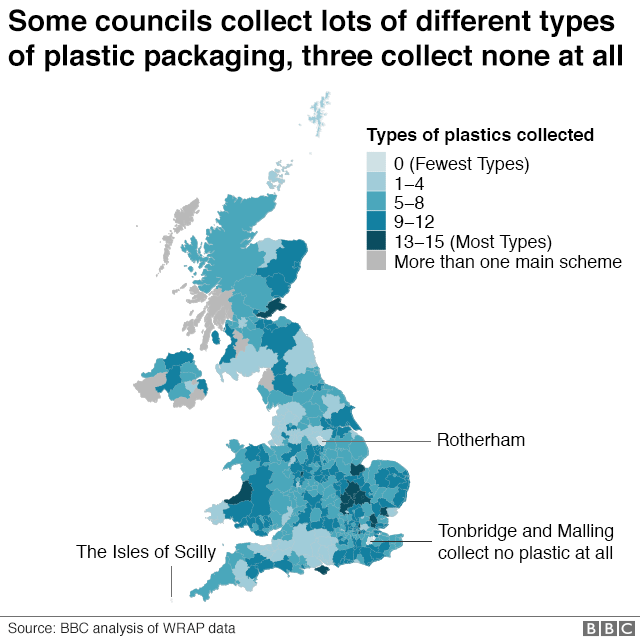
Each council collects their plastic recycling differently. BBC analysis shows there are 39 different sets of rules for what can be put in plastic recycling collections:
- Most collect bottles
- Others collect pots, tubs and trays
- Some collect a much wider range

Around the UK, all four nations are hoping to improve their recycling rates. The review by the government may change the target for recycling in England, but currently the aim is that 50% of waste will be recycled by 2020.
Scotland has a target to recycle 70% of waste by 2025 as does Wales. Northern Ireland has a proposal that 60% of municipal waste is recycled by 2020.
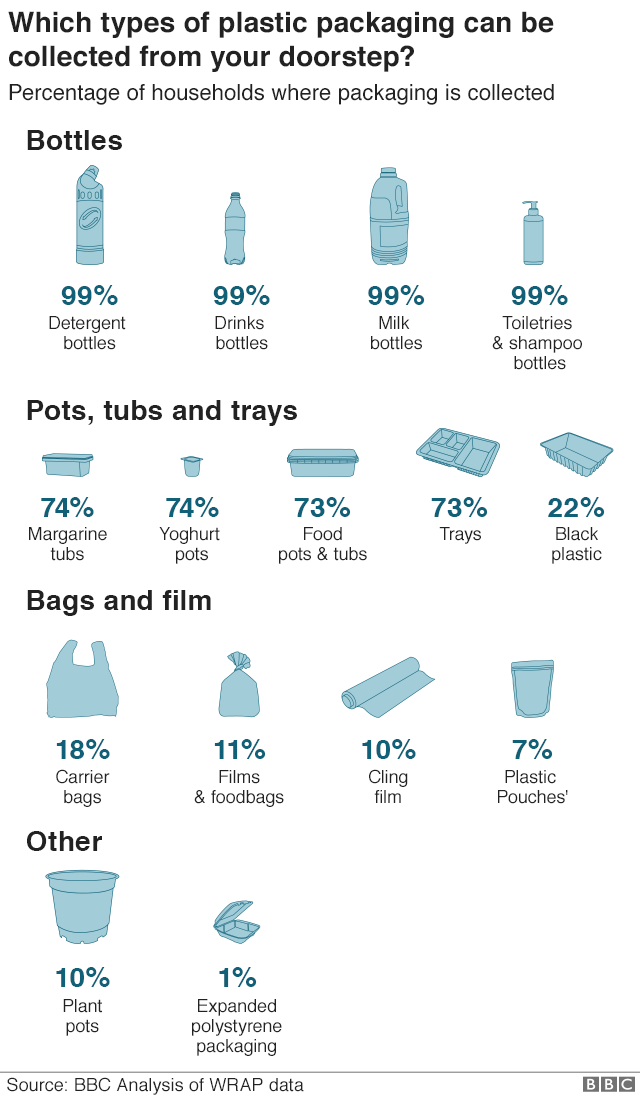
Waste plastic is collected is different ways too:
- Some local authorities collect all their recycling in one bin
- Others ask households to separate their plastics from the rest of their recycling
Councils also employ many different companies to collect and sort their plastics.
And having different recycling schemes in different areas – for example, in some areas you can recycle margarine tubs and in other areas you cannot – makes labelling difficult.
Most people in Britain regularly recycle plastic but almost half have had disagreements at home about what type they can put in which bin, a ComRes poll for the BBC suggests.
And more than a quarter have these disagreements at least once a month.
What to expect from the government’s review?
Of all the things we recycle, plastic is the most complicated. It comes in a profusion of very different types.
Many products carry labels about recycling but some do not. And the labels themselves can be a problem.
Your eye might fall on a recycling symbol but miss the very small print saying the item will not actually be collected from your home.
If you see the phrase “widely recycled” on a packet or carton, it means many councils will take it but not necessarily all of them.
Each of the UK’s local authorities has come to its own decisions about what to accept and what to refuse:
- In Reading, a yoghurt pot can be thrown into recycling
- In Manchester it cannot
- Swindon has plans to join the small band of councils recycling no plastic at all
The government realises the arrangements can be confusing, even irritating. And in England it’s undertaking a review of the whole recycling system.
- Ministers could order manufacturers to use only the types of plastic that are easiest to recycle – but might that lead to higher prices?
- They could insist on labels that everyone can see and understand – but how would that work on tiny pots and bottles?
- A more controversial idea is to get councils to harmonise their plastic recycling systems – but that risks provoking an uproar over local democracy
The desire to boost plastic recycling rates is clear. But every option comes with challenges. The word is, we’ll see the government’s plans in November.
Plastic can often become too contaminated for recycling and have to be sent to landfill or incinerated instead. This happens for several reasons:
- People are confused about what goes in which bin
- People are not always very careful about what they put in
- The plastic is contaminated with food waste
- In areas where all recycling is collected in one bin, one type of waste can contaminate another
Plastic packaging is made from seven different types
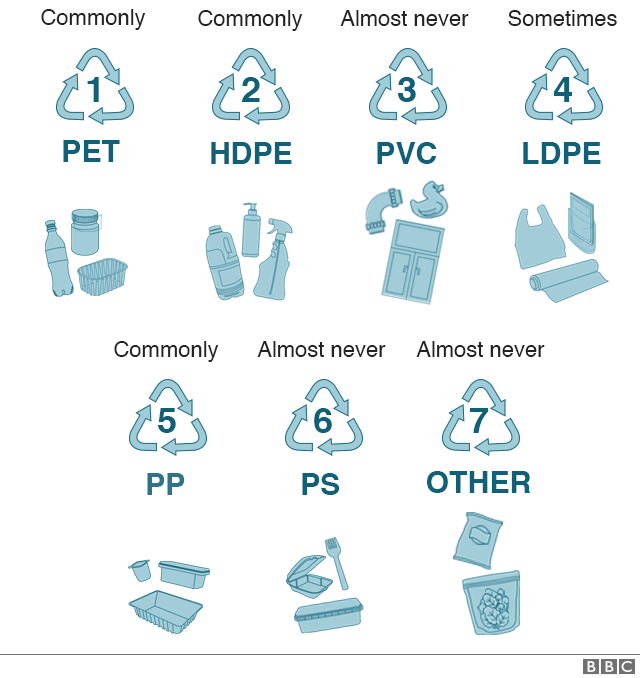
- Bottles are mainly made of PET and HDPE and these are easy to collect and recycle
- Most trays are made from polypropylene and this is pretty easy to recycle too but not all councils have access to the right facilities
- LDPE, used to make some carrier bags and cling film, is easy to process but more difficult to sort and can often be contaminated with food
- Polystyrene, used to make some yoghurt pots and plastic cutlery, is not widely recycled
- PVC makes up small amount of packaging but can contaminate other plastic recycling
- Biscuit wrappers and meat trays can be made from a mixture of many different types of plastic, making them the most difficult type of packaging to recycle
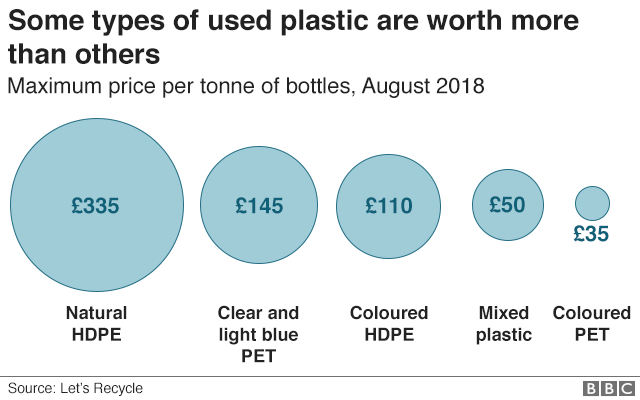
All plastic can be recycled – but it is not always economical to do so.
- Bottles attract the best prices, especially clear ones, which is why almost all councils recycle them
- Coloured plastic is less desirable because the colour cannot be removed, restricting its reuse
- Polystyrene is almost never recycled because there is no market for it
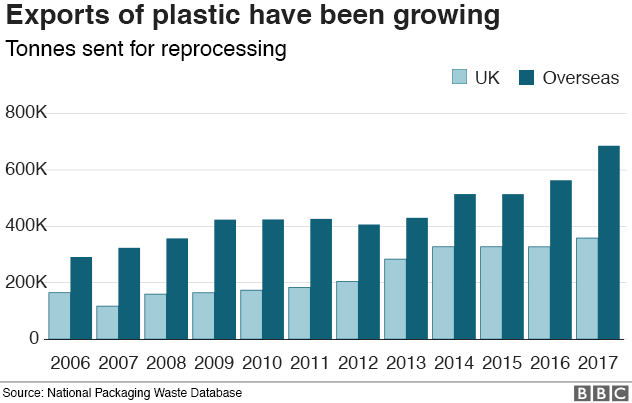
Most bottles will be sent for reprocessing in this country.
But plastic that is less valuable – about two-thirds collected for recycling – goes overseas and this figure has been rising.
Earlier this year, the National Audit Office reported the plastic sent abroad could be highly contaminated, meaning it may not be reprocessed and could end up in landfill or contributing to pollution.
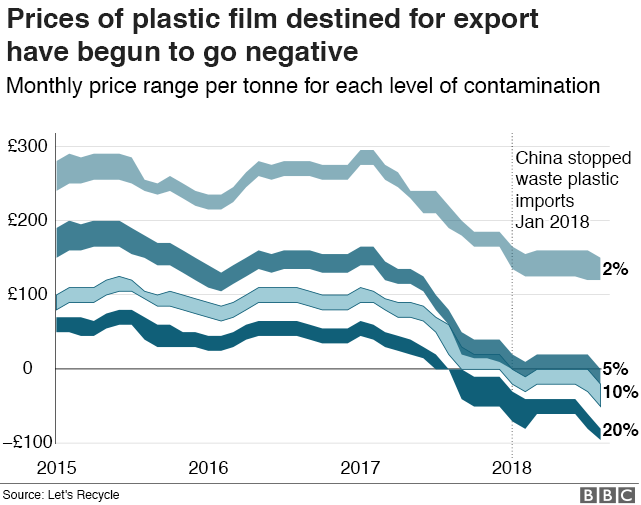
Some countries are refusing to take any more of our waste.
- China and Thailand have banned waste imports
- Malaysia is considering banning imports of waste plastic
These bans are having an effect on the prices paid for waste plastic.
And this year the prices of the more contaminated plastics have fallen below zero, meaning companies are now expecting to be paid to take them away.
Design: Debie Loizou. Development: Eleanor Keane.
We are being jammed, crammed into even smaller spacers and boxed into corners when we try to fight back
My only disappoitment with this comment piece, is that Tom Welsh talks more about cars, that most of us use no more than 5% of the time we own them. Even when he refers to roads, it’s about problems fitting the moving cars on to them.
He does however get on to the auwful boxes we are forcing our young people to put their hearts and souls into and maybe even raise a family in, if then priced out of the market for larger properties. Here’s where the roads come into play, with the narrowness of those now built in residential developments, turning pavement parking into the standard practice.
Comment piece from Sunday Telegraph 9th September 2018
Stop ramping up our daily stress by cramming us into smaller, tighter spaces
Much about modern life seems designed to provoke fury. Sinks in hotel bathrooms are too tiny to fill up even the miniature kettles they provide. Household goods are too complicated to fix without the services of an expensive expert. Now we have statistical confirmation of another failure by design that drives people mad: parking spaces are too small for today’s cars.
This is largely because cars have expanded in size. The most popular models have widened on average by 17 per cent since the late Nineties, to provide more room for passengers and to cram in all the technology that regulation and drivers demand. Roads and parking spaces haven’t widened to accommodate them, however.
Many streets have in fact become narrower to fit in bus and cycle lanes. Dents, scuffs and even bad backs from drivers angling themselves awkwardly from their vehicles are the sad consequences of too-small parking bays. Terrible drivers who feel the need to park across two do little for societal calm, either.
The broader problem is an obsession with rationing space. Britain feels overcrowded partly because the population has grown strongly, but also because the authorities are determined to squeeze as much as possible into as little room as they can, a perverse fixation on ever greater density. This leaves passengers on trains uncomfortable, new-build flats and houses barely inhabitable and much smaller than older properties, and a trip to the shops by car far more stressful than it need be. Ironically, cars are one of the few things that have changed to meet a natural demand for more comfort. Meanwhile, council car parking spaces rigorously stick to the minimum size permitted by law in order to cram more vehicles in.
Policy changes could fix all of this, of course, and release some of the fury that is built into our daily lives. Land is expensive, and should ideally become cheaper. Travel costs on rail are already high, so operators attempt to pack more into commuter trains. But they could avoid proposed measures like the outrageous scrapping of first class carriages, which enable people to escape the packed-in discomfort we are expected to put up with.
But would any of this get a fair hearing today? Politicians and regulators are wedded to three principles that conspire together against public comfort. First is an unhealthy belief in targets, which sees 200,000 homes built a year as a triumph, even if they’re just inner-city box flats and not the family houses people actually want; and which trumpets unusable bays as meeting demand for parking.
Second is a blind faith in regulations, wherein things are designed to meet regulatory criteria, rather than to satisfy consumer demand. Third is a skewed mania for equality – exacerbated by snobbery – in which those who choose to take up more room, whether by buying a family car or wanting a family home, are deemed to be offending against efficient use of space. It isn’t the owners of large cars we should be fuming against
 Roger Gambba-Jones