Local involvement in the NPPF

This afternoons #NPPF DCLG Select Committee – Practitioner agrees to need for transition
by andrew lainton October 17, 2011

In the second session Cllr Gary Porter – one of the practitioners group 4 – was entertaining. Not the sort of cllr you would want to cross at 11.00pm at the end of an exhausting meeting. He sees everything in very black and white terms and gets angry at other views.

He conceded the need for a transition – not just for putting plans in place but for updating plans to include things like parking standards. He also criticised the 20% rule saying the figure should be set locally.

The committee was rather slack jawed at his bizarre suggestion that local authorities should be able to choose from several competing sets of guidance on matters such as how to set housing targets – how could any plan be found sound by an inspector – or not have the decision challenged in the courts – in that set up.

Blog at WordPress.com. Theme by Onswipe.

Eric Pickles won’t be issuing any press release on this!

Media outrage about public sector manager salary increases is “unfounded” according to private sector research published this week.

Income figures from Hay Group’s salary database shows senior public sector employees have not received disproportionate pay rises over the last decade and continue to earn 33% less than private sector colleagues.

The data also shows front-line public servants are now better off than employees in the private sector although the management consultant’s pay experts have predicted this will be reversed as the government’s austerity drive takes effect.

However, Hay Group’s reward information consultant David Smith, said: “Our data shows that the media furore over public pay is unfounded, with percentage rises at senior management level largely identical to those in the private sector.

“Public sector managers should arm themselves with reliable and robust figures, particularly around the value of the total package, to help support their decisions about pay in the public domain.”

Communities secretary Eric Pickles has been a particularly vocal critic of “exorbitant” pay deals for town hall chief executives. Last year, he told the Daily Telegraph: “There is widespread public concern about soaring salaries in local government, with chief executives moving from council to council like football managers.”

Hay Group data for senior managers in the private and public sectors shows senior pay in both the private and public sectors has risen in line with each other between 2000 and 2011.

While private sector senior salaries rose by 62% to a current average of £176,498, public sector salaries rose by 61% to the current average of £118,673.

LGC’s Salary Tracker research, published in July, showed the average salary of chief executives appointed in the previous 12 months was 18% lower than their predecessors’ salary.

Hay group’s data shows a different trend for front-line and support staff in the public sector who now earn more than their private sector colleagues after average public sector salaries rose by 13% more than private sector wages

In 2000 average public sector salaries were £12,035 compared to the marginally higher £12,652 private sector average.

After more than a decade of Labour government public sector spending policies and following a drop in private sector wages since the recession hit in 2009, that position has switched with the average public sector salary of £18,027 compared to £17,332 in the private sector.

However, Hay Group predicted private sector salaries would soon be outstripping public sector salaries at all levels.

Mr Smith said: “The public sector was not directly affected by the global economic downturn, unlike the private sector. But with government austerity taking hold, many employees are beginning to feel the impact of cost cutting in their wallets.

“With pay restraint taking hold in the public sector and pensions set to become a less valuable benefit, we predict that the salary gap will start to widen at all levels in the next couple of years.

“In these tough times, the challenge for the public sector will be to contain costs yet still be able to attract and retain key talent.”
A timely warning to all of us

Here’s an interesting piece (for those of us interested in planning issues that is) from a planning website where local government planners pose questions to colleagues. It should serve as a timely warning to any council concerned about how to deal with neighbourhood plans. For those who don’t wish to read the whole thing, it’s all about neighbourhood plans being used by some parties as a way of promoting their own vested interests.

Having found no interest in these at all, suddenly here in (location deleted for obvious reasons) we’ve got 3 suggestions coming forward and need to act fast if we are to bid for CLG grant – assuming they could be runners.
What worries us is that they all propose housing developments that run counter to our recently adopted LDF (Core Strategy, Development Policies and Allocations DPDs) and therefore could fail at the first hurdle of not being in general conformity with the strategic policies of the local plan.
Being a large rural area we have a sustainable settlement hierarchy in our core strategy to promote development in the towns and larger villages with a good range of services, etc and we severely restrict new housing development elsewhere, including small villages. We now have a small village of 20 houses with a supportive parish council (covering a wider area) wanting to promote 2 dwellings for the families of well respected local business people, whose planning applications have previously been refused.
So only 2 dwellings – hardly a general conformity issue you might think? but it could be repeated and it undemines our strategy of delivering sustainable development, yet is probably in line with national policy.
What do you think? Anybody else proceeding with a neighbourhood plan for 2 dwellings? The other 2 proposed neighbourhood plans relate to secondary service villages with no housing allocations and tightly defined development limits and developers wanting to promote relatively large sites.
One sites was even rejected for allocation by the LDF Inspector last year. It’s not certain they would get 50% community support, but with a referendum not until the end of the process it’s an unknown and potentially a waste of money.
In one village several members of the parish council have direct interests in the site promoted, so presumably couldn’t vote. Is anybody else struggling over how to proceed with neighbourhood plans that don’t comply with the LDF and have PC members with vested interests?

Swan Street closure proposal

I recently wrote to LCC (link below) suggesting that they might like to extend the closure of Swan  Street in Spalding for a trial period, in order to gauge the long term effect.  The idea would be to prove, if proof were needed, that any such closure would be to the benefit of the town, by helping traffic to flow better and by reducing the tailbacks that clog up Winsover Road on a regular basis.

Swan St close

I have seen one letter in the press from a Spalding resident and would like to suggest that it would do no harm if a few more were to make their views known on the subject.


Steppingstone Bridge Spalding flooding

A bit more information for residents regarding the flooding problem the bridge suffers during periods of heavy rain.  Below is a link to a letter received from LCC.  As you will see from reading this, the issue of who does what on the bridge is far from straightforward.  I will do my best to make progress on this before the freezing weather arrives again this year.

Bridge flooding

Time to target MPs on the NPPF

With the likes of Francis Maude thinking he can say what he likes about those have the temerity to challenge the National Planning Policy Framework CONSULTATION document, perhaps the emphasis should now shift towards individual MPs.
Members of those organisations currently being slated by various CLG ministers and others who should know better, should now start filling their MP’s postbags with letters of protest at the intemperate and now insulting language being used against those who are exercise their democratic right to comment on a government policy document that is, after all, only out for consultation.
That is of course unless the consultation exercise is actually nothing but, to quote Francis Maude, the new foul-mouthed fishwife of Westminster, ‘bollocks’.

David Cameron advises us to use local policies to fill NPPF gaps

David Cameron so obviously doesn’t understand the way the planning system works and has not read the NPPF. He appears on the Andrew Marr show this morning, trotting out the propaganda fed to him by those who have been promoting wholesale changes to the planning system.

More interestingly, he suggested that, just because something isn’t ‘specified’ at the national level, such as the control of roadside advertising hoardings, this doesn’t mean it can’t done at the local level. Taken to it’s logical conclusion, this could see the thousands of pages that will been thrown on the bonfire, by the introduction of the 50 odd pages of the NPPF at the national level, replaced by thousands of pages of planning legislation being created at the local level – some improvement to an over complex system that will be!

I hope all of those involved in the producing planning policies at the local level take note of this steer from the Prime Minister. I read this as: Where the National Planning Policy Framework is, out of date, indeterminate or silent on a subject, a local policy is to be used to fill the gap.

An American abroad

Notwithstanding his role as the president of the Campaign for the Protection of Rural England (CPRE), Bill Bryson speaks with great wisdom on the potential damage the NPPF could do to the English landscape.

If government ministers won’t listen to its own people – Francis Maude, a supposedly clever man at the heart of government, describing their concerns as ‘bollocks’ – perhaps they will listen to an American, who has personal knowledge of the damage done to his country through uncontrolled development.

Pickles talks his normal rubbish

Bizarre performance from Eric Pickles on BBC TV this morning. Constantly referring to refuse as what sounded like ‘refuge’. Also making an extremely poor pun with the comment, ‘we are treating people like adults and…… not like rubbish’, get it? clever – NOT!

Notice the sudden use of ‘we’ by Pickles in the last bit? Eric Pickles is constantly criticising local government, yet when it’s good news, in his opinion, it suddenly becomes we this and we that. Hypocrisy come so easily to this man, he probably doesn’t even realise he doing it. Actually, on second thoughts, he knows exactly what he’s doing, because he’s all about the soundbite.

Steppingstone Bridge Spalding

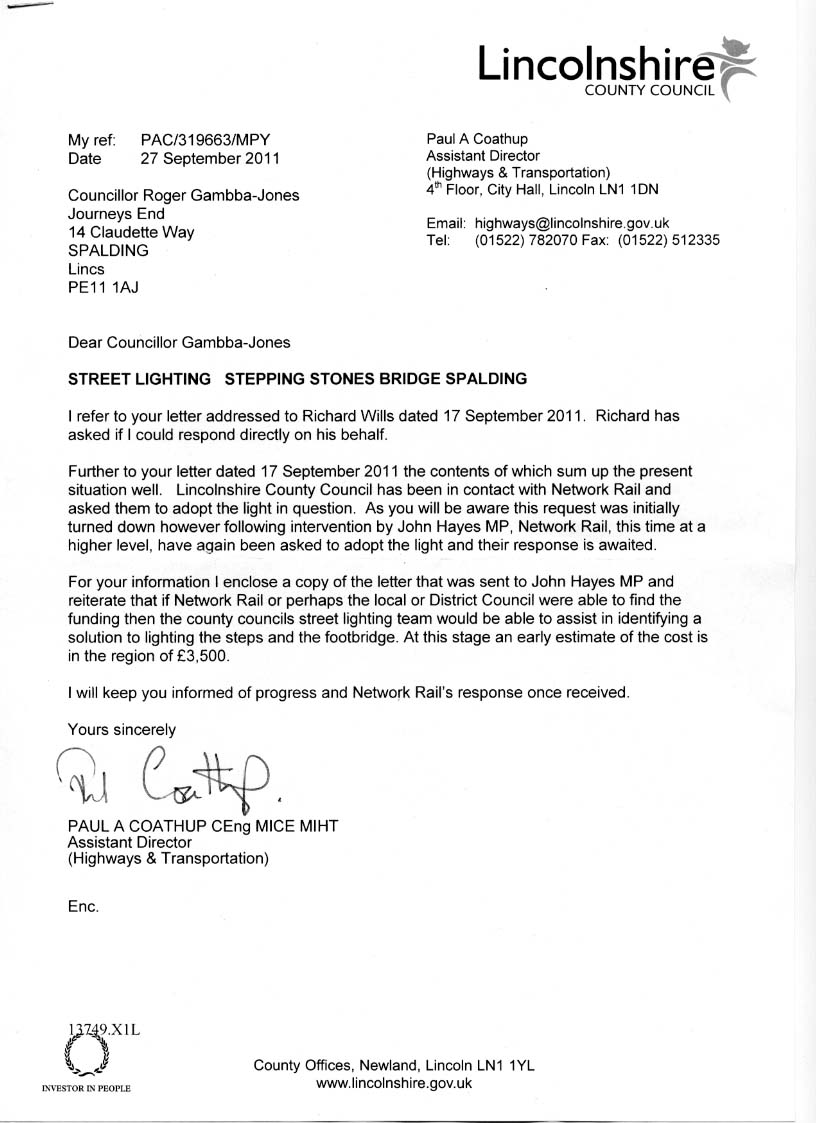
Minor progress of sorts on the lighting issue, although sadly no actual light at the end of the tunnel, because it still doesn’t work!  At least I now know that it is a waste of timing asking either Network Rail or LCC to fix it.

I received a letter from LCC today, giving me some information on the situation regarding the lack of a working light on the bridge.  It would seem that, despite being the county council and actually having responsiblity for the footpath that crosses the railway line via this bridge, LCC can’t get any more sense out of Network Rail than the rest of us.  It’s difficult to believe that a company that relies so heavily on public money for its survival, can be so arrogant when it comes to addressing the concerns of members of that public.

Below is a copy of the letter I received today along with one sent to John Hayes MP. 

Bottom line is, if I can find £3,500, the county council is willing to install and maintain lighting on the bridge.  I will now be seeking some support from other Spalding members at the next Spalding Town Forum.  This support could be by tapping in to the ward budgets, or maybe by seeking some help from the Spalding Power Station community fund.  Watch this space.