The way forward, but is anybody listening?

It’s unfortunate that, even when there is agreement that unitary is the best and most cost effective way to provide local government service, politicians still waste time and energy protecting their individual power bases.
I’ve yet to fathom Eric Pickles’s reasoning for sticking his oar in as soon as he got in to office in 2010, and stopping those that were in train. Possibly pre-election whinging, from Conservative councillors in those areas, fearful that they would get the boot from the electorate, was the cause of this early interference, something that has continued at a pace.

Too much time and effort is wasted by politicians protecting their own interests under the pretence of championing the interests of those who elected them. The vast majority of taxpayers care little for which part of local government provides the services they need to access. What they do care about, is how much their council tax bill will be every April. Yet despite what should be blindingly obvious, lower tier politicians spend their trying to pass on the cost to the upper tier, or refusing to work with that upper tier, because they can nothing in it for them.

As far as the taxpayer is concerned, a saving in their council tax, is a saving in the council tax, no matter where it comes from. Put another way, if a district council works with their county council, to help that county council save money, then that is as much to the credit of those district councillors as it is the county councillors, if not more. Unfortunately many councillors at the district level can only see the numbers in their own budget and refuse to acknowledge any wider savings that are being made.

However, it’s not just a case of making everything unitary and all will be well in local government. I’ve no idea how well or badly local government is working within the East Riding of Yorkshire. However, given that it’s the largest unitary in England, is divided into 26 wards and has a total of 67 councillors (Lincolnshire County Council has 77 councillors, covering only county council services) it would be very interesting to know and I don’t mean just what the council and it’s politicians would like you to believe.

Would Lincolnshire work as one large unitary? Personally, I don’t believe that it would, but that’s just my opinion. I’m always willing to be persuaded differently based on evidence that unitary councils such as East Riding of Yorkshire Council is serving its rural council taxpayers well.

Copied from the Local Government Chronicle. From a series of articles written by a senior local government officer, who remains anonymous.

Inside Out: Unitary is strength
5 March, 2014

I have always believed unitary is strength when it comes to local government. I was really pleased when it was recently reported that Labour is looking to embrace it.

I was less pleased with the government’s response. They ‘played politics’ with it rather than responding to the issue.

Granted, the move to unitary councils has never been smooth.Councils disappear, people lose their power and influence, places can feel they lose their identity, and there are always transitional costs. However, the advantages when unitary government is established far outweigh the transitory downsides.

I have worked for a district that became a unitary council, a county unitary and a district unitary. One size does not fit all circumstances. It seems to be assumed these days that unitaries should always be based on counties. This is a disservice to the strength and professionalism of district councils and will be a barrier to change in some circumstances.

There are three secrets to make moving to unitary local government successful. First, the area covered needs to make sense to residents. My hometown was moved from Lancashire to Merseyside in 1974. I still address Christmas cards to my relatives using Lancashire, 40 years later. The boundaries of unitaries need to be determined locally.

Second, there needs to be strong national leadership. The whole of England needs to be covered by unitary government. Unless this is made clear, local vested interests will fight change and drive up costs.

Finally, it needs strong local leadership, seeking consensus on change and then managing the change well. There are savings and service improvements that can be unleashed by bringing together tiers of government, but they have to be realised. They don’t happen on their own.

Given the financial struggle matched with rising demand, no element of transformational change can be dismissed. My heart sinks when I think of yet more organisational change. But maybe it needs such a shake-up to unlock the other changes we need to embrace. Unitary is strength.
Labour has a double whammy in store for local government

20140301-142042.jpg

It seems that Labour is willing to throw local government in to further turmoil, should it regain power at the next general election. The Electoral Society has published a document written by a Labour lobby group, promoting proportional representation voting as the way to re-energise democracy in this country.

Labour is also revisiting the issue of two tier local government, something that will effect shire areas such as Lincolnshire. This would probably a good thing from the council taxpayers’ perspective, as it would remove some of the confusion and frustration they experience when dealing with two tier local government. However, it’s by no means clear that this is intended to make democracy more accessible and straightforward for the taxpayer, as opposed to just making it easier for Labour to gain power outside of their current urban strongholds.

Reading the document, it would appear that Labour are concerned about running out of the foot soldiers they need to get re-elected. As many of these foot soldiers come from those standing in local elections, the Party appears to have a cunning plan to create more Labour councillors (foot soldiers) across the country.

This sudden enthusiasm for PR could of course be intended as a sop to the Liberal Democrats, just in case Labour needs to go into coalition with them, to freeze out the Conservatives in 2015, if plan A, an outright majority, doesn’t come to pass.

Perhaps the Labour Party really does believe PR is the way forward and are seeking to collude with the LibDems to foist it on to the British public via the back door, or rather from the bottom up. Using local government as a guinea pig, they will impose it on to councils, already buckling under the weight of doing more than their bit to help reduce Labour’s deficit legacy. Looked at cynically, one could suggest that the extremely low turn out in local elections, makes councils an easy target for this experiment and that any outcry from existing councillors will gain little, if any, support from an apathetic public.

There are many reasons why we should be extremely wary of PR at the local government level. There are a plenty of examples of councils that are in a form of leadership limbo, due to being in no overall control, because no single group has the majority. Even when there is what might be called a controlling group there are examples of councils being controlled by single issue groups, rather then one with any particular political allegiance. Boston Borough Council had something called the Boston Bypass Party until 2011. In both cases, this effectively leaves a council with no political direction, or leadership and being run by its officers.

I would also suggest that PR will inevitably lead to the introduction of professional councillors. The PR system means that a councillor representing a particular minor group, gets allotted a seat in a division well away from where they are actually living. As such, they are likely to need a far greater level of administrative support and spend a much greater amount of time and effort dealing with issues. They will also claim a much higher level of expenses and ultimately, find themselves needing to become a ‘full time’ councillor.

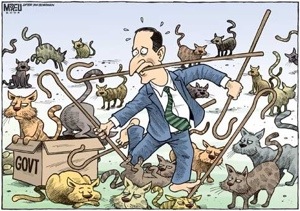
The prospect is, that should Labour gain power, either totally, or in a coalition, all councils will become single tier across England. Additionally, in many areas the council will be in the political control of what is politely called, rainbow alliances, but could soon be more accurately be described as, ‘a herd of cats’.

The Labour Party position on unitaries

A senior shadow minister has hinted that Labour would revive unitary local government reorganisation.

Shadow chief secretary to the Treasury Chris Leslie said in a speech to the Social Market Foundation thinktank that the government should work with councils that were already promoting unitary schemes, such as Leicestershire and Warwickshire.

“The previous Labour government helped local government to make efficiency savings. So we gave local authorities powers to merge and change their boundaries and in 2009 a series of local authority reorganisations brought together district and county councils and created new unitary bodies,” he said.

“Other changes in Devon, Exeter and Norfolk were in the pipeline but this government stopped those in their tracks and are continuing to resist local authorities’ proposals to unitaries.”

The earlier generation of county unitaries had delivered savings per head through efficiencies of £46 per person a year in Cornwall, £52 in Central Bedfordshire, £66 in Shropshire and £91 in Northumberland, Mr Leslie (pictured) said.

He said: “The government and Whitehall should be doing more to empower councils, that see from the bottom up the benefits of collaboration and are actively debating whether to come together. This should also include small district councils that are facing the greatest financial pressures of all.”

Mr Leslie, who was a junior local government minister under Labour and ran the New Local Government Network thinktank before he returned to Parliament in 2010, said he and shadow communities and local government secretary Hilary Benn would “continue to explore the full range of options to support councils as they share services, pool budgets, and choose to collaborate and integrate further”.

Local government minister Brandon Lewis contrasted Mr Leslie’s speech with reported remarks in which Labour policy co-ordinator Jon Cruddas appeared to rule out reorganisation.

He said: “The Labour Party are in disarray on unitary local government restructuring, ruling it out one week and calling for it the next.

“By contrast, the coalition government is very clear that restructuring would be expensive, divisive and time-consuming, diverting time from improving frontline services and locally-led co-ordination.

“Labour is motivated by partisan politics, doing what they think is best for Labour self-interest rather than what’s best for the country.”

Mr Leslie also said that English local government was “enduring eye-watering reductions in revenue support grant which are threatening basic activities in social services, housing, environmental services, libraries and local voluntary bodies”.

Labour’s Local Government Innovation Taskforce would examine how to orientate services “around users rather than necessarily sticking with the old – and expensive – bureaucratic way of working”, he said.

Minimum room size standards – if you can afford it.

This extract from the DCLG press release, really gives me the willies, as my old dad used to say. I don’t have a problem with making sure homes work for older people – as I will be one, sooner than I wish to admit – and disabled people, so they should be. What I don’t like and what makes me both suspicious and, as usual, extremely cynical, is the bit in bold. How can one local authority have different room size needs, compared to another? Are there any secret pockets of pygmies or giants DCLG know about and we don’t?

Or is this DCLG speaking out of both sides of their collective mouths? They give you an opportunity to make an improvement in your policies, but only if you are willing to invest in proving that it is justified for your particular area? This is of course standard practice in Local Plan preparation. Producing the evidence required to justify NOT providing enough housing land, being the most obvious one. Gypsy and Traveller sites, leisure, public open space requirements and road infrastructure, are all evidence based requirements that are totally appropriate, as somebody has to pay for them and they should not be required just for the sake of it – but room sizes, really?

This statement is clearly designed to con people into thinking that DCLG are, to quote Eric Pickles, “on the side of hard working taxpayers”, whilst at the same time discouraging cash strapped councils from actually doing the evidence gathering required. If DCLG were genuine in their wish to see our rabbits hutch homes consigned to history, they would simple produce a national standard to be applied in the same as the building regulations are. Score another one for the vested interests of the planning industry me thinks.

The Department for Communities and Local Government (DCLG) said the administration was inviting views on “minimum space and access standards that would allow councils to seek bigger homes to meet local needs, including those of older and disabled people”.

Early figures reveal cuts of 16% for some councils

Copied from Local Government Chronicle online
8 August, 2013 | By Ruth Keeling

Councils forced to revamp their savings plans after early sight of their individual funding allocations revealed cuts as high as 16% in 2015-16.

The indicative allocation figures, released last month by the Department for Communities & Local Government, have caused alarm within local government which had expected cuts of around 10%.

Councils suffering the deepest cuts have warned they could now be pushed towards a ‘doom’ scenario where services would have to be closed and vital growth plans ditched.

The extent of the cuts is the result of a series of ‘top slices’ taken from councils’ revenue support grant to fund central government programmes, such as the ‘Dilnot new burdens’ budget announced by the chancellor last month.

The hardest hit councils have been told their funding settlement assessment could fall by 16% in 2015-16. Only two authorities, Wokingham BC and Surrey CC, face cuts of less than 10%.

North Kesteven is among 69 councils facing a 16% cut. Deputy chief executive Alan Thomas said the authority might have to rethink its growth priorities. Its previous £1.75m saving plan will now have to be increased to £2.25m, equivalent to 15% of its £11.5m a year net budget.

Mr Thomas said the Conservative-run council might also review its existing policy of reserving New Homes Bonus payments for infrastructure spending. “I think we are going to have to take a different view of that now and use quite a bit of that New Homes Bonus to support core spending, otherwise we won’t be able to balance the books,” he said.

The authority was already reeling from the “absolutely devastating” government announcement that up to 35% of New Homes Bonus income will be handed to local enterprise partnerships from 2015-16, he added.

Districts and inner London boroughs were the hardest hit group of councils in 2015-16, facing 15% cuts on average. Outer London boroughs, metropolitan districts and unitaries face reductions of 14%; counties will see an average reduction of 13%.

David Huxtable (Con), cabinet member for resources at Somerset CC, which faces a 15% cut, said the reduction matched its most pessimistic plan and would have “a huge impact on services”.

He said: “We will have to stop doing things… We will only be looking after statutory services.”

While the early release of individual figures for 2015-16 has been welcomed, treasurers bodies are due to meet senior civil servants to discuss missing details in the coming months.

Brian Roberts, former president of the Society of County Treasurers and Leicestershire CC director of corporate resources, said: “Having these before the summer recess is very helpful. But there is still a lot of uncertainty.”

Local government has another 10% to find – for starters

I’ve borrowed this from the article published in today’s Sunday Telegraph – thank you ST. The further 10% cut in funding to local government, has been on the cards almost since the last cuts were announced, so that’s not the interesting bit.

What is interesting, is the Telegraph’s assessment that this is a defeat, I assume for the DCLG and Eric Pickles, as that couldn’t be further from the truth, given Mr Pickles constant eagerness to please his bosses. Let’s not forget, he was the first minister to settle, if that’s the right word for it. It’s more likely that Pickles was actually waiting outside the front door of the Treasury on the first day of this spending cuts round. He was probably like one of those over excited shoppers on the first day of the January sales, but in reverse. Instead of grabbing the bargains, as he burst through the doors, he leapt in, gleefully spreading local government grant funding around like confetti.

Dept of Communities and Local Government – Budget £25.92bn – Minister Eric Pickles

Battlegrounds Local authority budgets will bear the brunt of savings. The Local Government Association warns that children’s centres, museums, roads and bus fares will suffer cuts in the range of 10 per cent to the money local authorities get from Whitehall. Louise Casey, head of the Troubled Families Unit, is said to be behind moves to “take over” billions of pounds of spending from other departments.

Outcome – No deal yet. – Verdict Defeat

Crisis leads to council tax referendum call

Copied from Local Government Chronicle online
30 May, 2013 | By Mark Smulian

Herefordshire Council could become the first to hold a council tax increase referendum after an emergency meeting over a budget crisis.

This followed a review by incoming chief executive Alastair Neill, which found the budget set only in February contained errors and weaknesses.

It must now save an extra £8.4m this year and make 290 job cuts, against some 120 originally intended.

The council has saved some £21.1m over the last two years, and must save a further £32.2m over this year and the next two.

Mr Neill’s review found areas in the February budget “where the plans were not sufficiently resilient and [where] additional savings need to be made to ensure that the council delivers its plan within its budget”.

This included £1m of procurement savings which had “slipped and needed to be tackled” and £3.8m of learning disabilities grant which had in effect been counted twice.

Tony Johnson (Con), the council’s new leader, said: “We are facing a very challenging time over the next few years and as such we need to consider alternative approaches to delivering some of our services.

“Inevitably, non-mandatory services must bear the brunt of the cuts and although this will unfortunately involve job losses, it does not automatically mean the loss of services.”

The extraordinary council meeting agreed that the cabinet would consider holding a referendum to increase the 2014-15 council tax above whatever cap level is imposed.

Some 25% of Herefordshire’s income comes from council tax, which it had frozen from 2011-13. It increased it this year by 1.9%, equivalent to £1.5m.

Cllr Johnson said: “We must consider the possibility of raising council tax responsibly and proportionately across the county, as we begin to consider next year’s budget.”

Before doing so, he wanted to gauge whether residents “would be prepared to vote in favour of raising taxes to protect the county’s vital services”.

The coalition dropped Labour’s council tax cap, but substituted a system where tax could be raised above a nationally defined level only following a local referendum.

No council has yet held such a referendum, fearing both the cost and the likely outcome. In Herefordshire’s case a referendum would cost £100,000 to conduct.

In a joint statement with Unison, Herefordshire said it had agreed to reduce from three to two the number of days of unpaid leave to be taken during the Christmas period and to increase redundancy terms from the statutory minimum to 1.5 times that level.

Unison would prefer to keep in-house provision but will engage “fully in consideration of alternative business models that may be required in areas of service, where the council has to reduce or withdraw funding”.

DCLG does a high speed u turn

Copied from LGC on line
8 February, 2013 | By Ruth Keeling

Almost thirty rural councils which were this week awarded funding to help deliver services in their sparsely populated local areas have now been told they will receive nothing after all.

Local government minister Brandon Lewis (Con) announced £8.5m funding for 113 councils as part of the final local government settlement, but data issued on Monday was reissued on Tuesday with changed allocations for every council on the list.

Twenty nine authorities informed of the grant on Monday were told on Tuesday they would get nothing, while six new authorities have been added to the list. Of those remaining on the list, some have lost 90% of the original allocation while others have seen their grant more than quadruple.

LGC understands a number of councils have contacted the department for an explanation but have not received any information.

Graham Biggs, chief executive of Sparse, part of the Rural Services Network which campaigned for extra funding for rural councils, said DCLG had not explained why the change had taken place.

“We have been inundated with queries as to what is going on,” he said. “But we are in a position of not being able to answer them.”

One finance director from an authority which had lost out in the second list described the reissue of the allocations as “yet another example of total ineptitude in DCLG”.

A DCLG spokesman admitted its allocation list for the sparsity fund had been “temporarily incorrect”. She added: “As soon as we realised this – within 24 hours – the correct version was put on the website and councils were informed.”

In total, 58 authorities gained something or were added to the list while 68 lost funding or were removed from the list altogether.

The six authorities added to the list were Ashford BC, Boston BC, Carlisle City Council, Harrogate BC, Scarborough BC and West Berkshire Council with grants ranging from £3,600 to £24,000.

Authorities who were already on the list issued by the Department for Communities & Local Government but now have bigger grants include Eden BC which saw the biggest increase of 484%, with an allocation which has gone from £12,000 to £67,000 within a day.

Authorities who have lost their allocation completely include Oxfordshire CC which had been set to receive £465,000 to the Council of the Isles of Scilly which had been allocated £4,000 – see table below.

Of those who remain on the list, significant losers include Cambridgeshire CC whose allocation was cut by 91% from £342,000 to 32,000 and Bassetlaw BC which lost 95% from £13,000 to £649.

For full details of the new and old allocations and the difference between them see LGC’s data table.

Councils losing 100% of allocation
Original allocation £m
Oxfordshire 0.465
Durham 0.224
Cheshire East 0.205
Central Bedfordshire 0.160
North Somerset 0.144
Isle of Wight Council 0.109
Cambridgeshire Fire 0.038
Tendring 0.027
South Oxfordshire 0.019
Sevenoaks 0.019
Mid Sussex 0.018
Tonbridge and Malling 0.018
Lewes 0.017
East Hampshire 0.017
Test Valley 0.017
Dover 0.016
Durham Fire 0.016
Waverley 0.016
West Lancashire 0.014
Stroud 0.014
Lichfield 0.014
East Dorset 0.014
Tandridge 0.013
Rushcliffe 0.012
High Peak 0.011
Tewkesbury 0.011
North West Leicestershire. 0.011
South Bucks 0.010
North East Derbyshire 0.010
North Warwickshire 0.008
Isles of Scilly 0.004

Note: South Holland figures are:
New Allocation £m Previous Allocation £m Difference £m % change
0.016 0.013 0.003 25%
Makes you wonder why they bothered

READERS’ COMMENTS (1)

patrick newman | 8-Feb-2013 5:20 pm

If you think DCLG is in a poor way just wait until this unprotected department is assaulted by Osborne’s next cuts while Eric Piffle holds his coat and cheers him on.
Unsuitable or offensive?

Pickles defends his tough love approach

If it wasn’t so bloody infuriating to read such utter b******ks from this blustering windbag, it would be comical. Promoting his vindictive and spiteful sound bites as ‘tough love’, hopefully will attract the ridicule it deserves from all corners of local government. Disappointingly, the editorial page of the Daily Telegraph will be falling over itself, in the next day or two, to praise this latest guff.

Copied from Local Government Chronicle online
4 February, 2013 | By Ruth Keeling

Communities secretary Eric Pickles has professed his “love” for local government, praised it for doing a better job at cutting the deficit than the rest of government.

The declaration came after a tumultuous few weeks during which more than 30 Conservative council leaders wrote a joint letter of complaint to the prime minister warning of a “fractious relationship” with ministers.

Speaking at the New Local Government Network’s annual conference, Mr Pickles declared: “I love local government.

“Sometimes I do take liberties in trying to push you on…but it is on the basis of a loving relationship. I just want you to do a little bit better.

“I am there cheering you on, I want you to do better and you can do better.”

He added: “Local government has been absolutely outstanding in dealing with the deficit. If other bits of government had shown your resolve we would be in a better position.”

Mr Pickles was responding to a question from Peter John (Lab), leader of Southwark LBC, questioning the mixed messages from ministers about the role of councillors.

“Two years ago you were questioning the need for a chief executive, but then two weeks ago [former housing minister] Grant Shapps said we were the equivalent of scout leaders. Are we volunteers or proto-chief executives?”

Cllr John was referring to a BBC interview during which Mr Shapps argued that an increase in councillor allowances in recognition of their time and career sacrifice would be inappropriate as they were “volunteers”.

Mr Shapps’ comments has sparked an angry response from councillors, especially as they came shortly after local government minister Brandon Lewis had called for councillors to be barred from the Local Government Pension Scheme. Mr Lewis has also argues they were “volunteers” but not “professional, full-time politicians”.

Mr Pickles’ protestations of love for local government were dismissed by shadow communities secretary Hilary Benn whose speech to the conference came immediately after Pickles’.

“It is no good asking local government to take on this challenge [of falling funding and rising service demand] if at the same time the people expected to take on the challenge are criticised, patronised and belittled.

Prepare for ‘widespread financial failure’, ministers warned

Copied from Local Government chronicle online
30 January, 2013 | By Ruth Keeling

The government must establish mechanisms for dealing with “widespread financial failure” in local authorities, the National Audit Office has warned in its first assessment of the sector’s financial robustness.

A report by the watchdog said Whitehall was failing to understand the combined effects of its policy reforms on councils’ finances. Despite councils having “generally coped well” with the significant cuts made to their budgets, the NAO’s head Amyas Morse warned that councils would struggle to absorb further cuts over the next two years without reducing services.

“The [Department for Communities & Local Government] will need to be able to detect emerging problems and respond flexibly and quickly,” Mr Morse said.

Margaret Hodge, the Labour chair of the public accounts committee, went further, describing herself as “alarmed” by details in the NAO report and describing the lack of transparency over the scale of the cuts ministers had made to council budgets as “extraordinary”.

“The department needs to make clear what it will do if multiple authorities fail financially,” she said.

DCLG ministers and officials will be expected to appear before the committee’s MPs to answer questions on how they have assessed risks and intend to monitor for failure.

“My committee will expect the department to provide us with a clear statement on the financial impact of the government’s changes to authorities’ funding and what this might mean for local services,” Ms Hodge added.

The NAO report details several significant funding and policy changes that have heightened risk and uncertainty for local government.

And in a key finding, it claimed some Whitehall departments had failed to provide DCLG with costed estimates of the effects of their policies on councils.

The watchdog’s researchers discovered that the Department for Education’s 2010 spending review submission failed to include an estimate of aggregate cost pressures or possible cost savings across children’s services.

This omission resulted in DCLG assuming cost pressures on children’s services would be no greater than inflation over the spending review period.

The NAO also discovered that Whitehall departments lacked data on how policy reforms would hit different regions.

Research by the Association of Directors of Children’s Services last year revealed that demand for services had not only gone up – meaning service costs outstripped inflation – but also that geographical cost variations ranged from -30% to +100%.

LGA chair Sir Merrick Cockell said: “It is concerning that the departments examined by the NAO had not fully scoped the demand for and cost of delivering services to different areas and that not enough effort was made across Whitehall to assess what savings were possible before cuts would start eating into frontline services.”

Speaking as the government embarks on a new spending review, Sir Merrick called for assessments of cumulative impact of changes to become “a basic feature” of future government decisions.

DCLG did not respond to the specific recommendation of the NAO report but said: “Every bit of the public sector needs to do its bit to tackle the deficit left by the last administration, including local government which accounts for a quarter of all public spending. Councils need to do their bit to deliver sensible savings, and in turn, protect frontline services and keep council tax down.

“Our broader local finance reforms will reward councils which promote local jobs and enterprise, driving economic growth and making councils less dependent on Whitehall handouts.”

A Department for Education spokesperson said: “Local authorities know best how to meet the specific needs of their communities. That is why we have removed ring-fencing from a number of grants so that local authorities have more freedom to spend their resources where they are needed most – on disadvantaged children and families.

“We are working with local authorities to consider the possibility for efficiencies in major spending areas.”

We hope you enjoyed the above article. To get unlimited access to all articles on LGCplus.com you will need to have a paid subscription. Subscribe now to save yourself £100 off the standard subscription rate.

Tory leaders warn PM of ‘fractious’ relationship

Copied from Local Government Chronicle online
23 January, 2013 | By Ruth Keeling

Conservative council leaders have written to the prime minster warning that a “retrograde tendency towards greater centralism” and “constant criticisms” by ministers have left local activists “angry” and possibly unwilling to help the party win the next general election.

More than 30 county and unitary leaders have warned David Cameron of an “unhelpfully fractious relationship” between the local and central arms of the party and called for a “new start” to ensure the party does not lose in 2015.

The letter, marked “private and confidential” but seen by LGC, lists a range of issues which have angered Conservative councillors including the bypassing of councils in favour of local enterprise partnerships, constraints on council tax powers as well as proposals that “volunteer” councillors should not receive a pension.

“It is not only the substance of such policy but also the nature and tone of constant criticisms of their work by Conservative ministers which is most worrying,” the letter said.

“We are open to genuine feedback where it can be evidenced that we have fallen short in some way. Our issue is with ill informed and anecdote based general criticism and sometimes highly inaccurate personal attacks.”

The letter makes prominent mention of local government minister Brandon Lewis and Conservative party chairman Grant Shapps’ comments that councillors were volunteers, questioning their eligibility for pensions and larger allowances, but also contains a list of policies and statements from ministers covering areas such as education, business and media.

Local government was blamed for a number of problems, from poor education standards to a lack of house building, with “little or no evidence”, the letter said. In one example, the letter said local government had been blamed for the slow roll out of high speed broadband at a time when councils were “immensely frustrated by some six months of delay in [the Department for Culture, Media & Sport] in obtaining EU state aid clearance”. However, this aspect of the delay was “never mentioned”, the letter said.

So many policies appear at stark variance to our party’s commitment to localism
The creation of the Education Funding Agency, plans to bypass local planning authorities and restrictions on council tax increases above 2% were all given as examples of where the government’s policies appeared to be in “stark variance to our party’s commitment to localism”.

County and unitary leaders also complained they were being bypassed in the government’s growth agenda as the government focused on local enterprise partnerships, City Deals and planning, the latter power held by districts in two-tier areas.

“Many councils feel increasingly bypassed when responsibilities and funding is proposed to be diverted to still inexperienced and poorly resourced Local Enterprise Partnerships for roles that councils currently perform well,” the letter said.

It is unfortunate to read of LGA leaders referred to in the press in pejorative terms by a cabinet member
The Conservative signatories to the letter said they had written to the prime minister because their concerns “are not solely with one department”, but they also appeared to allude to communities secretary Eric Pickles’ occasionally dismissive treatment of local government concerns.

“We have been raising these concerns for some time via our senior Conservative Party representatives on the LGA. It is therefore unfortunate to read of them referred to in the press in pejorative terms by a cabinet member.”

In a recent interview with House magazine Mr Pickles said the LGA was “the voice of the officer class with the odd politician thrown in as a hostage handcuffed to the radiator and they occasionally speak”.

The Conservative party has recently made some changes in a bid to improve the representation of Conservative councillor views in its structures with the appointment of former local government minister Bob Neill in a new post of party vice chairman with special responsibility for local government.