Osborne made a mess now they’re letting another b****y accountant screw with the planning system – again!

I know that in modern times the Budget has become far more than just the chief account reading out the end of year figures and the countries spending and revenue raising plans for the next year.

However, this practice of having the chief bean-counter make announcements about yet further changes to the planning system, clearly designed to avoid spending any government money at any cost, is really grating.

For starters, this is not a subject area one would associate with Philip Hammond – anymore than I would with Sajid Javid come to that.  Secondly, putting everything into the hands of developers and the private sector, when this is supposedly a top priority for government, seems to be both disingenuous and a betrayal of those in desperate need of affordable market housing.

This desperation to avoid giving local government its rightful role in leading the campaign to get Britain building houses again, is also a betrayal of those who can’t even aspire to step onto the first rung of the home ownership ladder.

Allowing houses and blocks of flats to be increased in height, would seem to offer little opportunity to deliver a meaningful increase in additional housing units.  It will however do exactly that for the bank balances of those who own suitable properties in high demand areas.  Although, it might suit a single, unattached person, is the newly added top floor, plonked on top of an outdated housing block, really the first home a young couple aspires to?

Copied from Sunday Telegraph 11 November 2017

POLITICS
Hammond considers ‘build up, not out’ planning proposal
Budget measure may allow developers to raise height of homes without needing permission
By Edward Malnick, Whitehall Editor
DEVELOPERS and homeowners would be allowed to extend the height of properties without planning permission, under plans being considered for the Budget by the Chancellor.
Philip Hammond is weighing up proposals to relax planning laws to enable houses and blocks of flats to be raised to the height of the tallest building or tree in the same area without the cost or delay of seeking council approval.
The “build up, not out” plan, which is backed by several former ministers, together with David Cameron’s ex-policy chief, is being pushed by MPs as a way to help solve the housing crisis without building on greenfield land.
It mirrors similar proposals originally made by Sajid Javid, the Communities Secretary, and George Osborne, Mr Hammond’s predecessor, for homes in London, and offers a solution to an impasse between the Treasury and No 10 over proposals by the Chancellor to relax rules restricting construction on the green belt. A housing White Paper published by Mr Javid in February proposed to “offer scope to extend buildings upwards in urban areas by making good use of the ‘airspace’ above them”.

The plan now being considered by Mr Hammond would involve extending the “permitted development” scheme under which Parliament grants a general planning permission for ­certain types of work, meaning specific approval is not required from local ­authorities each time.
Advertisement

Under Mr Cameron, permitted ­development rights were created to make it easier to convert buildings from one use into another and extend existing homes.
The plan to extend those rights to those seeking to build upwards are understood to have been put forward to Mr Hammond last month by John Penrose, a former heritage minister, and have since drawn support from MPs including Nick Boles, the former planning minister, Mark Prisk, a former housing minister, and Sir Oliver Letwin, who was David Cameron’s head of policy.
The proposals would mean that an owner could extend the height of their building to match that of the tallest building in its “block”, in urban areas, or to the height of mature local trees. MPs supporting the plan say that the restrictions would ensure that the policy simply led to higher mansion blocks, terraces and mews housing, rather than skyscrapers and giant tower blocks.
They point out that some of the most expensive and attractive areas of London are full of four or five-storey ­terraces, compared to single, double, or triple storey buildings elsewhere.
Mr Penrose said the move would help regenerate “tired or run-down” town and city centres, and head off the pressure from developers to build on greenfield sites.
“This will unlock huge numbers of new urban housebuilding sites and create mansion blocks, Georgian terraces and mews houses rather than controversial sky-high tower blocks.”
Mr Boles is to outline a similar proposal tomorrow in the latest chapter of his book setting out proposals to ­improve the economy.
“It is very good way of assuring people that we’re doing our damnedest to make use of already developed land,” he said. Sir Oliver said: “There’s quite a lot of evidence now that the steps we took a while back to create permitted development for those trying to switch use from commercial to residential use have proved effective in enlarging the number of homes available and improving high streets which were languishing. This seems to me to be an extension of that same thought.
“There is quite a lot of land in the country that is occupied by very low-rise dwellings where it would make it aesthetically quite ­uncontroversial to raise the height up to the level of ­the adjoining buildings or trees around them.”

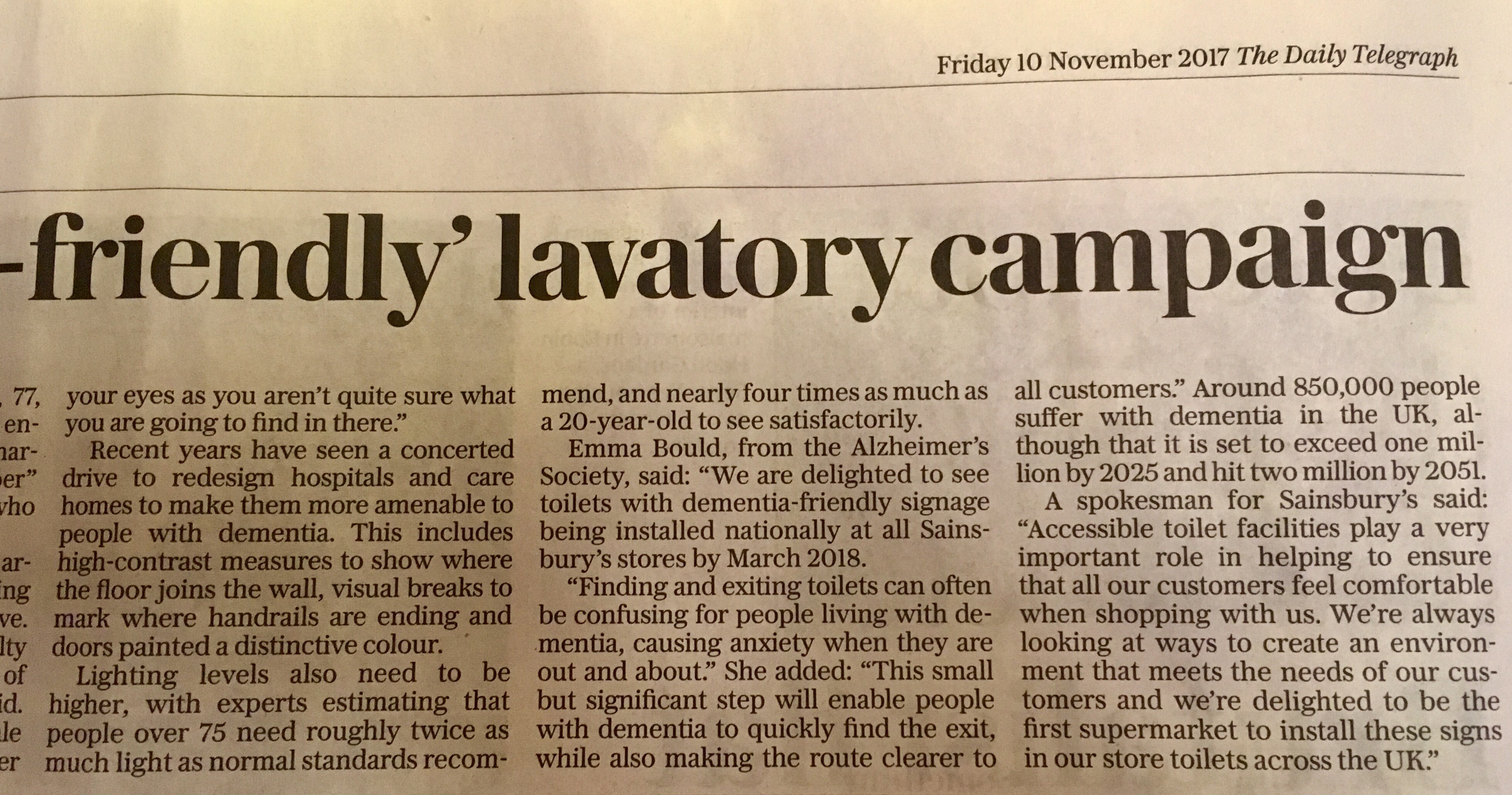
Some insight into what could await many of us, unless they find a cure for this most cruel of diseases

As well as showing us that the everyday world is an extremely terrifying place for those suffering from Dementia, this article makes reference to some interesting research on an even wider issue.

Apparently, those of the age of 75 require twice the lighting levels of younger people and four times of that required by those in their twenties. The reason why this is of particular interest to me at the moment, is because I’ve just responded to a resident on a lighting issue.

The gentleman was, along with other issues, was raising the potential for using special lighting in our toilets and in particular our disabled toilets. These lights are designed to make it extremely difficult for those wishing to use intravenous drugs, because the blue lighting makes veins virtually impossible to see under the skin of the addict.

Unfortunately, these anti-drug lights produce a cold and stark atmosphere and wash all colour from the surroundings. It’s hardly surprising then, that when the Environmental Services team installed these anti-drug lights in our disabled toilets, a number of users complained.

I don’t know if all, or indeed any of those who raised concerns were over 75, but I suspect that at least some were. Even if they weren’t, I think most of us law abiding citizens would find a public toilet, bathed in a cold, harsh blue light, a very unwelcoming place to visit, let alone spend time doing something very personal in.

Fields of homes for people, or fields of grass for those that already have homes?

COMMENT
October 30 2017, 12:01am, The Times
Either build on fields or cut immigration
Matt Ridley
It is absurd for people to insist that swathes of green land remain untouched when our population continues to rise

The Office for National Statistics says it expects Britain’s population to grow slightly more slowly than it thought three years ago, partly because of lower immigration after Brexit and partly because of slowing increases in life expectancy. But it still forecasts the figure to pass 70 million in a little more than ten years from now. That is not necessarily a bad thing, unless we remain as reluctant to build new houses, roads, schools and hospitals as we currently are. Britain can thrive as a dense city-state, a big Singapore, but not if it hates development. Openness to immigration and antipathy to building cannot both persist.
The ONS may be wrong, of course. In 1965 it expected that there would be 76 million Britons by 2000. Then the birth rate collapsed and immigration slowed, so by 1994 the statisticians were expecting a population of just over 60 million and falling by 2020. Ten years later they were back to projecting an acceleration upwards and by 2014 they predicted 74 million by 2039 and rising. The forecasts of demographers are little better than those of soothsayers gazing at the entrails of chickens.
Still, we are adding about half a million people a year, most of which is from net immigration and the higher birth rate of immigrants. Of the 1,447 people that Britain added every day in the 12 months to the end of June last year, roughly 529 were births minus deaths, 518 were net arrivals from the European Union, and 537 net arrivals from elsewhere, minus 137 departing British citizens. Given such a flow, our unemployment rate of 4.3 per cent and employment rate of 75.1 per cent are remarkable, if not miraculous. We are one of the world’s great workplaces, which, of course, is why people come.
A recent paper from the think tank Civitas, Britain’s Demographic Challenge: The implications of the UK’s rapidly increasing population, by Lord (Robin) Hodgson makes the point that we are not facing up to the implications of the rate of population expansion. He takes the previous ONS projections for four similar-sized towns — Dundee, Norwich, Stockton-on-Tees and Guildford — and calculates how much land must be built on to accommodate the expected increase in population to 2039. Taking into account not just housing, but roads, shops, offices, schools and such, he arrives at the conclusion that Guildford and Norwich will need to build on at least 65 acres every year, Stockton 55 and Dundee 40. That’s several fields a year.
Britain is already more densely populated than France, Italy and Germany but only in the southeast and the northwest of England do we begin to approach the population density of the Netherlands. Yet Schiphol airport has six runways, to Heathrow’s two, Dutch roads are far less congested, and the price of a flat outside a city centre is almost 30 per cent lower than in Britain. What are we doing wrong?

Though a densely populated country, Britain is not in any sense running out of land. Only about 7 per cent of the land area is classified as urban, rising to almost 11 per cent in England. But of that 11 per cent a great deal is still not concrete: gardens, parks, water and so forth. So the actual paved-over percentage, even just in England, is about 2.27 per cent according to the National Ecosystem Assessment in 2012, and more like 1 per cent for Britain as a whole. This is why a flight over southern England, let alone the Pennines, gives a very different impression from a car journey through the ribbon development along the roads: there is vastly more farmland and woodland (13 per cent of Britain and rising) than concrete.
Yet every time somebody wants to build a bypass, or housing development, let alone a runway, there is fury from NIMBYs and their lobby groups. Green belts, national parks, areas of outstanding natural beauty and other designations, together with planning delays and inquiries, constrain and increase the price of every attempt to provide the annual half a million extra Britons with houses, roads and schools.
What is more, I am guessing that the very people who rail against building development are more often than not the people who are most enthusiastic about immigration. The educated and wealthy tend to dominate nimbyism and also to dominate the argument for more immigration, whether out of admirable compassion for refugees or for good economic reasons. Whereas the people who most object to immigration, the urban working class, on the whole tend not to join the protest groups that oppose development. I am not taking sides here, just pointing out an irony.
There is no escape route in saying you are in favour of development but only on derelict or unused urban land. It is fanciful to think that the demands of the rising population can be met from “brownfield” sites alone. Fields and woods will have to go too. A recent paper by John Myers (founder of the group London Yes In My Back Yard) for the Adam Smith Institute, called Yimby: how to end the housing crisis, boost the economy and win more votes, recommends sensible reforms to get people behind sensitive development, mainly by giving streets and parishes control over their destinies. He estimates that a building boom to deliver more housing could raise GDP per capita by a gigantic 25-30 per cent.
Environmentalists were once more honest about this. It is often forgotten just how right-wing the roots of the environmental movement are, especially on population and immigration. Take the book that more than any other defined the birth of the environmental movement as a political force in Britain. It was called A Blueprint for Survival and it began life as a special issue of The Ecologist magazine in 1972. Signed by the great and the good of the green movement and written by Edward Goldsmith, it sold 750,000 copies. It called on the world’s governments to “declare their commitment to ending population growth; this commitment should also include an end to immigration”.
This is misanthropic, and unrealistic, but at least they had the courage of their convictions. They wanted to save the world, or the country, from (other) people, so they wanted fewer people. Those of us, and at least partly I include myself here, who like the preservation of all green spaces but also like welcoming immigrants should surely recognise that we are being hypocritical. We cannot have both.
@mattwridley

Is Europe destined to repeat past mistakes because of EU’s hunger for power?


Copied from editorial comments Sunday Telegraph 29 October 2017

Not so much, ‘We told you so’, but rather a suggestion that, by seeking to impose heavy handed control from the centre, on any group of people with their own clear and separate identities, it will inevitability lead to some form of rebellion.

How such a rebellion, whatever it’s form, is responded to, is not only key to regaining the loyalty of the rebels, if that’s a possibility, it’s also key to the longterm credibility of those seeking to impose their will, in the eyes of those watching from the sidelines.

Spanish crisis shows 
UK is on right path
Ever since the EU referendum, opponents of Brexit have called it reckless, even suicidal. But the events in Catalonia prove how rational Brexit actually is. We are leaving behind a chaotic EU that is blind to its problems and incapable of fixing them, and while Brexit is undoubtedly a monumental decision that has to be handled extremely carefully, the crises on the continent are far greater by comparison.
The Remainer narrative is that everything on the other side of the Channel is okay. The economic picture has improved in the short-term thanks to the European Central Bank’s easy money policy. But structurally the continent remains in crisis and its politics veers to extremes. The Czech Republic has elected an anti-corruption businessman who is under investigation for financial irregularities. Hungary and Poland are in revolt. Two Italian regions have voted for enlarged autonomy. Austria may well be governed by a coalition that includes nationalists. And Germany’s far-Right won 94 seats in the Bundestag.
Spain is at the epicentre of Europe’s crisis of identity. Catalonia’s declaration of independence caps a violent history of regional nationalism that British politicians of Left and Right have tried and failed to explain in terms relevant to our own country. In fact, the stark contrast between how the UK is handling the Scottish nationalists and how Madrid has mishandled the Catalonians illustrates the wide gulf between Britain’s tradition of small government versus the authoritarianism found across much of the continent. London prefers diplomacy and democracy. Madrid’s force backfired horribly, and if it thinks that will resolve this disaster then it is likely to be mistaken.
The EU looks on, impotent – knowing that Catalonia won’t be the last region to make this leap into the unknown. The nationalist genie is out of the bottle and no amount of coercion, condescension or feigned ignorance will make it go away. Brexit is not Europe’s biggest problem. Under the present circumstances, given that all we are asking for is to depart on good terms and trade to mutual benefit, the EU would be wise to keep Britain onside and conclude a deal as swiftly as possible.

Inside story on Falklands landings and it’s tragic losses

Copied from Daily Telegraph letters page 28 October 2017

Falklands landings
SIR – As the two commanders responsible for planning and carrying out the amphibious landings on the Falklands in 1982, the only point on which we agree with Dr Mark Campbell-Roddis (Letters, October 27) concerns retaining HMS Ocean.
He suggests that the right way to land troops in 1982 would have been by helicopter inland and on a smaller scale under air cover. We considered this approach, but rejected it on the grounds that we did not have air superiority, or enough helicopters to land enough troops and their supporting artillery in sufficient strength, in the time required, to fight off counter-attacks by the Argentine army. The only way to achieve a quick enough build-up was by landing craft.
The landings were opposed on the ground by very few enemy troops. The main opposition came from the Argentine air force. Had we attempted major helicopter moves in daylight, the Argentine fighters would have had a turkey shoot among our helicopters. Our landing was in a relatively narrow creek with very little loss on the first day, despite our escorts being armed for the open ocean and not for action close inshore.
The tragedy of the Welsh Guards at Fitzroy (not Bluff Cove) was caused by the chaotic deployment to the South Atlantic of 5th Infantry Brigade, with insufficient logistic support or staff. Their move could only be supported by sea. The Argentine air force was fortunate in that the low cloud lifted in the west just in time. The landing was not opposed by ground troops. The sinking of the container ship Atlantic Conveyor with three Chinooks and eight Wessex helicopters did not help.
The major factor that “armchair warriors” usually forget is logistics. You cannot hope to defeat an army equipped with artillery by landing a few troops with sandwiches in their pockets and what ammunition they can carry, unsupported by artillery. It takes 50 medium helicopter sorties to move a battery of six light guns and sufficient ammunition for one battle.
Michael Clapp
Commander, Amphibious Task Group, Falklands 1982
Julian Thompson
Commander, 3 Commando Brigade, Falklands 1982

Why May and Khan are in a ‘War of Words’ over Housing

Nothing to add to this picture of doom.

andrew lainton's avatarDecisions, Decisions, Decisions

Evening Standard – 13/10/2017 Oddly not on website.  Briefing from No 10 not city Hall.  Thanks to Daniel Bentley for the Pic.

The fatal weakness of PM May is her inability to partner with anyone.  She behaves with everyone like the worst form of hectoring boss.  Contrast her behavior on Friday with that of Lord Adonis and City Mayors in launching the National Infrastructure Assessment   on the same day.

Clearly Gavin Barwell is having an influence, but in giving May more things to panic and strut about not necessarily a good one.

The mistakes on housing, particularly planning for housing land, and the taxation of land, are so longstanding and systemic.  You can’t turn that around in a couple of years.  It would be much better to take bold long term decisions, like on Garden Cities and New Settlements, that will leave a legacy.

But lets look at another…

View original post 587 more words

Introducing MOAN – Model for Objective Assessment of Needs – A Fudge Factor Free Approach

What a brilliantly ironic acronym for such a controversial process.

andrew lainton's avatarDecisions, Decisions, Decisions

We only have till 9th of November to respond to Planning for the right homes in the right places.

I have a week next week between finishing one contract and starting another so what better time to write up a model i’ve been developing for many months for estimating need for every LPA in England, and crucially without the ‘Global Fudge Factor’ that fatally undermines the DCLG -LPEG derived approach.  This model was a free by product of a research project which has to remain confidential for a few weeks.

There will be many technical post explaining the different modules and assumptions of the approach but first – here – a non technical introduction.

In summary the DCLG model wont work and will make our national systematic housing shortfall far worse.

The housing crisis in Britain has two main supply side reasons (there are demand side reasons but they are…

View original post 1,037 more words

May (in panic) to Housebuilders – You Naughty Naughty Boys

The culprit is named at the start of this piece, one Eric Pickles, now Sir Eric Pickles, his reward as is often the case, for such people when leaving chaos in their wake, when in a ministerial position. Given the damage he managed to do in such a relatively short space of time, I’m amazed he wasn’t elevated to sainthood, although I did anticipate a lordship at least for the Bradford wrecking ball.
As a reminder, just a couple of things of Pickles did to make the planning system the mess it is now and blight the housing estates built in the last ten years are. He trashed regional planning, because it was a top down system dictating housing numbers, this being replaced by the farcical duty to cooperate and objectively assessed housing need figures that tie every local Plan examination in knots.
He changed the density requirements, so that even the most rural locations had to build at 30 to the hectare, almost double in many cases. If developers and house builders had a track record of working to such densities and knew how to design sympathetically to such densities it might not have been such a problem. However, they didn’t and the y still don’t.
All they did, was build small houses on smaller plots, with smaller garden, more cramped parking arrangements and then serve many of these estate with private and therefore unadoptable roadways.

andrew lainton's avatarDecisions, Decisions, Decisions

Telegraph   

Given the lead in times between outline on big sites and development – even with a drop in ‘landabnking’ only a realtively number of extra homes could be buolt by yhe next election.  Upping numbers is a long term game.  The Tories are paying the consequences years later of Eric Pickles breaking the Planning System for Growth areas/

Theresa May has called Britain’s biggest developers to a Downing Street summit this week after pledging to “dedicate” her premiership to fixing the “broken” housing market.

Government sources said the Prime Minister will “lay down a challenge” to the industry to construct more homes, in a “significant intervention” following her promise to get more people onto the housing ladder.

Leading developers and building firms are expected to attend the summit on Tuesday, together with representatives from local authorities and housing associations.

The meeting comes after Mrs May used her conference…

View original post 290 more words

South Staffs – A totally predictable ‘clusterf###k’ Local Plan Examination

Lots of good points in here, worthy of note for anybody working on their Local Plan now. Too late for us to make any changes (not that we need any, actually that’s up to the inspector to decide for us) as our examination in public starts on 10 Oct in Boston. It’s a public meeting so anybody can attend and listen to the proceedings.

andrew lainton's avatarDecisions, Decisions, Decisions

Amongst the names of local authorities that are heading for disaster and have plunged over the cliff despite all warning there are a few sad cases, one that always come up are the likes of St Albans, South Oxfordshire, Erewash and yes South Staffs – all of which think they have a duty to obstruct and stick two fingers up to all of their neighbors.

They have taken advantage of the fact they have a core strategy (without allocations) adopted in 2012 before any overspill form any adjoining area, Black Country, Brum, Stafford, Cannock Chase or Wrekin was set; taking advantage of recent case law (including Cooper Estates v Tunbridge Wells BC [2017; EWHC 224 (Admin)]; Oxted Residential Ltd v Tandridge DC [2016; EWCA Civ 4140]; Gladman Development Ltd v Wokingham BC [2014; EWHC 2320 (Admin)];) that an allocations plan following a recent core strategy does not have to examine…

View original post 537 more words

Buying property in Britain to get tougher for foreigners

I assume this is more about London than anywhere else in the country.  Even so, one has to wonder how it can possibly help deliver a single, genuinely affordable dwelling within the M25, for an ordinary working person, or family.

Taking highly expensive scarce housing out of wealthy foreign hands and placing into the welcoming arms of our domestic rich list, seems like another form of gerrymandering.  In this case, R.A. ther than manipulating electoral boundaries for political advantage, this could be seen as the manipulation of financial boundaries for political purposes.

How this will ensure that those needing to live in London in order to work, is a mystery and can only create more work for those lawyers expert in international property law.

intriguing comments by Luke Hall MP at the end of the article.  Given his relatively youth and inexperience as an MP, one can only assume that he has either personal experience, or received significant constituency pressure in this respect.

The watered down version now in place, doesn’t seem especially effective at addressing the issue of the many thousands of empty dwellings across the country.  Many of these are in some of the more high demand areas and attempts to prise them out of the hands of absent owners, or uncommunicative lawyers, is frustrating, time consuming and expensive.

Given the limited resources of the majority of councils and the likelihood that there will be more than enough longterm empty propertiesto be dealt with, Luke Hall appears to be making a great deal of noise about issues that would simply never arise.

Copied from Sunday Telegraph 24 September 2017

Home Affairs

By Ben Riley-Smith
FOREIGN buyers will face tougher restrictions on purchasing British property under Treasury plans to help first-time buyers.
Polices could be announced within weeks as getting younger people on to the housing ladder becomes a major part of the Conservatives’ autumn 
 political drive.
“There’s an issue in London with a large proportion of new-build flats being purchased off plan by, particularly, Far Eastern buyers: China, Hong Kong, Singapore, Malaysia,” a Whitehall source said.
“They are bought when the flats are still under construction, meaning first-time buyers don’t get a look-in. That is not just in central London, but in the suburbs and other cities such as Manchester.”
Number 10 and Treasury officials will discuss housing policy this week ahead of the Conservative Party conference in the first week of October and the Budget in November.

Other ideas in the running include accelerating the sale of government-owned land and easing the rules on building on brownfield sites to help boost supply.
Some Whitehall figures also back more borrowing to invest in housing. Sajid Javid, the Communities Secretary, has previously supported the move in public – though the Treasury is concerned about cost.
Theresa May wants her domestic policy agenda to dominate the party conference after delivering her speech in Florence on leaving the EU. Sources involved in the preparations said that housing is likely to become a big theme of the coming weeks as the Tories look to win back younger voters who backed Jeremy Corbyn in June.
Philip Hammond, the Chancellor, told Tory MPs at the 1922 Committee recently that he wanted to address the difficulty faced by first-time buyers.
He called for ideas to be submitted for the November Budget and – alongside student debt – identified it as an area the Tories must tackle to win back young voters. An ally of the Chancellor said he feared people in their twenties and thirties were being “left behind economically” and therefore “punished” the Tories, as the governing party, at the election.
Ministers have already announced “accelerated” plans for selling off Government land for housing, but some Tories feel that more could be done.
Land around railways, owned by the Ministry of Defence or part of the NHS estate is especially being considered by Treasury officials.
The developments come as the Conservatives launched an attack on a little-known Labour policy announced in its housing manifesto during the election.
Labour pledged to restore Empty Dwelling Management Orders – a controversial policy introduced by New Labour in 2006 but watered down by the Tories – to its full strength.
The change would empower councils to take over private homes that have been left empty for six months, rather than two years.
Luke Hall, the Tory MP for Thornbury and Yate, warned: “The return of John Prescott’s bullying powers would mean town hall bureaucrats seizing everyday homes in streets across the country, including those of recently deceased.
“Labour’s hard-Left agenda would entail widespread state confiscation of private property, targeting the elderly and the families.”