A good old boy takes the day

The consultation period for the revisions of the National Planing Policy Framework closes at 11.45pm on 10 May 18.

It’s highly unlikely that it will make the decision making process any easier when it comes to dealing with unhappy residents, something the planning system appears to be destined to do almost every time a planning application is submitted.

Although the government are themselves elected, the policies contained in the NPPF are designed to set out government’s approach at the national level, with councils needing to produce their own, locally focussed policies to reflect local conditions and to a certain degree, views. The vehicle for ensuring this local position is applied consistently and more importantly equitably, in the Local Plan.

South Holland is currently working with Boston Borough to produce a new Local Plan, something that, with a bit of luck, will be completed by the end of the year.

National and local policies don’t always cover every issue that might arise when a planning application is submitted and this is where the planning committee come in. This is the locally accountable, democratic face of the planning system, used as a way of giving a voice to local people and allowing them to hear the arguments for both sides when an application is significant, or contentious.

However, whilst it’s good that local people have such access and a way of expressing their views, national and local planning policies always apply and will sometimes lead to tension and even conflict, when the outcome is not to the public’s liking.

Members of planning committees are required to be trained and to use this training when reaching decisions. They can of course use their judgement to weigh the issues presented during a debate and give more weight to one than another, but always keeping in mind the policy.

Unfortunately, on occasion, members choose to override policy completely and take what can only be seen , in planning terms, a perverse decision. When that decision is to refuse, an applicant has the right of appeal. However, when it is to approve you’re stuck with it with the perversity.

Such perverse decisions can take many forms, they are all frustrating and not a little embarrassing for a planning authority. This especially so when the decision is the opposite of a previous one, the application is no different from a previous one for the same thing and that decision was appealed against and upheld by an independent planning inspector.

The perversity in this particular case stems, it seems, from what I call the ‘good old boy syndrome’. The case that was made by supporters, on behalf of the applicant, was that he was local, hardworking, long serving and ‘deserved’ to be able to have a dwelling in a particular location. It didn’t seem to matter that the location in question was classified as the open countryside in policy terms and that many similar applications by people who wanted to built themselves a nice retirement property out in the countryside had been refused.

Apparently this particular person had some sort of extra merit that didn’t fit into the planning system and therefore deserved some sort of special treatment, ignoring the local planning policy and the recent planing inspector’s decision, completely.

Such potential inequity of treatment, between what are otherwise identical applicants, is a very worrying practice and one that makes me, personally, both uncomfortable and more than a little angry.

I can think of plenty of situations where an application from somebody whose face does not fit, isn’t a good old boy, doesn’t get a letter of support from the local MP, or actually sees their application receive a number of local objections, has been dismissed out of hand.

Allowing non-material planning considerations – to use the jargon, to influence decisions and over ride policy, is a slippery slope and one that causes major problems in other council areas. Thankfully, it is not a common problem here in South Holland. However, having experienced a recent perverse, ‘good old boy’ decision, I fear we are soon to suffer another. This, just when I thought the planning committee was starting to get the hang of it.

Government offers free advice on neighbourhood planning

This one will probably bring a sinking feeling to some council planning policy departments, because it does require the commitment of resources.  Therefore, the more neighbourhood plans you have in a given local plan area, the more challenging it can be for the LPA.

Housing minister Dominic Raab has announced that communities across England will be able to get free access to expert advice and guidance to help make their neighbourhood vision a reality.

The free help will include financial support and the latest planning expertise from trained professionals, to guide them through the process of preparing a neighbourhood plan.

Some 2,300 communities across England have started the process of neighbourhood planning, with 530 plans approved in local referendums.

These plans will give local people a say in the development of their area, including where homes, schools and businesses should be built, and the infrastructure needed to support them.

Raab said: “Neighbourhood plans are a powerful tool to help communities shape their local area, making sure the right homes are built in the right places. It’s vital that communities have the right support and advice available to help deliver a plan that meets their own ambitious aspirations.”

Previous government support has helped around seven out of 10 of these communities progress their plans, with 365 neighbourhood plans finalised using support provided by the government.

The maximum grant available has been increased by £2,000 to £17,000, helping communities to access more resources to develop a plan for their area.

Community groups can find out more information about how to apply for funding on the neighbourhood planning website.

20 March 2018
Prithvi Pandya, The Planner

Waste Enforcement Regulations to put pressure on occupiers and landowners

Copied from Lexology.com online website

Osborne Clarke

United Kingdom March 23 2018

Over the past five months, the government has shown an increasing commitment to cleaning up waste and dealing with waste offenders, most notably through its publication of the Clean Growth Strategy (12 October 2017), the Industrial Strategy (27 November 2017) and the 25 Year Environment Plan (11 January 2018). Whilst these initiatives have been criticised by some for not going far enough or failing to establish concrete obligations or enforcement policies in respect of waste, on 8 March 2018 the Waste Enforcement (England and Wales) Regulations 2018 became law. The Regulations aim to strengthen the powers of environmental regulators to address waste crime in England and Wales.

The Regulations form part of the government’s wider policy intention to tackle waste crime. This is an issue that is also referred to in Chapter 4 of the 25 Year Environment Plan, which highlights the cost of waste crime to taxpayers and the long-term impact of waste on the natural environment. In particular, fly-tipping and poorly managed waste sites lead to problems with fumes, dust, vermin, insect infestations and waste fires, with the latter often causing significant disruption to roads, railways and schools. According to the Environment Plan, the cost to local authorities of fly-tipped waste was £57.7m in 2016/2017, which does not include the additional costs borne by landowners forced to deal with illegal waste disposal.

What do the Regulations do?

As set out in the Industrial Strategy, the government is seeking clean growth as one of its four “Grand Challenges” to boost UK productivity. The government aims to minimise waste by establishing a more circular economy, whereby materials are recycled up the waste hierarchy and are used more efficiently.

To achieve this and reduce pollution, the Regulations provide environmental regulators (the Environment Agency in England and the Natural Resources Body in Wales) with the following new powers:

1. Waste removal

Regulation 2 empowers the regulators to serve notice on an occupier of a property which requires them to:

• remove waste from the property which is being illegally stored, kept or disposed of, within in a specified period of time (of not less than 21 days), including waste that was initially lawfully deposited; and

• take steps (within the above specified period) to eliminate or reduce the consequences of the unlawful keeping or disposal of the waste.

Failure to comply with a waste removal notice (without reasonable excuse) is a criminal offence and is punishable by way of a fine. Additionally, should the offender fail to comply with the waste removal notice, the regulator may remove the waste and recover from the occupier the expenses reasonably incurred in doing so.

2. Restricted access to waste sites

Regulation 3 empowers the regulator to prohibit access to and the importation of waste into a site for up to (i) 72 hours by serving a restriction notice; or (ii) 6 months where the court issues a restriction order, in the following circumstances:

• there is a risk of serious pollution to the environment or serious harm to human health which is a result of the treatment, keeping, deposit or disposal of waste in or on the premises; and

• the notice is necessary to prevent the risk from continuing.

The regulators’ power to restrict access is a significant one and could have a notable impact on the movement of goods and services into and out of waste sites, which could have serious knock-on effects for business.

Failure to comply with a restriction notice is a criminal offence and is punishable by way of a fine or imprisonment for a period not exceeding 51 weeks, or both. Failure to comply with a waste removal restriction order is punishable by either: (i) on summary conviction, to a fine or imprisonment for up to 12 months (or to both); or (ii) on conviction on indictment, to a fine or imprisonment for a term not exceeding two years (or to both).

Impact of the Regulations: cost to landlords

In certain circumstances, as set out below, landlords could find themselves responsible for the cost of removing illegally kept or disposed of waste. Leaseholder and freeholder landlords of sites which house regulated or exempt facilities should be aware that they could be held responsible for unlawful waste on their properties.

The Regulations permit the regulator to serve notice on landowners requiring them to remove unlawful waste if:

• there is no occupier;

• the occupier cannot be found without the regulator incurring unreasonable expense; or

◦ the occupier has failed to comply with a waste removal notice within the specified period.

It will therefore become increasingly important for landlords to ensure that waste obligations are clearly set out in tenancy agreements and that regular property inspections are held. Enhanced scrutiny of a tenant’s financial status should also be considered before tenancies are agreed. This is particularly the case as the powers granted to the regulator by the Regulations are capable of interfering with business practice.

Ahead of the government’s Resource and Waste Strategy, the Regulations come into force on 29 March 2018, with the exception of regulation 2 and certain related transition provisions, which come into force on 8 May 2018.

Osborne ClarkeKiera TaylorMatthew Germain and Caroline Bush

Thanks for next to nothing Sajid

Copied from the MJ on line


Lifting the council tax cap is just passing the buck
By Heather Jameson | 18 December 2017
Heather Jameson
The Scottish Budget does not bode well for local government – on both sides of the border.

Finance secretary Derek MacKay’s decision to use his tax raising powers to pay for public services may herald a welcome shift towards ending austerity. However, the Scottish local government finance settlement also included the presumption that councils would do the same.

Without a double whammy of income tax rises, and council tax increases, taxpayers north of the border are set to feel the pinch.

And so we wait for the English settlement – delayed, we have been assured, due to communities secretary fighting for a good deal for the sector.

It seems unlikely there will be anything extra for adult social care as we wait for the green paper – although there may be measures to ease the rising pressures on children’s services. We can also expect an extension of transition grants. In the absence of a plan for fair funding and full business rate retention, a fiscal fudge may be the only option.

But the coffers are empty – there is no cash handout on the horizon. Last time round the gap was plugged with the adult social care precept. This time round, we could see the government lift the cap on council tax rises.

Is it a win for local government? Freeing councils from central government interference has got to be a good thing. Democratically elected councillors have every right to choose their own levels of taxation.

However, failing to fund local government and letting councils take the flack for raising taxes is passing the political buck. This is not giving councils the choice to raise taxes – it is forcing their hand.

Finance settlement offers no lifeline to the struggling sector
By Heather Jameson | 19 December 2017
Heather Jameson
Watching the local government finance settlement after last month’s budget, it is fair to say the Government can be commended for its consistency. It has consistently failed to address the financial crisis facing local government.

There are some positives. Easing the council tax referendum threshold gives local government a modicum more control over its own destiny. A three percent increase puts council tax broadly in line with inflation – assuming you ignore the social care precept, which taxpayers will not.

And the extension of business rate pilots will be welcomed in the lucky areas bestowed with the gift. A pledge to shift to 75% business rate retention is also a good move – and as far as Sajid Javid could go without legislation.

Promises to review the funding system and maintain New Homes Bonus are also likely to play well with the sector.

There is an extra £13m for struggling Northamptonshire, Mr Javid told Parliament – mentioned with the aside that he would listen to any reorganisation proposals put forward. Does this mean if you truly fail, government will come in and pick up the pieces?

However, council tax measures will raise around £250m – at different levels across the country – compared with the £2bn needed. Adult social care is in crisis, with a green paper planned for the summer – and a solution even further away.

Children’s services are increasingly becoming a concern and the settlement failed to find a solution there. Councils remain on a precipice, and the draft settlement provides very little in terms of a safety net.

Two years ago, MP’s threatened to vote against the settlement – could we see the same thing happen again? With some of the main protagonists handed business rate deals, Sajid Javid may have done enough to keep the sector quiet – but not enough to send a lifeline to the sector.

Call for action as fly-tipping hits eight-year high

No doubt this story in the Times will generate the standard response of criticism of councils.

This is normally along the lines of, we don’t collect the stuff often enough, we don’t collect the right stuff – or we charge for taking stuff away and of course, the tip isn’t open often enough.

As with every Council service, all this costs money to do and has to be paid for by every taxpayer, even if they don’t use that service.

People never seem to go straight to criticising the criminals, who actually do the tipping and blighting of the countryside, or streets.

Councils are calling for a more effective legal system to streamline prosecutions for fly-tipping, which latest figures show has reached an eight-year high.

There were more than a million fly-tipping cases over the past financial year but the number of prosecutions has halved since 2012. Cllr Martin Tett, the LGA’s Environment spokesman, said: “When they take offenders to court, councils need a faster and more effective legal system which means fly-tippers are given hard-hitting fines for more serious offences.

Clearing up fly-tipping is costing councils more than £57 million a year, money that could be spent on services like caring for the elderly, protecting children or tackling homelessness.

The Government has allowed us to apply fixed-penalty notices for small-scale fly-tipping and this is a big step in the right direction.” Cllr Tett also called for manufacturers to take more responsibility for taking back old products when they sell new ones.

Council tax bills could rise

The comments from readers make very interesting reading. They offer significant insight into the levels of ignorance that exist, because of the complex systems of local government and taxation we have created in this country.

The Times suggests that council tax could rise under plans to head off deep cuts to frontline services and ease the social care crisis. Theresa May is reportedly resisting calls from councils to scrap rules that require them to hold a vote for the largest increases. However she could allow them more flexibility to increase bills when the Local Government Finance Settlement is announced next week. Lord Porter, LGA Chairman, urged Mrs May to lift all restrictions on council tax rises. He said: “The money local government has to provide vital day-to-day services is running out fast. There is huge uncertainty about how local services are going to be funded beyond 2020.” Philip Hammond, the Chancellor, who was criticised for failing to provide extra cash for social care in last month’s budget, is said to be sympathetic.

No Housebuilding Announcement on ‘Housing Day’ shows something being held back for Budget

Hammond means there’s no money from me, when he says there’s no silver bullet.

andrew lainton's avatarDecisions, Decisions, Decisions

Guardian – the Avo on Toast Millennials Meme comes from some stupid remarks from an Australian politician.

Held back – probably because May is still dithering about it so Javid had nothing to announce bar a headine grabbing theme.

Jaivi’ds s speech in Bristol came shortly after Theresa May visited a social housing estate in north London, as part of a concerted government push on the issue ahead of next week’s budget.vid had tough words for “baby boomers who have long since paid off their own mortgage” who believed there was no need to build more homes, saying they were “living in a different world”.

Such people argue that “affordability is only a problem for millennials that spend too much on nights out and smashed avocados,” Javid said, adding: “It’s nonsense. They’re not facing up to the reality of modern daily life and have no understanding of the modern market.”

View original post 874 more words

Osborne made a mess now they’re letting another b****y accountant screw with the planning system – again!

I know that in modern times the Budget has become far more than just the chief account reading out the end of year figures and the countries spending and revenue raising plans for the next year.

However, this practice of having the chief bean-counter make announcements about yet further changes to the planning system, clearly designed to avoid spending any government money at any cost, is really grating.

For starters, this is not a subject area one would associate with Philip Hammond – anymore than I would with Sajid Javid come to that.  Secondly, putting everything into the hands of developers and the private sector, when this is supposedly a top priority for government, seems to be both disingenuous and a betrayal of those in desperate need of affordable market housing.

This desperation to avoid giving local government its rightful role in leading the campaign to get Britain building houses again, is also a betrayal of those who can’t even aspire to step onto the first rung of the home ownership ladder.

Allowing houses and blocks of flats to be increased in height, would seem to offer little opportunity to deliver a meaningful increase in additional housing units.  It will however do exactly that for the bank balances of those who own suitable properties in high demand areas.  Although, it might suit a single, unattached person, is the newly added top floor, plonked on top of an outdated housing block, really the first home a young couple aspires to?

Copied from Sunday Telegraph 11 November 2017

POLITICS
Hammond considers ‘build up, not out’ planning proposal
Budget measure may allow developers to raise height of homes without needing permission
By Edward Malnick, Whitehall Editor
DEVELOPERS and homeowners would be allowed to extend the height of properties without planning permission, under plans being considered for the Budget by the Chancellor.
Philip Hammond is weighing up proposals to relax planning laws to enable houses and blocks of flats to be raised to the height of the tallest building or tree in the same area without the cost or delay of seeking council approval.
The “build up, not out” plan, which is backed by several former ministers, together with David Cameron’s ex-policy chief, is being pushed by MPs as a way to help solve the housing crisis without building on greenfield land.
It mirrors similar proposals originally made by Sajid Javid, the Communities Secretary, and George Osborne, Mr Hammond’s predecessor, for homes in London, and offers a solution to an impasse between the Treasury and No 10 over proposals by the Chancellor to relax rules restricting construction on the green belt. A housing White Paper published by Mr Javid in February proposed to “offer scope to extend buildings upwards in urban areas by making good use of the ‘airspace’ above them”.

The plan now being considered by Mr Hammond would involve extending the “permitted development” scheme under which Parliament grants a general planning permission for ­certain types of work, meaning specific approval is not required from local ­authorities each time.
Advertisement

Under Mr Cameron, permitted ­development rights were created to make it easier to convert buildings from one use into another and extend existing homes.
The plan to extend those rights to those seeking to build upwards are understood to have been put forward to Mr Hammond last month by John Penrose, a former heritage minister, and have since drawn support from MPs including Nick Boles, the former planning minister, Mark Prisk, a former housing minister, and Sir Oliver Letwin, who was David Cameron’s head of policy.
The proposals would mean that an owner could extend the height of their building to match that of the tallest building in its “block”, in urban areas, or to the height of mature local trees. MPs supporting the plan say that the restrictions would ensure that the policy simply led to higher mansion blocks, terraces and mews housing, rather than skyscrapers and giant tower blocks.
They point out that some of the most expensive and attractive areas of London are full of four or five-storey ­terraces, compared to single, double, or triple storey buildings elsewhere.
Mr Penrose said the move would help regenerate “tired or run-down” town and city centres, and head off the pressure from developers to build on greenfield sites.
“This will unlock huge numbers of new urban housebuilding sites and create mansion blocks, Georgian terraces and mews houses rather than controversial sky-high tower blocks.”
Mr Boles is to outline a similar proposal tomorrow in the latest chapter of his book setting out proposals to ­improve the economy.
“It is very good way of assuring people that we’re doing our damnedest to make use of already developed land,” he said. Sir Oliver said: “There’s quite a lot of evidence now that the steps we took a while back to create permitted development for those trying to switch use from commercial to residential use have proved effective in enlarging the number of homes available and improving high streets which were languishing. This seems to me to be an extension of that same thought.
“There is quite a lot of land in the country that is occupied by very low-rise dwellings where it would make it aesthetically quite ­uncontroversial to raise the height up to the level of ­the adjoining buildings or trees around them.”

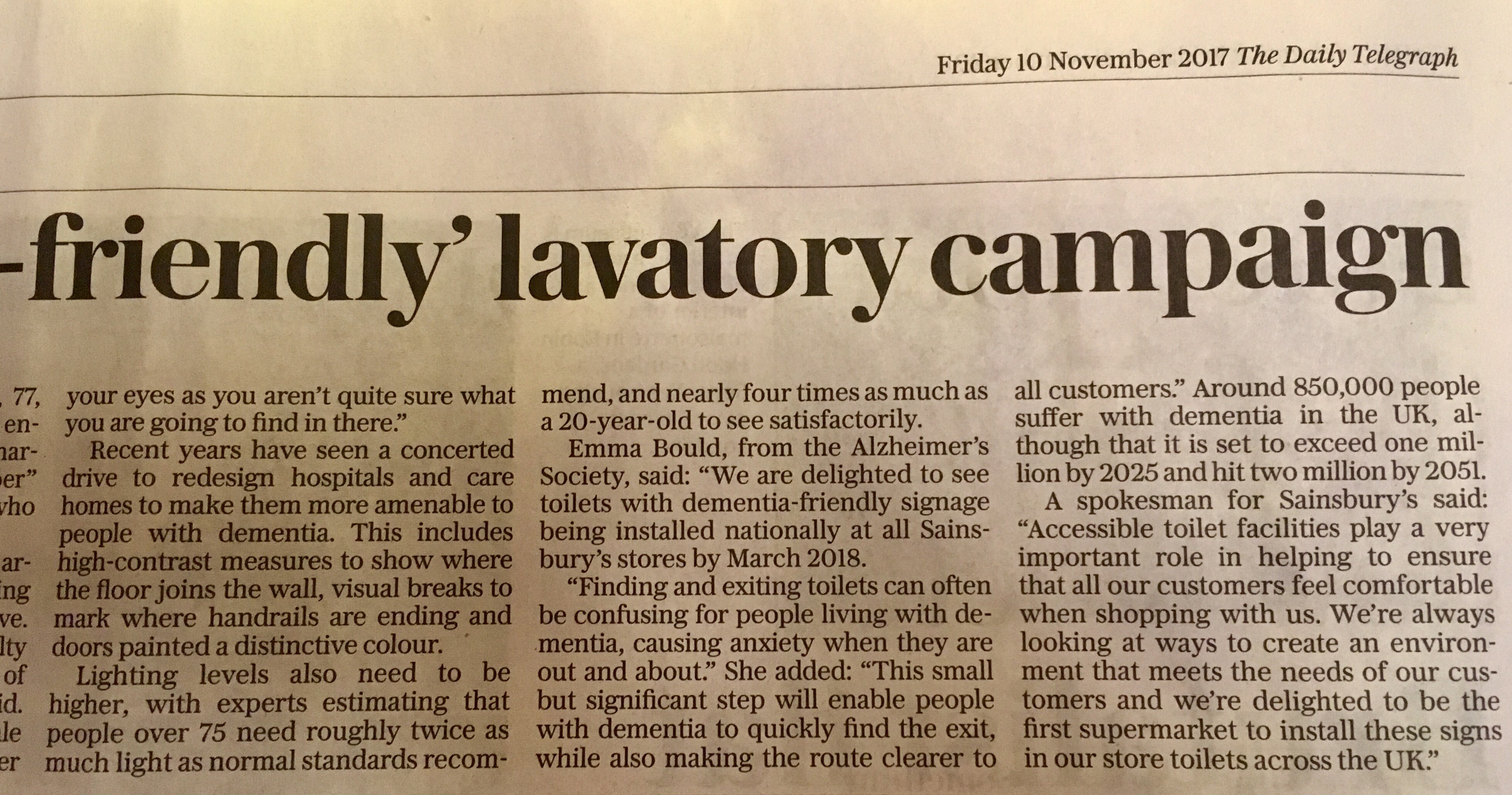
Some insight into what could await many of us, unless they find a cure for this most cruel of diseases

As well as showing us that the everyday world is an extremely terrifying place for those suffering from Dementia, this article makes reference to some interesting research on an even wider issue.

Apparently, those of the age of 75 require twice the lighting levels of younger people and four times of that required by those in their twenties. The reason why this is of particular interest to me at the moment, is because I’ve just responded to a resident on a lighting issue.

The gentleman was, along with other issues, was raising the potential for using special lighting in our toilets and in particular our disabled toilets. These lights are designed to make it extremely difficult for those wishing to use intravenous drugs, because the blue lighting makes veins virtually impossible to see under the skin of the addict.

Unfortunately, these anti-drug lights produce a cold and stark atmosphere and wash all colour from the surroundings. It’s hardly surprising then, that when the Environmental Services team installed these anti-drug lights in our disabled toilets, a number of users complained.

I don’t know if all, or indeed any of those who raised concerns were over 75, but I suspect that at least some were. Even if they weren’t, I think most of us law abiding citizens would find a public toilet, bathed in a cold, harsh blue light, a very unwelcoming place to visit, let alone spend time doing something very personal in.

Fields of homes for people, or fields of grass for those that already have homes?

COMMENT
October 30 2017, 12:01am, The Times
Either build on fields or cut immigration
Matt Ridley
It is absurd for people to insist that swathes of green land remain untouched when our population continues to rise

The Office for National Statistics says it expects Britain’s population to grow slightly more slowly than it thought three years ago, partly because of lower immigration after Brexit and partly because of slowing increases in life expectancy. But it still forecasts the figure to pass 70 million in a little more than ten years from now. That is not necessarily a bad thing, unless we remain as reluctant to build new houses, roads, schools and hospitals as we currently are. Britain can thrive as a dense city-state, a big Singapore, but not if it hates development. Openness to immigration and antipathy to building cannot both persist.
The ONS may be wrong, of course. In 1965 it expected that there would be 76 million Britons by 2000. Then the birth rate collapsed and immigration slowed, so by 1994 the statisticians were expecting a population of just over 60 million and falling by 2020. Ten years later they were back to projecting an acceleration upwards and by 2014 they predicted 74 million by 2039 and rising. The forecasts of demographers are little better than those of soothsayers gazing at the entrails of chickens.
Still, we are adding about half a million people a year, most of which is from net immigration and the higher birth rate of immigrants. Of the 1,447 people that Britain added every day in the 12 months to the end of June last year, roughly 529 were births minus deaths, 518 were net arrivals from the European Union, and 537 net arrivals from elsewhere, minus 137 departing British citizens. Given such a flow, our unemployment rate of 4.3 per cent and employment rate of 75.1 per cent are remarkable, if not miraculous. We are one of the world’s great workplaces, which, of course, is why people come.
A recent paper from the think tank Civitas, Britain’s Demographic Challenge: The implications of the UK’s rapidly increasing population, by Lord (Robin) Hodgson makes the point that we are not facing up to the implications of the rate of population expansion. He takes the previous ONS projections for four similar-sized towns — Dundee, Norwich, Stockton-on-Tees and Guildford — and calculates how much land must be built on to accommodate the expected increase in population to 2039. Taking into account not just housing, but roads, shops, offices, schools and such, he arrives at the conclusion that Guildford and Norwich will need to build on at least 65 acres every year, Stockton 55 and Dundee 40. That’s several fields a year.
Britain is already more densely populated than France, Italy and Germany but only in the southeast and the northwest of England do we begin to approach the population density of the Netherlands. Yet Schiphol airport has six runways, to Heathrow’s two, Dutch roads are far less congested, and the price of a flat outside a city centre is almost 30 per cent lower than in Britain. What are we doing wrong?

Though a densely populated country, Britain is not in any sense running out of land. Only about 7 per cent of the land area is classified as urban, rising to almost 11 per cent in England. But of that 11 per cent a great deal is still not concrete: gardens, parks, water and so forth. So the actual paved-over percentage, even just in England, is about 2.27 per cent according to the National Ecosystem Assessment in 2012, and more like 1 per cent for Britain as a whole. This is why a flight over southern England, let alone the Pennines, gives a very different impression from a car journey through the ribbon development along the roads: there is vastly more farmland and woodland (13 per cent of Britain and rising) than concrete.
Yet every time somebody wants to build a bypass, or housing development, let alone a runway, there is fury from NIMBYs and their lobby groups. Green belts, national parks, areas of outstanding natural beauty and other designations, together with planning delays and inquiries, constrain and increase the price of every attempt to provide the annual half a million extra Britons with houses, roads and schools.
What is more, I am guessing that the very people who rail against building development are more often than not the people who are most enthusiastic about immigration. The educated and wealthy tend to dominate nimbyism and also to dominate the argument for more immigration, whether out of admirable compassion for refugees or for good economic reasons. Whereas the people who most object to immigration, the urban working class, on the whole tend not to join the protest groups that oppose development. I am not taking sides here, just pointing out an irony.
There is no escape route in saying you are in favour of development but only on derelict or unused urban land. It is fanciful to think that the demands of the rising population can be met from “brownfield” sites alone. Fields and woods will have to go too. A recent paper by John Myers (founder of the group London Yes In My Back Yard) for the Adam Smith Institute, called Yimby: how to end the housing crisis, boost the economy and win more votes, recommends sensible reforms to get people behind sensitive development, mainly by giving streets and parishes control over their destinies. He estimates that a building boom to deliver more housing could raise GDP per capita by a gigantic 25-30 per cent.
Environmentalists were once more honest about this. It is often forgotten just how right-wing the roots of the environmental movement are, especially on population and immigration. Take the book that more than any other defined the birth of the environmental movement as a political force in Britain. It was called A Blueprint for Survival and it began life as a special issue of The Ecologist magazine in 1972. Signed by the great and the good of the green movement and written by Edward Goldsmith, it sold 750,000 copies. It called on the world’s governments to “declare their commitment to ending population growth; this commitment should also include an end to immigration”.
This is misanthropic, and unrealistic, but at least they had the courage of their convictions. They wanted to save the world, or the country, from (other) people, so they wanted fewer people. Those of us, and at least partly I include myself here, who like the preservation of all green spaces but also like welcoming immigrants should surely recognise that we are being hypocritical. We cannot have both.
@mattwridley