Holding the European Parliamentary elections on same day as the local council elections this coming May, is likely to see more than a few councillors loose their seats for all the wrong reasons.
We’ve already seen the UKIP effective have an impact on the local government elections that took place in 2013. This can surely only be seen as an indication of what is likely to happen this May, when UKIP have both European and council election candidates on offer.
Despite repeatedly telling people that a vote for UKIP is a wasted vote at the local level – your local council can’t stop immigration, it can’t take us out of Europe, it can’t even stop the EU from grabbing more and more power. So what exactly is the point of voting for the UKIP candidate, if all you want to do is send a message to Westminster,manner that candidate is only interested in national issues?
Overarching all of this, is the stark fact, that holding both the European and local council elections on the same day, knowing how strong the UKIP protest vote can be, shows how little regard the government has for its so called grass roots Conservative councillors.
The government will of course sight cost as the reason for holding them on the same day and were it not for the proven negative and distorting effect of UKIP on local government election outcomes, I might agree. However, in this case, consideration should have been given to the potential impact and an alternative arrangement sort.
Of course, given this government’s completely negative attitude to local government, I’ve no doubt that this issue was never even given a thought.
Category Archives: Government
Local government – something we used to have in the UK?
I am sure we would all agree with Cllr Sir Merrick Cockell, LGA Chairman, when he said last week:
“While this Budget has not brought further cuts for local government, it has not changed the fact that the next two years will be the toughest yet for people who use and rely upon the services which councils provide. The black hole in funding for local bus services, a £10.5 billion backlog in road repairs and continuing uncertainty over funding for much-needed reforms of the adult social care system have yet to be properly addressed.”
By next year, central government funding for councils will have been cut by 40 per cent during this Parliament. If we are to avoid an upturn in the economy coinciding with a decline in public services, we need nothing less than a fundamental reform of the way the public sector works and an honest reappraisal of how public services are provided and paid for in post-austerity Britain.
———————————————
Add to all of this, the recent announcement that the government is looking at centralising children services in England, combined with the push for academy schools, both services currently delivered by county councils, and you could be forgiven for thinking that there’s a hidden ‘European’ agenda in play here.
The last labour government made an abortive attempt to up the game of parish councils, encouraging them to takeover the delivery of services that were being carried by district councils. As well as leading to the demise of two tier government in shire areas, the idea seemed to be about refocusing local people on to the parochial (very local) and away from greater than local issues, thereby strengthening the position of the then emerging regional government bodies.
The current government seems to be hell bent on a similar goal of undermining, or even eliminating local government at the district level and possibly county level, but without anything being put in place between the very local (parish) and national levels.
One can only suggest that the way things are done in many European countries, with village and town councils run by some form of mayor and looking after the basics, a regional government body at the next level and everything else controlled by the national government, is what all our MPs want, no matter what party they represent.
Localism was always a con game
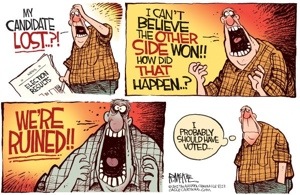
Localism was nothing more than a sound bite, created for the benefit of the media. It was also designed to con an increasingly unhappy and non-voting public, in to thinking that things were going to change for the better, when it came to local decision making.
There can be little doubt that the public have now realised that they’ve been conned, but worryingly, they don’t actually seem to care that much. Using local elections, as a way of sending a message to the government of the day, is something of a tradition in this country and may well indicate the true feelings of the majority of people when it come to local government in general and their local councils in particular.
Perhaps it’s time for political parties to bow out of any further involvement in local government. Why not require all councils to run elections without any party political logos or emblems on the ballot papers, as in the case of parish councils?
Once elected, councillors would be required to form alliances in order to form an administration. Without party politics in the mix, the public would be required to focus on the performance of the people in charge and not the political party they belong to. This isn’t a plea for proportional representation by the way, as I don’t support that, given it’s continued linkage with Party based politics.
Those who chose to form alliances and work together,min order to get each other elected and subsequently form an administration, would still be elected on their own merit and the reputation they had gained with the local electorate, not just the fact that they belonged to a particular political party, that a particular element of the electorate supports come what may. It may be something of an exaggeration, but it is suggested that some dyed in the wool voters, would vote for a gate post as long as it had their Party’s emblem on it!
An added bonus from such a system, would be the dismantling of the political party associations. These tend to be made up of those who have to be in them by default, because they are standing for election under that particular party emblem. This requirement gives some prospective parliamentary candidates a standing workforce (in theory at least), that other, non-party political candidates, don’t enjoy. Breaking the link between MPs and local government, would probably be good for the democratic process in more way than we can imagine!
Now to the point of this post and an LGC comment that partially echoes a previous posting of mine.
Copied from Local Government Chronicle online
Why Labour should not support council tax referendums
Don’t sacrifice localism on the altar of spending restraint
20 March 2014 | By Nick Golding
So who doesn’t expect Ukip to be the big winner of the local government elections, which are being held on the same day as their European counterparts?
One of the main reasons that a party set up to oppose the European Union will win seats on numerous councils is that the electorate is indifferent to voting for candidates representing regular parties who may have local policies but lack the ability to implement them.
Central government imposes cuts on councils without regard to local need and councillors have seen their powers over issues such as planning and education whittled away to the point of impotence. With representative democracy looking this unhealthy, one can understand someone’s rationale for using the local elections to make a bold statement about an issue largely unrelated to local politics or indeed not voting at all.
So the question arises of how local democracy can be reinvigorated. It is clearly an issue shadow communities secretary Hilary Benn has given much contemplation.
In his LGC interview this week, Mr Benn proposes the extension of city deals to counties, ensuring power is devolved in more places, making it more worthwhile to vote in them. The same is true of his promise that councils will get a significant role in commissioning back-to-work schemes.
However, Mr Benn says Labour is likely to retain council tax referendums, forcing locally elected politicians to navigate a prohibitively expensive and risky hurdle if they seek to safeguard services by raising bills above an arbitrary limit imposed from afar by a minister. To date no council has successfully pursued this path.
Mr Benn says the impetus to keep bills low brought about by the referendum policy will help people suffering due to the “cost of living crisis”. While it is true that council tax bills cost people dear, so too do service cuts that have had their worst impact on society’s most vulnerable. And so do opportunities to drive growth that are missed because councils lack the resources to lead on projects to create jobs.
Eric Pickles regards the council tax referendum as a device to secure democracy. Well, if that is true, will the government commit to holding polls every time a decision is required on the expenditure it controls? More likely, ministers will argue their government is the democratic representative of the people, entrusted to make tough decisions on their behalf. The same argument applies to local government.
Councillors should take decisions on local public expenditure, facing grief at the ballot box if they prove unpopular. Referendums only muddy the waters of local democracy, introducing a semblance of people power which hinders representative democracy. The fact that they are only applicable to a minute portion of public expenditure – one of the few slithers of spending not centrally controlled – makes them a democratic illusion.
The council tax referendum is a bellwether issue when it comes to local democracy. In this case Labour has sacrificed localism on the altar of spending restraint.
Nick Golding, editor, LGC
6 Million Stuck in Rent Hell
The LGA said four in five councils are unable to replace Right to Buy homes because they can only use 30 per cent of sales to build new ones.
It comes as six million people are found to be stuck in rented homes because they cannot afford a mortgage, according to a survey by Generation Rent reveals.
On the face of it, it seems like a no-brainier to suggest that the government should be allowing councils to keep 100% of the money received when a council house is sold. Unfortunately, this would not achieve the desired result, unless it was also possible to find further funding, to build a replacement.
The generous discounts, of between 35 and 60%, with a maximum of £75,000, now offered to those using the right to buy system, means that councils are only getting 30% of an already reduced house purchase price.
It’s unlikely the government will do anything to redress this, given their (currently) covert dislike for social housing.
NPPF additions, it’s becoming more and more like ‘guided’ planning
Following in the footsteps of the bovver booted Eric Pickles approach to Localism – called ‘guided Localism’, we are now seeing more and more ‘guided’ planning.

Despite their claims that this government had swept away thousands of pages of planning guidance and regulation and replace it with a 52 page, clear and succinct document called the National Planning Policy Framework, we continue to see more and more detailed additional guidance being added to fill the huge holes in the planning system, created by the NPPF.
As an aside, the NPPF was never, ever only 52 pages, end of story. As soon as it was published, I went through it, checking for how many other documents were referred to in the numerous footnotes, detailed in the small print at the bottom of nearly every page. I stopped when I got to 1800 pages plus, as my suspicions had been confirmed. Admittedly, some of these footnotes have themselves been superceded, but the fact remains, that the NPPF was a con job.
This extract from the latest addition to the NPPF +, is tantalising to say the least, given the poor quality of the new housing currently being built. The full document can be viewed by following this link.
http://planningguidance.planningportal.gov.uk/blog/guidance/
Housing design issues
Well-designed housing should be functional, attractive and sustainable. It should also be adaptable to the changing needs of its occupants.
In well-designed places affordable housing is not distinguishable from private housing by its design, nor is it banished to the least attractive part of the site.
Consideration should be given to the servicing of dwellings such as the storage of bins and bikes, access to meter boxes, space for drying clothes or places for deliveries. Such items should be carefully considered and well designed to ensure they are discreet and can be easily used in a safe way.
Unsightly bins can damage the visual amenity of an area. Carefully planned bin storage is, therefore, particularly important. Local authorities should ensure that each dwelling is carefully planned to ensure there is enough discretely designed and accessible storage space for all the different types of bin used in the local authority area (for example landfill, recycling, food waste).
In terms of parking, there are many different approaches that can support successful outcomes, such as on-street parking, in-curtilage parking and basement parking. Natural surveillance of parked cars is an important consideration. Car parking and service areas should be considered in context to ensure the most successful outcome can be delivered in each case.
We don’t need a tilt, we need an earthquake
Balance of power tilts back towards councils, by Richard Garlick
14 March 2014 by Richard Garlick

The planning minister struck a slightly penitent note when he was explaining his finalised planning practice guidance to the Daily Telegraph last week.
Nick Boles said that additions were being made to planning guidance in some areas where the National Planning Policy Framework (NPPF) was “not working as it should”.
The message to the Telegraph readers was clear: we are listening to your concerns about an NPPF-enabled development free-for-all, and we are taking steps to bring it under control.
It was the latest step ministers have taken to insulate the government from such criticisms. Only a few days earlier, Boles had written to complain about an inspector who had told Reigate & Banstead Borough Council to release green belt land, saying the latter “had invited misinterpretation of government policy”.
He can fairly argue that the finalised guidance will in some ways bolster local planning authorities’ control of development. But it would be an oversimplification to suggest that ministers are reaching for the reverse gear on their planning liberalisation.
Boles can argue that the guidance will bolster local controls on development
Alongside the guidance, Boles confirmed changes that will mean that in most places planning permission is no longer needed to convert shops outside key shopping areas, or agricultural buildings with a floor space of up to 450 square metres, into homes.
These are major incursions into local democratic control of development. What’s more, the guidance itself instructs planning authorities to leave no stone unturned in the struggle to make brownfield sites viable and competitive with greenfield alternatives.
Commentators have suggested that this will force councils to accept lower design standards on brownfield sites than elsewhere, as well as relinquishing any claim to deciding the scale of developer contribution necessary to provide the infrastructure needed to support the scheme. Boles may be bolstering councils on some fronts, but he continues to undermine them on others.
That said, the finalised guidance does offer genuine reinforcement for town halls.
No longer is it the government’s position that only “in exceptional circumstances” will applications be dismissed as premature in terms of prejudicing an emerging plan. Guidance now spells out that the duty to cooperate is not a “duty to accept”, and planning authorities are not obliged to meet their neighbours’ unmet needs. Unmet housing need is unlikely to constitute the “very special circumstances” needed to justify development in the green belt, the guidance says.
Not of all these provisions are major changes to the status quo. In some cases, the finalised guidance is confirming an approach that councils have already been arguing for successfully in front of inspectors, or which the secretary of state for communities and local government has been enforcing in call-ins. But, cumulatively, these and other measures in the guidance look likely to, in some sectors at least, slightly tip the balance of power back towards local authorities.
Richard Garlick, editor, Planning richard.garlick@haymarket.com.
It’s called throwing the baby out with the bath water

I can’t believe that these councillors can be so naïve as to think they would gain support from the planning puppet master, Nick Boles. How can they not realise that the Planning Inspectorate (PINS) is simply doing what it is told by DCLG and it’s current incumbents, Eric Pickles and the hyperactive Nick Boles? They in turn, are of course under the thumb of George Osborne, who seems to believe that building hundreds of thousands of houses,min a short space of time, will be the saviour of the UK economy.
If you want to improve things in planning terms, don’t throw out what’s been proven to work over many years, instead, get rid of the ‘external elements’ that are undermining it.
PINS fulfils a vital role, by addressing the sometimes aberrant behaviour of some planning departments and their associated planning committees. How else would an applicant, with a perfectly reasonable planning proposal, gain redress against a council that had refused that application, despite it being in compliance with both local and national planning policies?
Until you can be sure that elected members will always behave in a totally professional and unbiased manner, when considering an application and that planning officers will get it right every time, PINS will continue to be an essential element of the planning system.
Copied from Local Government Chronicle online
Leader urges Planning Inspectorate abolition
12 March, 2014 | By Mark Smulian
A council leader has called for abolition of the Planning Inspectorate after being sent a “bitterly disappointing” letter by planning minister Nick Boles.
A delegation of North Devon DC councillors (pictured) led by local MP Sir Nick Harvey (Lib Dem) handed in a letter at 10 Downing Street and met Mr Boles to highlight problems created by government planning policy on their community.
Council leader Brian Greenslade (Lib Dem) said that while the minister had been encouraging when they met his follow-up letter was short, unhelpful and evasive.
“I think he was got at by civil servants after our meeting,” Cllr Greenslade said.
The council delegation, led by local MP Sir Nick Harvey (Lib Dem), raised concerns about the refusal of planning inspectors to count inactive sites with planning permission towards councils’ required five-year land supply for housebuilding, and inspectors’ habit of substituting their own decisions for those of councils.
North Devon also objected to proposals to deprive councils of the New Homes Bonus where planning permission is given only after an appeal to inspectors.
“We were all bitterly disappointed with the short response from the planning minister, who avoided all of our main points, despite making positive comments to our councillors at the time of the meeting,” Cllr Greenslade said.
He added: “We believe that the localism agenda and the restoration of democracy to planning will be greatly enhanced if Mr Pickles were to follow the example he set when he scrapped the Audit Commission by also scrapping the Planning Inspectorate.
“I understand this is a course of action favoured by a number of Conservative MPs.”
Our way of recycling should be safe – for now
Copied from Local Government Chronicle
Be aware of new recycling regulations
11 March, 2014 | By Andrew Bird
The Department for Environment, Food & Rural Affairs recently published the long-awaited materials recovery facility regulations and a summary of responses from last year’s consultation.
The regulations aim to drive up the quality of both materials entering such facilities and the output of materials sold on for reprocessing.
A mandatory code of practice will come into effect this autumn, requiring all facilities processing more than 1,000 tonnes of material to sample and report on inputs and the various materials streams resulting from sorting and separation.
While I think the regulations could have gone further, I welcome their introduction.
They will serve to increase confidence in the purchasing of materials from MRFs by reprocessors, supporting the move towards a more circular economy.
The regulations will be enforced by the Environment Agency and Natural Resources Wales through one pre-arranged inspection and one unannounced inspection each year.
So what will the code mean for councils?
It should enable them and waste companies to demonstrate greater transparency and provide mechanisms which help reassure residents that the efforts they put into recycling result in high-quality materials.
It will also help reassure that the commingling of recycling collections can deliver high-quality materials, and help to provide a more robust monitoring framework to assess whether commingled collections meet the requirements of the revised Waste Framework Directive, or TEEP.
So what is TEEP?
In essence it refers to it being technically, environmentally and economically practicable to collect each material separately.
Technically practicable means that separate collection may be implemented through systems developed and proven to function in practice.
Environmentally practicable means the added value of ecological benefits justifies possible negative environmental effects of separate collection.
Economically practicable refers to separate collections that do not cause excessive costs in comparison with the treatment of a non-separated waste stream, taking into account the added value of recovery and recycling and the principle of proportionality.
If you are not currently aware of the implications of the revised Waste Framework directive and its implications for your authority, you need to consider them urgently, and particularly if you are considering changes to the way you collect materials for recycling.
Here are the articles pertinent to Waste Collection Authorities:
Article 4 – Waste hierarchy
Article 10 – Recovery. Paragraph 2 – first mention of waste needing to be collected separately to facilitate or improve recovery if it is TEEP.
Article 11 – Re-use and recycling – about promoting re-use of products and high-quality recycling
Article 13 – Protection of human health and the environment
Article 15 – Responsibility for waste management
If you are unaware of the implications of the revised directive and its implications for your authority, you need to consider them urgently, particularly if you are changing the way you collect materials for recycling.
These requirements come into force in 2015, so decisions taken now and in the future need to be robust.
Andrew Bird, chair, Local Authority Recycling Advisory Committee
Could you ever get 66.6% of 4.5 million people to agree to anything?
Copied from Local Government Chronicle online
Lib Dems offer councils devolution route
10 March, 2014 | By Mark Smulian
The Liberals want to try to reintroduce regional government for some reason, despite it being a failed experiment under Labour. The danger for Lincolnshire, with a total population of less than 800,000, is that it could end up with regional government by default. The suggestion is that every local authority, would have to achieve a vote of two thirds in favour, but two thirds of what? Also, how would it work if you got a patchwork quilt of councils, where neighbouring authorities voted differently?
General elections average a turnout of over 70%. Local government elections are often lucky to get more than a 30% turnout. The elections for the Police and crime Commisioners, that took place in 2011, averaged a miserable turnout of 15%. Would you be happy to end up back in a regional government arrangement, based on a 15% turnout?
The Liberal Democrats would offer English councils a ‘devolution on demand’ mechanism, the party’s spring conference has decided.
Delegates meeting in York at the weekend voted for the idea, defeating a large minority who preferred a move to devolution throughout England based on the old regional development agency boundaries.
Under the Lib Dem plan, a council or councils comprising at least one million inhabitants would be able to apply for a range of devolved powers similar to those enjoyed by Wales.
Such a change would require a two-thirds majority vote by each local authority involved.
Supporters of the idea argued that this would allow those parts of England that wanted devolution – such Cornwall and major northern conurbations – to go ahead, while areas with little enthusiasm would not have devolution foisted on them.
But opponents argued that assembling the required two-thirds majorities would be difficult, and that even if they could, there would be an untidy patchwork of devolved areas potentially with, for example, a devolved county surrounding a city that was not without devolved status.
Policy working group chair Dinti Batstone said devolution on demand would work better than uniform regional government, citing voters’ rejection of this in the north-east referendum in 2004.
“England does not want a Prescott-style top-down devolution approach,” she said.
Calling for restoration of the old region as a tier of government, Leeds party member Mick Taylor said: “This resolution calls for devolution to a mishmash of collections of local authorities. Are we going to have the NHS devolved in some places but not others?”
He also complained that the paper did not confer automatic tax raising powers on the devolved areas.
The paper offered immediate devolution to Cornwall because of its cultural identity, and further powers to London building on its already semi-devolved status.
It also called for the use of the single transferable vote system for all English local elections, as used in Scotland.
As an interim measure the party would devolve more powers to city deal and growth deal areas.
Answering questions from party members at an earlier session, deputy prime minister Nick Clegg made clear his support for decentralising power further in England.
He said: “City deals have been a really important innovation. I want that approach extended to across the whole country to other cities, to urban and rural areas.”
Is LGA whistling in the wind, because it’s a ‘European’ report?
Copied from Local Government Chronicle online
LGA demands more power for England
7 March, 2014 | By Marino Donati
The LGA is calling for greater devolution of powers to English councils after a European report concluded that local authorities in Wales and Scotland were better off.
The report from the Council of Europe, Local and Regional Democracy in the United Kingdom, expressed concern about “the financial resources of local authorities, their limited taxing powers and their dependence on government grants”.
It concluded: “Despite significant cuts, in Wales and Scotland local authorities are (still) better off financially than their English counterparts, but lacking diversity of local finances is a concern also there.”
The report said that “ambiguities” around the lack of recognition of the right to local self-government in the law beyond the general powers granted by the Localism Act 2011, also needed to be addressed.
It recommended the UK government reduce the financial burden on local authorities from budget cuts. It also called for better consultation arrangements for local government for “taking into account the necessity or opportunity for local authorities to consult their local population”.
LGA chairman Sir Merrick Cockell (Con) said that English councils were being “short changed” and called for the current model for the financing and running of local government to change.
He said: “Devolution of decision-making and tax-raising powers to local areas is needed to help save money and improve services and English communities need to be given the same significant say over everything from health services to public transport as they do across the border in Scotland, Wales and Northern Ireland.
“Our European counterparts also identified the urgent need for a fair and equitable distribution of public money across the United Kingdom, The 34-year-old Barnett Formula is short changing English communities by as much as £4.1bn a year and a needs-based model is needed for a fairer deal.”
The report also raised concern about councils’ ability to meet international obligations. It said: “A fundamental question in relation to Article 9 of the Charter [European Charter of Local Self-Government] is whether local government will have adequate (own) financial resources and whether these are commensurate with its functions.”
The Council of Europe regularly reports on the state of local and regional democracy in the EU’s member states. Its local government arm, the Congress, is responsible for the monitoring of local democracy in member states by assessing the application of the European Charter of Local Self-Government, which was adopted in 1985 and ratified by the UK in 1998.
Responding to the report, local government minister Brandon Lewis said: “The coalition government has delivered a fair settlement to every part of the country – north and south, rural and urban, metropolitan and shire. We have given councils new financial flexibilities, such as the local retention of business rates and scrapped top-down interfering quangos.”
 Roger Gambba-Jones