County councillor response in Voice is a fiction

Cllr Reg Shore, the Lincolnshire County Council portfolio holder for Waste & Recycling, appears to have read a completely different document to me, based on his recent letter in the Spalding Voice.
The county council have not been doing any ‘working with’ as far as South Holland is concerned. What they have done, is tell us that they will no longer be paying recycling credits to the three Lincolnshire councils that have their own recycling contracts. As if that wasn’t enough, they have also told these councils, that the county is taking over the disposal of the recycling that these councils collect.
Just to add insult to injury, the county council has put in place something they are calling transfer payments. The double whammy for the three councils affected, is that these payment will be made to all seven councils, including the four that are not actually loosing any recycling credits, or contract revenue.
Cllr Shore has kindly informed readers that I was wrong about the county council grabbing the £10 a ton South Holland currently receives. At the time of writing my previous blog entry on this issue, I was not privy to the details of the contract the county council had negotiated. Imagine my surprise, when I read a briefing note stating that Lincolnshire County Council had secured a contract that gives them NO REVENUE! Ironically, Cllr Shore emphasises this point in his letter, as though it is somehow to his and the county council’s credit – extraordinary!!
Just to be clear; Lincolnshire County Council will stop paying South Holland DC and two other councils, North and South Kesteven, £42 a ton in recycling credits from 2016. Also, with immediate effect, SHDC will be loosing the £10 a ton paid by the materials contractor and that helped to support our recycling collections.
The financial impact for South Holland will be:
– £377,830 after three years
– £895,570 after five years
Cllr Shore’s claim that every council will gain financially and that this should be viewed as ‘a real opportunity’, is technically correct, but only if you ignore completely the last 20+ years of recycling credit payments received from LCC and the last 3 years of revenue, received for our recycling, from our various contracts.
The proposal now, is that we all pretend that the last 20+ years of recycling never happened, that there were no recycling credits and that we were never able to sell our recycling. We also have to ‘pretend’ that we haven’t managed to achieve a recycling rate of 30%. This is because the county council has offered to make incentive payments for any increase in recycling rates, from this point forward. They have also offered to share some of the revenue they receive from the contractor – a contract that currently provides no revenue – how generous is that!
Had the county council been more upfront and open about these proposals and agreed to discuss openly all of the financial issues, there would have been no need for this hostility. Unfortunately, the only image in Cllr Shore’s ‘big picture’ is the one showing the county council, with every other council in Lincolnshire conveniently cropped out.

As a footnote, the government has just announced the financial settlement
For the forthcoming financial year. South Holland will be loosing a further 6.2% of its funding, equivalent to £0.755m.

Psychological test for UKIP MPs & MEPs – what about your councillors?

Apparently, UKIP are concerned about the ‘mental state’ of those wishing to become an MP, or MEP for their party.
However, there’s no suggestion that they have the same concerns about those wishing to become councillors. Does that mean that these potential candidates are somehow different, or of better ‘mental state’ than their prospective MPs and MEPS colleagues? Of course they aren’t, in fact, quite the opposite, given some of the press reports in recent months.
Indeed, the performance of UKIP councillors, elected to Lincolnshire County Council in 2013, strongly suggests that those wishing to enter local government politics, as UKIP councillors, definitely need their heads testing!

UKIP chief says half his time is spent weeding out “lunatics”…

UKIP logo“The man in charge of vetting Ukip’s election candidates has complained that ‘half my time is spent weeding out the lunatics’. David Soutter, who found himself at the heart of a party sex scandal last week, has been conducting psychological tests on prospective MPs and MEPs in order to ensure that they are ‘vaguely sane’. During a speech at Ukip’s Welsh conference last weekend, Soutter admitted that the party lacks discipline” – Sunday Times (£)

…but a UKIP candidate denounces his “pooftah” colleagues

“The UKIP activist picked last week to fight a key Parliamentary seat made homophobic, racist and obscene comments and accused Nigel Farage of corruption, it was revealed last night. In tape-recorded phone calls leaked to The Mail on Sunday, Kerry Smith, chosen to fight Ukip target seat of Basildon South in Essex, mocks ‘f***ing disgusting old pooftahs’…Makes baseless claims about party leader Farage accepting a bribe to promote a Ukip ally over another rival” – Mail on Sunday

Councils continue to suffer from the Labour legacy

Copied from Local Government Chronicle online
Next five years to see higher-than-expected cuts
10 December, 2014 | By Kaye Wiggins

Council spending is set to be over 4% lower than previously projected in both 2016-17 and the following two years, it has emerged, after George Osborne heralded “colossal” spending cuts.

Forecasts published by the Office for Budget Responsibility in the wake of the autumn statement last week showed “net current expenditure” by English local authorities would be £106.9bn in 2016-17, down from the £111.9bn forecast by the watchdog in March.

The OBR’s latest forecast for 2017-18 spending is £106.9, down from £111.6bn in its March forecast. In 2018-19 the OBR predicts spending will fall by £4.9bn more than it forecast in March.

The revised forecasts, which have emerged as councils await the publication of the provisional local government finance settlement for 2015-16, were due in large part to a steeper-than-assumed fall in central government grants to councils.

This came after the publication of the autumn statement revealed plans to accelerate public spending cuts in a bid to balance the budget by 2018-19 and generate a surplus by 2019-20.

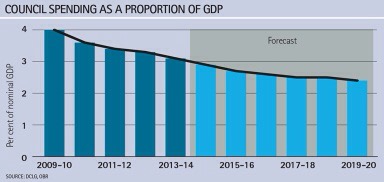
The OBR’s gloomy forecasts also showed local authority current spending, excluding education, public health and housing benefit, would fall from 4% of nominal GDP in 2009-10 to 2.5% by 2019-20. In 2014-15 the figure is 2.9%.

In a speech on the day of the autumn statement, OBR chair Robert Chote said there was “no robust basis” on which to assume that cuts in overall public spending were “undeliverable”.

Mr Chote noted that councils were “in aggregate still adding to their financial reserves rather than running them down.”

The OBR’s figures showed non-schools reserves would rise from 10.7% of councils’ net current expenditure in 2009-10 to 24% in 2019-20. The watchdog has assumed councils will add to their current reserves by £1.5bn in 2014-15 and will continue to add to their reserves, but by decreasing amounts, until 2018-19.

The OBR reached its figures using Treasury policy assumptions for total spending after 2015-16, assuming grants to local government remained the same as a proportion of overall spending as they were due to be in 2015-16.

The figures emerged as Paul Johnson, director of the Institute of Fiscal Studies, said public spending cuts would be made on a “colossal scale” over the next five years. This could cause the “role and shape of the state” to change “beyond recognition”, he said.

Jon Rowney, London Councils’ strategic lead for finance, procurement and performance, told LGC: “Our early analysis suggests the pace of the cuts could be steeper and faster than previously thought.” The body had previously estimated London boroughs would see a 60% reduction in core funding from central government between 2010-11 and 2018-19.

Local government minister Kris Hopkins said: “What these figures actually show is a big increase in council reserves. Local authorities should of course maintain a healthy cushion when balancing the books but such substantial reserves are completely unnecessary and should be tapped into to protect frontline services and keep council tax down.

“Councils should be making creative use of reserves to address short-term costs, such as restructuring or investing now to realise savings in the longer-term.”

IMG_1373.JPG

Recycling rates under threat

Although we in South Holland are currently enjoying some success in our campaign to increase recycling, the article below highlights the challenges yet to come.
Just some of the emerging issues for us, will be the end of the external funding pot we succeeded in gaining a couple of years ago. Added to this, Lincolnshire County Council, in their wisdom and for no other reason than to save money for themselves and grab the available materials revenue, are in the process of taking control of our recycling. We will have to continue to collect the recycling, but the council will not receive any recycling credits from the county council, with the county also receiving the £10 a ton we currently get.
As is usual with everything the county council does, it hadn’t thought through the details and have now had to come up with an incentive scheme for those districts they have ‘stolen’ recycling collections from. Without such a scheme, why would we bother to continue to put any effort into increasing our recycling collection rate?
Further pressure is also being applied by the recycling industry, under the cloak of an environmental pressure group. Supposedly committed to ‘saving the planet’ by increasing recycling rates, the group is actually funded by the recycling industry, so have more of a financial imperative than an environmental one. I believe that, despite loosing a high court case, they are still trying to ‘force’ councils into collecting recycling in separate streams, as opposed to a single container, as we do in South Holland.

Copied from Local Government Chronicle online
Recycling could fall for first time this century
8 December, 2014 | By Corin Williams

Local authority budget cuts and new recycling standards could lead to a reduction in England’s recycling rates for the first time this century.

With a tiny 0.05 percentage point increase in English local authority household recycling between 2012 and 2013, to 44.16%, it is now considered highly unlikely that the UK will meet the target set by the EU that 50% of waste will be recycled by 2020.

The Chartered Institution for Wastes Management (CIWM) said there was a “real risk” that recycling rates would decline over the next 12 months.

Chief executive Steve Lee said: “We have seen a lot of welcome emphasis recently on recycling quality. Now the government must put quantity back at the top of the priority list.”

A new code of practice aims to boost the quality of waste materials sent for recycling. One consequence of this could be that waste management companies increase the quality threshold for material they receive from local authorities – thereby reducing the recycling rate.

Steve Rymill, a waste management consultant at the environment and energy firm Ricardo-AEA, told LGC’s sister title Materials Recycling World that councils’ environmental and regulatory service budgets had fallen by 16% between 2010-11 and 2013-14.

“Authorities have been evaluating what their statutory service requirements are and this has meant that a number of areas, such as communications and food waste collections, have been subject to significant cuts,” he said.

The budget just isn’t there to fund the much-needed communications campaigns required to further improve recycling performance.

“The authorities that have seen big increases in their recycling rate are where they have generally coincided with a service change – something which requires positive communications messages to residents.”

Mr Rymil said it was a particular concern that some councils had actually seen a decline in rates, which was partly blamed on street sweeping being reclassified and garden waste services being retracted.

“We’d expect this to continue next year, as more authorities are considering paring back their service, where permissible.”

Phil Conran, director at consultancy 360 environmental, told MRW some councils with high rates were seeing a significant proportion rejected with contractors complaining the material was not good enough to recycle.

High recycling rates achieved at the expense of quality are generally not sustainable,” he said.

“Some [recycling plants] might prevent local authorities from delivering [mixed]materials with glass in it, because of quality issues and because of the potential impact of the code of practice. If they revert to bottle banks to collect glass rather than as part of the mix, that would potentially depress recycling rates.

“I think there is every possibility that the rates will decline.”

Mr Conran added that many questions remained over why some English councils achieved high rates when others floundered. “The UK clearly can achieve [the EU target of] 50%. It’s just a matter of bringing everyone up to best practice,” he said.

Meanwhile, the latest statistics on waste and recycling in Wales indicate the country is on track to meet its 2015-16 statutory target, the Welsh environment ministry has said, with one council recycling more than 70% of its waste.

Between April and June, Welsh local authorities recycled, reused or composted 58% of municipal waste, an all-time high.

This is in line with a 58% target for 2015-16.

“Wales is the only UK nation to set statutory recycling targets and we are leading the way in the UK,” said natural resources minister Carl Sargeant. “Welsh local authorities are already meeting the European target of recycling a minimum of 50% by 2020.”

Most Welsh councils reported a quarter-on-quarter increase in the period and recycled over half of the waste they collected, except for Rhondda Cynon Taf, which slipped six percentage points to 47%.

The best performer was Denbighshire, which topped the table with a municipal waste reuse, recycling and composting rate of 71%, followed by Pembrokeshire at 69%, Monmouthshire at 66% and Bridgend at 64%.

DCLG is local government’s version of Bird Flu

Copied from Local Government Chronicle online
NAO report proves it’s time to axe the DCLG
19 November, 2014 | By Nick Golding

The National Audit Office’s report into the financial sustainability of local authorities is a suitably damning epitaph for the Department for Communities & Local Government’s stewardship of council finances this parliament.

It is packed full of nuggets which leave one questioning the competence of the DCLG to oversee a funding system which helps determine whether the vulnerable young and old receive adequate care, the economies of towns and cities grow and hundreds of thousands of local government workers receive fair reward for difficult jobs.

The DCLG “does not have an accurate measure of the cumulative financial challenge facing local authorities,” Sue Higgins, the NAO’s executive leader of local services, says.

It “does not have an accurate measure of the cumulative financial challenge facing local authorities” and is “unsighted” on the extent to which councils might financially fail.

The time has come to abolish the DCLG and invest the savings in efficient local services
The list of charges levied at the DCLG would be astonishing had the last four-and-a-half years not happened. As it is, councils are all too used to hearing Eric Pickles blustering on about flags or complaining about “spy cars” and avoiding proper debate about the central funding decisions which meant they were being forced into a position where they had to deny older people care or close flagship facilities.

Now we get confirmation that the department has not even had the curiosity to analyse the impact of a radical set of policies.

While the NAO says councils will see a 25% real-terms cut to their total income between 2010 and 2016, the DCLG has not even been able to produce a figure for spending pressure to be meaningfully calculated over the course of the parliament. Metropolitan authorities in particular are quaking under the burden of the cuts they are being forced to make and the DCLG’s response consists of little more than burying its head in the sand.

This is not to say that it is wrong to seek to balance the books. The deficit will hamper future generations and has to be tackled. It is right that the public sector should become more efficient and councils’ performance at retaining frontline services and rooting out unnecessary expenditure has been truly commendable.

However, we have long seen the DCLG’s political leadership fail to engage in a meaningful debate about where the burden of cuts is targeted. There has been no attempt to stand up for local services or to query whether certain parts of the country, namely the north, are being disproportionately affected.

If the department which is supposed to be local government’s gateway to the rest of Whitehall cannot successfully undertake its responsibilities then it should be axed.

We all too regularly see interaction with the Treasury or Department for Business, Innovation & Skills prove more fruitful for councils than that with the DCLG and it was no surprise when Greater Manchester’s mayoral deal was hatched with the Treasury, not Eric Pickles’ department. The time has come to abolish the DCLG and invest the savings in efficient local services.

A lesson in planning from the Germans?

We will probably never experience a totally pain free development process in this country; nimbyism has become too ingrained in our culture. However, we could go a long way towards reducing the almost universal resistance we currently experience, to new housing, by actually delivering the high quality development, instead of just talking about it.

The question is, how do you ‘force’ developers to build homes that have suitable room sizes, enough inside storage, outside storage for wheelie bins and bicycles, sufficient off street parking – and of course, look good?

In defence of developers, they often start on the back foot, by paying too much for the land they want to build on.  It’s easy to suggest that this is the developers’ fault and that they should just refuse to pay the inflated prices demanded by the landowners.  However, developers have businesses to run and would soon be on the breadline if they held out for a more sensible price, as there will always be another developer willing to pay.

So what’s the answer? Whilst there are many who distrust much about Europe – mainly because of the EU – we do admire much of what the Germans do and the way they do it. As well as their black and white traffic laws, highly efficient manufacturing base and litter free streets, the Germans also seem to have a planning system, that delivers high quality housing.

They do this is two ways. Firstly, they use zones of development, within which building can take place without the need to go through the sort of planning processes we use in this country. Of course, underpinning these zones, there are a raft of design and development guides, that have to be applied to the build.

The second thing they do and the one that must surely allow them to deliver high quality development, along with the required infrastructure and facilities, is exercise a degree of control on the price of land.  They do this by ensuring that there is enough of it available to satisfy demand, thereby avoiding the sort of price inflation that always happens when something is in short supply and high demand.

I suspect the present government has attempted to mimic the German system to some extent, by requiring all local authorities to have a Local Plan identifying a five year supply of housing land.   In addition to this five year land supply, councils must also have an ‘objectively assessed need’ of what housing is required for their area.   In practical terms, this means that the council can’t just produce a Local Plan and stick it on a shelf the next 20 years, as seems to be the passed practice.

Of course, this housing needs assessment and five year housing land supply requirement has not gone down well with the majority of councils, especially those in areas where house prices are high, such as the south east and rural areas adjacent to large cities.

The politicians in these councils are screaming blue murder about concreting over the countryside, the loss of the green belt and urban sprawl, all this whilst ignoring the increasing demand for housing and the ever increasing difficult for young people trying to get on the housing ladder.

Frustratingly, the government has failed to explain the thinking behind the changes introduced by the National Planning Policy Framework, fuelling the suspicion that these changes are more about the bank accounts of the developers, than providing homes that people can afford. This suspicion is further reinforced, by the trump card government handed to developers, in the form of a viability test.

The viability argument allows developers to wriggle out of providing affordable housing, community facilities and just about anything else they believe will, according to them, make the development financially unviable. Which of course rolls us all the way back to the price paid for the land in the first place. If you provide enough of anything to satisfy the demand, then the cost of the commodity on offer, in this case land, not only remains stable , but often reduces in real terms. Clearly, we’re not ‘making’ any more land, so it has its own dynamic when it comes to value. As such, it wouldn’t be helpful to compare it to something that was in the past expensive to produce and therefore expensive to buy, but now has become affordable to all, such as the simple cup of tea, but it does help to set the scene. Provide enough of anything and then make it readily available to those who want it and the price of it finds an affordable level. That seems to be the very simple rule the Germans have used.

Something every planning committee already knows

Copied from Local Government Chronicle online

Homeowners prevent housebuilding, report finds
24 October, 2014 | By David Paine

House-building rates are lower in local authority areas with higher proportions of homeowners, according to analysis by the Institute for Government (IfG).

The report,‘Housing that Works for All – The Political Economy of Housing in England’, covered the period from 2001 to 2011.

It follows the publication of the Lyons housing review, which outlined how up to 200,000 new homes a year could be built by the year 2020.

The IfG said there was a risk of planning decisions being biased in favour of current homeowners.

This was in part because of a lack of city or region-wide planning co-ordination, which meant planning policy operated “exclusively at the local level and is responding to the interests of local residents”.

It said new developments often created new infrastructure costs for councils, and extra demand for public services, yet the increase in revenues from developments was “limited”.

The report also warned that the requirement for planning permission to be granted for any change of land use made decisions “slower and more uncertain”. Homeowners were among the most likely groups to oppose new homes, it said.

Miguel Coelho, IfG fellow and co-author of the paper, said: “A common accusation is that planning decisions tend to cater for the interests of current homeowners, rather than allow for a wider, more balanced set of interests. New empirical presented in this paper lend support to this hypothesis.

“Our analysis shows in particular that in the decade to 2011, housing stock grew significantly less in local authorities where there were higher proportions of owner-occupiers amongst local households.

“Credible proposals to reform the planning system should address this problem and ensure that planning decisions allow for the full breadth of interests affected by development.”

However, the paper acknowledged reforming the planning system would be difficult.

It claimed there had, so far, been a lack of public support to do so, and that the wealth of households and health of the UK financial sector had “become inextricably intertwined with the macro-economy, thus undermining the case for fast, radical reform”.

It also claimed that “successive governments have struggled to find a sensible balance between regional/national planning co-ordination and local democratic legitimacy”.

HAVE YOUR SAY

Exorbitant spending on Overseas Aid hasn’t made us any safer

One of the reasons given by David Cameron for his year on year increases in the Overseas Development budget since 2010 – well beyond that of any other European country – is that it will make our country a safer place, by helping those in foreign countries, improve their lot and become less radicalized by political extremists.  It has in fact, done nothing of the sort and will never do so, as long as we give the extremists reason, in their eyes, to see our country as their enemy and oppressor.

Some might suggest that our history as a colonial power, exploring and exploiting the world over many centuries,  had already done the damage, but I don’t believe that, given that many of our previous colonial conquests, remain members of the Commonwealth.  What has done the real damage and made us especially vulnerable, is our much cherished special relationship with the USA and our willingness to march shoulder to shoulder with them, into recent middle eastern conflicts.

Whilst successive Westminster leaders of all political persuasions, have viewed this relationship as the Holy Grail of international politics, giving the UK much great influence and kudos than it might otherwise have, I see it more as putting a target on the backs of every British citizen living and working in some of the most volatile areas of Africa and the Middle East.

Multiculturalism, a legacy of the Blair years, but again eagerly pursued by virtually all administrations, has opened our doors and left us vulnerable within our own boarders, something the Americans have bent over backwards to eliminate, post September 2001.  Live and let live, when those you are letting live in their own extremist ways – Sharia law is a very good example of this, along with female genital mutilation, is an irresponsible and ultimately dangerous political doctrine to pursue.

The upshot of this government’s single minder pursuit of international glory, often described as, ‘punching above our weight’ – a rather unfortunate term to use when you are supposedly trying to be everybody’s friend – is that an increase in spending in one area, has to be matched by a decrease elsewhere.  This applies even more so, when you are in the middle of a global financial crisis, but still determined to spend, spend, spend!  Which brings me to my point and the reason I have borrowed the article below.

Before anybody starts telling me that, despite all the cuts in local government funding, taxpayers haven’t noticed any reduction in services, I’d like to put that in some context.

Yes, most, if not all the essential services have been maintained to a good standard and residents won’t have seen their bins left un-emptied, streets knee deep in litter, or grass too long see over, let alone walk through.  Council houses are still being allocated and maintained and benefits are still being paid out on time.

However, what is suffering and will be cut even further in years to come, are those things we call discretionary – the things councils do because they believe their residents would like that service to be provided, even though the law doesn’t require it.  Leisure centres, youth clubs, play equipment, sports pitches, libraries, public toilets and maybe even usable, or at least affordable, burial grounds, could all disappear from localities, as cuts in local government funding continue for years to come.  Remember, all this is being done under the banner of deficit reduction, whilst the overseas aid budget continues to grow and grow, year on year.

Copied from Local Government Chronicle – 23 August 2014

Author – Tony Travers, director. Greater London Group, London School of Economics

The government will soon be spending twice as much on international development as councils can on highways

Under cover of mid-summer, the government has published two sets of figures about public expenditure.

The Department for Communities and Local Government revealed local authority revenue spending and income totals for 2014-15, while at the start of this month the Treasury belatedly released the annual Public Expenditure Statistical Analyses volume. Together these publications show how the years of austerity have affected individual services.

Although some parts of central government, notably the Home Office, defence and transport, have seen reductions of 100/o or more in their cash budgets, all the biggest programmes have been protected.  Council spending, by contrast, has been forced down at a remarkable pace.  The UK government will soon be spending twice as much on international development as English councils can afford to spend on highways and transport. Housing, roads, environment and planning have seen their cash expenditure fall by almost 30% in four years. In real terms, the cut is over 40%.

Council productivity increases must be among the greatest ever achieved by the public sector.  Planners appear to be processing as many applications in 2014 as in 2010 with barely half the resources. [What the planners are probably doing, is giving up the fight to maintain standards, given that the NPPF was written by developers, for developers and just passing applications to meet the targets set by Whitehall]. 

The government and opposition have no choice but to find additional money for the NHS: fear of public opinion will open the Treasury’s vaults. Pensions, as the biggest part of social security, are triple-locked into inflationary increases. Schools cannot be denied cash.

By 2020, many council spending programmes will have been halved within a decade.


CENTRAL AND LOCAL GOVERNMENT SPENDING CHANGES

  2010-11  £millions 2014-15  £millions Change %
Local government
Housing

2,733

1,945

-28.8

Highways & transport

6,661

4,814

-27.8

Environment, planning, culture

10,959

9,029

-17.6

Social care

20,851

22,090

+5.9

Central government
International development

5,930

7,870

+32.7

Social security

164,512

184,380

+12.8

NHS

97,469 109,650

+12.5

Education

50,387 54,500

+8.2

Districts face loss as county waste deal ends

Copied from Local Government Chronicle online
13 August, 2014 | By Corin Williams

Districts in Lancashire are challenging the county council’s plans to change the funding system for waste collection in a way they say could cost them hundreds of thousands of pounds.

Lancashire CC has said it will no longer fund district councils for each household they supply with a kerbside recycling collection after the present agreement, which began in 2004, runs out in 2018.

Districts will instead be paid by recycling credits issued for the tonnages of recyclable materials they collect.

Wyre BC leader Peter Gibson (Con) has warned his council would face a revenue reduction of more than £980,000, equivalent to a 15% increase in council tax, as a result of this change.

He said in a report to a council meeting that recycling credits were an unreliable payment method as “districts couldn’t predict what their recycling levels would be and this made financial planning more difficult”.

Eleven districts are involved in the existing deal with Lancashire, the exception being Ribble Valley BC.

A Lancashire spokesman told LGC’s sister title Materials Recycling World: “The county council has made the waste collection authorities aware that it is considered highly unlikely that these agreements will be further extended once they expire in 2018 in order to ensure that they have sufficient time to plan their financial strategies beyond this date.”

This story could just as easily be about Lincolnshire County Council and its treatment of Lincolnshire district councils – but worse!

Each Lincolnshire district council already pays for its recycling collection service and only get recycling credits from LCC. The county are now stopping the payment of recycling credits AND taking over the disposal contract, so that they collect the revenue that is currently paid by the contractors.
Revenue from recycling is never a certainty and depends on a global market so, to be fair, the county council is at least taking on that risk. However, as the world recovers from the financial crisis, the risk becomes significantly lower.
This move by LCC, is a financial double whammy for South Holland and two other Lincolnshire district councils. Out taxpayers will still have to pay to collect recycling, but now the cost will not be offset, in part at least, by the payment of recycling credits, or revenue from the contract.

Spalding Today website infested by trolls?

internet troll – Web definitions
In Internet slang, a troll is a person who sows discord on the Internet by starting arguments or upsetting people, by posting inflammatory, extraneous, or off-topic messages in an online community, either accidentally or with the deliberate intent of provoking readers into an emotional response …
http://en.wikipedia.org/wiki/Internet_troll

It seems the last place to go, if you want to get an insight into what people in South Holland think about a a local issue, is the website run by our local newspaper.
Oh don’t get me wrong, you’ll get plenty of opinion, but only from a very small element of the population – six at the last count. However, these opinions won’t be from what one could call right minded, or informed people, hence my inclusion of the above definition.
Although the screen names are different, the tone of their comments are not. To a man and possibly woman, they all display the same uninformed, spiteful, small mindedness.
Indeed, I’ve yet to read one that doesn’t sound like it’s come from somebody holed up in a darkened room and fermenting on the conspiracy theory that, all councillors are corrupt and the district council is out to destroy South Holland, one piece at a time.
Unfortunately, these trolls display little, or no grasp of even the basic facts behind the online stories they comment on – all they know is what they read on their screens – so it would be pointless to enter into any sort of constructive online debate with them. Indeed, I don’t think they even care about the content of story, they just see it as an opportunity to snipe and sneer at others.

IMG_0321.JPG