We don’t need a tilt, we need an earthquake

Balance of power tilts back towards councils, by Richard Garlick
14 March 2014 by Richard Garlick

20140315-011903.jpg

The planning minister struck a slightly penitent note when he was explaining his finalised planning practice guidance to the Daily Telegraph last week.

Nick Boles said that additions were being made to planning guidance in some areas where the National Planning Policy Framework (NPPF) was “not working as it should”.

The message to the Telegraph readers was clear: we are listening to your concerns about an NPPF-enabled development free-for-all, and we are taking steps to bring it under control.

It was the latest step ministers have taken to insulate the government from such criticisms. Only a few days earlier, Boles had written to complain about an inspector who had told Reigate & Banstead Borough Council to release green belt land, saying the latter “had invited misinterpretation of government policy”.

He can fairly argue that the finalised guidance will in some ways bolster local planning authorities’ control of development. But it would be an oversimplification to suggest that ministers are reaching for the reverse gear on their planning liberalisation.

Boles can argue that the guidance will bolster local controls on development
Alongside the guidance, Boles confirmed changes that will mean that in most places planning permission is no longer needed to convert shops outside key shopping areas, or agricultural buildings with a floor space of up to 450 square metres, into homes.

These are major incursions into local democratic control of development. What’s more, the guidance itself instructs planning authorities to leave no stone unturned in the struggle to make brownfield sites viable and competitive with greenfield alternatives.

Commentators have suggested that this will force councils to accept lower design standards on brownfield sites than elsewhere, as well as relinquishing any claim to deciding the scale of developer contribution necessary to provide the infrastructure needed to support the scheme. Boles may be bolstering councils on some fronts, but he continues to undermine them on others.

That said, the finalised guidance does offer genuine reinforcement for town halls.

No longer is it the government’s position that only “in exceptional circumstances” will applications be dismissed as premature in terms of prejudicing an emerging plan. Guidance now spells out that the duty to cooperate is not a “duty to accept”, and planning authorities are not obliged to meet their neighbours’ unmet needs. Unmet housing need is unlikely to constitute the “very special circumstances” needed to justify development in the green belt, the guidance says.

Not of all these provisions are major changes to the status quo. In some cases, the finalised guidance is confirming an approach that councils have already been arguing for successfully in front of inspectors, or which the secretary of state for communities and local government has been enforcing in call-ins. But, cumulatively, these and other measures in the guidance look likely to, in some sectors at least, slightly tip the balance of power back towards local authorities.

Richard Garlick, editor, Planning richard.garlick@haymarket.com.

It’s called throwing the baby out with the bath water

20140312-111956.jpg

I can’t believe that these councillors can be so naïve as to think they would gain support from the planning puppet master, Nick Boles. How can they not realise that the Planning Inspectorate (PINS) is simply doing what it is told by DCLG and it’s current incumbents, Eric Pickles and the hyperactive Nick Boles? They in turn, are of course under the thumb of George Osborne, who seems to believe that building hundreds of thousands of houses,min a short space of time, will be the saviour of the UK economy.
If you want to improve things in planning terms, don’t throw out what’s been proven to work over many years, instead, get rid of the ‘external elements’ that are undermining it.

PINS fulfils a vital role, by addressing the sometimes aberrant behaviour of some planning departments and their associated planning committees. How else would an applicant, with a perfectly reasonable planning proposal, gain redress against a council that had refused that application, despite it being in compliance with both local and national planning policies?

Until you can be sure that elected members will always behave in a totally professional and unbiased manner, when considering an application and that planning officers will get it right every time, PINS will continue to be an essential element of the planning system.

Copied from Local Government Chronicle online
Leader urges Planning Inspectorate abolition
12 March, 2014 | By Mark Smulian

A council leader has called for abolition of the Planning Inspectorate after being sent a “bitterly disappointing” letter by planning minister Nick Boles.

A delegation of North Devon DC councillors (pictured) led by local MP Sir Nick Harvey (Lib Dem) handed in a letter at 10 Downing Street and met Mr Boles to highlight problems created by government planning policy on their community.

Council leader Brian Greenslade (Lib Dem) said that while the minister had been encouraging when they met his follow-up letter was short, unhelpful and evasive.

“I think he was got at by civil servants after our meeting,” Cllr Greenslade said.

The council delegation, led by local MP Sir Nick Harvey (Lib Dem), raised concerns about the refusal of planning inspectors to count inactive sites with planning permission towards councils’ required five-year land supply for housebuilding, and inspectors’ habit of substituting their own decisions for those of councils.

North Devon also objected to proposals to deprive councils of the New Homes Bonus where planning permission is given only after an appeal to inspectors.

“We were all bitterly disappointed with the short response from the planning minister, who avoided all of our main points, despite making positive comments to our councillors at the time of the meeting,” Cllr Greenslade said.

He added: “We believe that the localism agenda and the restoration of democracy to planning will be greatly enhanced if Mr Pickles were to follow the example he set when he scrapped the Audit Commission by also scrapping the Planning Inspectorate.

“I understand this is a course of action favoured by a number of Conservative MPs.”

Our way of recycling should be safe – for now

Copied from Local Government Chronicle
Be aware of new recycling regulations
11 March, 2014 | By Andrew Bird

The Department for Environment, Food & Rural Affairs recently published the long-awaited materials recovery facility regulations and a summary of responses from last year’s consultation.

The regulations aim to drive up the quality of both materials entering such facilities and the output of materials sold on for reprocessing.

A mandatory code of practice will come into effect this autumn, requiring all facilities processing more than 1,000 tonnes of material to sample and report on inputs and the various materials streams resulting from sorting and separation.

While I think the regulations could have gone further, I welcome their introduction.

They will serve to increase confidence in the purchasing of materials from MRFs by reprocessors, supporting the move towards a more circular economy.

The regulations will be enforced by the Environment Agency and Natural Resources Wales through one pre-arranged inspection and one unannounced inspection each year.

So what will the code mean for councils?

It should enable them and waste companies to demonstrate greater transparency and provide mechanisms which help reassure residents that the efforts they put into recycling result in high-quality materials.

It will also help reassure that the commingling of recycling collections can deliver high-quality materials, and help to provide a more robust monitoring framework to assess whether commingled collections meet the requirements of the revised Waste Framework Directive, or TEEP.

So what is TEEP?

In essence it refers to it being technically, environmentally and economically practicable to collect each material separately.

Technically practicable means that separate collection may be implemented through systems developed and proven to function in practice.

Environmentally practicable means the added value of ecological benefits justifies possible negative environmental effects of separate collection.

Economically practicable refers to separate collections that do not cause excessive costs in comparison with the treatment of a non-separated waste stream, taking into account the added value of recovery and recycling and the principle of proportionality.

If you are not currently aware of the implications of the revised Waste Framework directive and its implications for your authority, you need to consider them urgently, and particularly if you are considering changes to the way you collect materials for recycling.

Here are the articles pertinent to Waste Collection Authorities:

Article 4 – Waste hierarchy

Article 10 – Recovery. Paragraph 2 – first mention of waste needing to be collected separately to facilitate or improve recovery if it is TEEP.

Article 11 – Re-use and recycling – about promoting re-use of products and high-quality recycling

Article 13 – Protection of human health and the environment

Article 15 – Responsibility for waste management

If you are unaware of the implications of the revised directive and its implications for your authority, you need to consider them urgently, particularly if you are changing the way you collect materials for recycling.

These requirements come into force in 2015, so decisions taken now and in the future need to be robust.

Andrew Bird, chair, Local Authority Recycling Advisory Committee

Is LGA whistling in the wind, because it’s a ‘European’ report?

Copied from Local Government Chronicle online
LGA demands more power for England
7 March, 2014 | By Marino Donati

The LGA is calling for greater devolution of powers to English councils after a European report concluded that local authorities in Wales and Scotland were better off.

The report from the Council of Europe, Local and Regional Democracy in the United Kingdom, expressed concern about “the financial resources of local authorities, their limited taxing powers and their dependence on government grants”.

It concluded: “Despite significant cuts, in Wales and Scotland local authorities are (still) better off financially than their English counterparts, but lacking diversity of local finances is a concern also there.”

The report said that “ambiguities” around the lack of recognition of the right to local self-government in the law beyond the general powers granted by the Localism Act 2011, also needed to be addressed.

It recommended the UK government reduce the financial burden on local authorities from budget cuts. It also called for better consultation arrangements for local government for “taking into account the necessity or opportunity for local authorities to consult their local population”.

LGA chairman Sir Merrick Cockell (Con) said that English councils were being “short changed” and called for the current model for the financing and running of local government to change.

He said: “Devolution of decision-making and tax-raising powers to local areas is needed to help save money and improve services and English communities need to be given the same significant say over everything from health services to public transport as they do across the border in Scotland, Wales and Northern Ireland.

“Our European counterparts also identified the urgent need for a fair and equitable distribution of public money across the United Kingdom, The 34-year-old Barnett Formula is short changing English communities by as much as £4.1bn a year and a needs-based model is needed for a fairer deal.”

The report also raised concern about councils’ ability to meet international obligations. It said: “A fundamental question in relation to Article 9 of the Charter [European Charter of Local Self-Government] is whether local government will have adequate (own) financial resources and whether these are commensurate with its functions.”

The Council of Europe regularly reports on the state of local and regional democracy in the EU’s member states. Its local government arm, the Congress, is responsible for the monitoring of local democracy in member states by assessing the application of the European Charter of Local Self-Government, which was adopted in 1985 and ratified by the UK in 1998.

Responding to the report, local government minister Brandon Lewis said: “The coalition government has delivered a fair settlement to every part of the country – north and south, rural and urban, metropolitan and shire. We have given councils new financial flexibilities, such as the local retention of business rates and scrapped top-down interfering quangos.”

Another hidden tax on the council taxpayer is set to increase

Copied from Local Government Chronicle online
LGA calls on chancellor to freeze landfill tax
7 March, 2014 | By Chris Smith

The chancellor has been urged to freeze the landfill tax as part of this month’s budget by council leaders.

Ahead of George Osbourne’s keynote speech on 19 March, the LGA claimed landfill tax had achieved its purpose and warned any increase would punish hard-pressed families.

Mr Osborne was urged to keep landfill tax at its present rate of £72 per tonne and to redistribute revenue to local taxpayers.

The tax, paid by businesses, is set to increase to £80 per tonne in April and the money raised goes into central government funding.

The LGA warned the costs would be passed by on to residents and claimed each household would pay £30 towards landfill tax in 2014-15.

Mike Jones (Con), chair of the LGA’s environment and housing board, said: “Instead of using the receipts from the tax to boost recycling technologies and reward residents for the gains made in recycling levels, the Treasury has held on to receipts. We need a clear indication from the chancellor that this tax will be frozen at its present rate, with the money raised from it returned to taxpayers and invested in growth.”

The way forward, but is anybody listening?

It’s unfortunate that, even when there is agreement that unitary is the best and most cost effective way to provide local government service, politicians still waste time and energy protecting their individual power bases.
I’ve yet to fathom Eric Pickles’s reasoning for sticking his oar in as soon as he got in to office in 2010, and stopping those that were in train. Possibly pre-election whinging, from Conservative councillors in those areas, fearful that they would get the boot from the electorate, was the cause of this early interference, something that has continued at a pace.

Too much time and effort is wasted by politicians protecting their own interests under the pretence of championing the interests of those who elected them. The vast majority of taxpayers care little for which part of local government provides the services they need to access. What they do care about, is how much their council tax bill will be every April. Yet despite what should be blindingly obvious, lower tier politicians spend their trying to pass on the cost to the upper tier, or refusing to work with that upper tier, because they can nothing in it for them.

As far as the taxpayer is concerned, a saving in their council tax, is a saving in the council tax, no matter where it comes from. Put another way, if a district council works with their county council, to help that county council save money, then that is as much to the credit of those district councillors as it is the county councillors, if not more. Unfortunately many councillors at the district level can only see the numbers in their own budget and refuse to acknowledge any wider savings that are being made.

However, it’s not just a case of making everything unitary and all will be well in local government. I’ve no idea how well or badly local government is working within the East Riding of Yorkshire. However, given that it’s the largest unitary in England, is divided into 26 wards and has a total of 67 councillors (Lincolnshire County Council has 77 councillors, covering only county council services) it would be very interesting to know and I don’t mean just what the council and it’s politicians would like you to believe.

Would Lincolnshire work as one large unitary? Personally, I don’t believe that it would, but that’s just my opinion. I’m always willing to be persuaded differently based on evidence that unitary councils such as East Riding of Yorkshire Council is serving its rural council taxpayers well.

Copied from the Local Government Chronicle. From a series of articles written by a senior local government officer, who remains anonymous.

Inside Out: Unitary is strength
5 March, 2014

I have always believed unitary is strength when it comes to local government. I was really pleased when it was recently reported that Labour is looking to embrace it.

I was less pleased with the government’s response. They ‘played politics’ with it rather than responding to the issue.

Granted, the move to unitary councils has never been smooth.Councils disappear, people lose their power and influence, places can feel they lose their identity, and there are always transitional costs. However, the advantages when unitary government is established far outweigh the transitory downsides.

I have worked for a district that became a unitary council, a county unitary and a district unitary. One size does not fit all circumstances. It seems to be assumed these days that unitaries should always be based on counties. This is a disservice to the strength and professionalism of district councils and will be a barrier to change in some circumstances.

There are three secrets to make moving to unitary local government successful. First, the area covered needs to make sense to residents. My hometown was moved from Lancashire to Merseyside in 1974. I still address Christmas cards to my relatives using Lancashire, 40 years later. The boundaries of unitaries need to be determined locally.

Second, there needs to be strong national leadership. The whole of England needs to be covered by unitary government. Unless this is made clear, local vested interests will fight change and drive up costs.

Finally, it needs strong local leadership, seeking consensus on change and then managing the change well. There are savings and service improvements that can be unleashed by bringing together tiers of government, but they have to be realised. They don’t happen on their own.

Given the financial struggle matched with rising demand, no element of transformational change can be dismissed. My heart sinks when I think of yet more organisational change. But maybe it needs such a shake-up to unlock the other changes we need to embrace. Unitary is strength.

Labour has a double whammy in store for local government

20140301-142042.jpg

It seems that Labour is willing to throw local government in to further turmoil, should it regain power at the next general election. The Electoral Society has published a document written by a Labour lobby group, promoting proportional representation voting as the way to re-energise democracy in this country.

Labour is also revisiting the issue of two tier local government, something that will effect shire areas such as Lincolnshire. This would probably a good thing from the council taxpayers’ perspective, as it would remove some of the confusion and frustration they experience when dealing with two tier local government. However, it’s by no means clear that this is intended to make democracy more accessible and straightforward for the taxpayer, as opposed to just making it easier for Labour to gain power outside of their current urban strongholds.

Reading the document, it would appear that Labour are concerned about running out of the foot soldiers they need to get re-elected. As many of these foot soldiers come from those standing in local elections, the Party appears to have a cunning plan to create more Labour councillors (foot soldiers) across the country.

This sudden enthusiasm for PR could of course be intended as a sop to the Liberal Democrats, just in case Labour needs to go into coalition with them, to freeze out the Conservatives in 2015, if plan A, an outright majority, doesn’t come to pass.

Perhaps the Labour Party really does believe PR is the way forward and are seeking to collude with the LibDems to foist it on to the British public via the back door, or rather from the bottom up. Using local government as a guinea pig, they will impose it on to councils, already buckling under the weight of doing more than their bit to help reduce Labour’s deficit legacy. Looked at cynically, one could suggest that the extremely low turn out in local elections, makes councils an easy target for this experiment and that any outcry from existing councillors will gain little, if any, support from an apathetic public.

There are many reasons why we should be extremely wary of PR at the local government level. There are a plenty of examples of councils that are in a form of leadership limbo, due to being in no overall control, because no single group has the majority. Even when there is what might be called a controlling group there are examples of councils being controlled by single issue groups, rather then one with any particular political allegiance. Boston Borough Council had something called the Boston Bypass Party until 2011. In both cases, this effectively leaves a council with no political direction, or leadership and being run by its officers.

I would also suggest that PR will inevitably lead to the introduction of professional councillors. The PR system means that a councillor representing a particular minor group, gets allotted a seat in a division well away from where they are actually living. As such, they are likely to need a far greater level of administrative support and spend a much greater amount of time and effort dealing with issues. They will also claim a much higher level of expenses and ultimately, find themselves needing to become a ‘full time’ councillor.

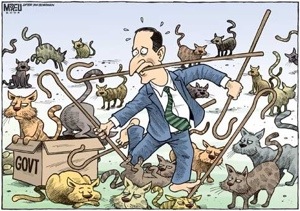
The prospect is, that should Labour gain power, either totally, or in a coalition, all councils will become single tier across England. Additionally, in many areas the council will be in the political control of what is politely called, rainbow alliances, but could soon be more accurately be described as, ‘a herd of cats’.

The Labour Party position on unitaries

A senior shadow minister has hinted that Labour would revive unitary local government reorganisation.

Shadow chief secretary to the Treasury Chris Leslie said in a speech to the Social Market Foundation thinktank that the government should work with councils that were already promoting unitary schemes, such as Leicestershire and Warwickshire.

“The previous Labour government helped local government to make efficiency savings. So we gave local authorities powers to merge and change their boundaries and in 2009 a series of local authority reorganisations brought together district and county councils and created new unitary bodies,” he said.

“Other changes in Devon, Exeter and Norfolk were in the pipeline but this government stopped those in their tracks and are continuing to resist local authorities’ proposals to unitaries.”

The earlier generation of county unitaries had delivered savings per head through efficiencies of £46 per person a year in Cornwall, £52 in Central Bedfordshire, £66 in Shropshire and £91 in Northumberland, Mr Leslie (pictured) said.

He said: “The government and Whitehall should be doing more to empower councils, that see from the bottom up the benefits of collaboration and are actively debating whether to come together. This should also include small district councils that are facing the greatest financial pressures of all.”

Mr Leslie, who was a junior local government minister under Labour and ran the New Local Government Network thinktank before he returned to Parliament in 2010, said he and shadow communities and local government secretary Hilary Benn would “continue to explore the full range of options to support councils as they share services, pool budgets, and choose to collaborate and integrate further”.

Local government minister Brandon Lewis contrasted Mr Leslie’s speech with reported remarks in which Labour policy co-ordinator Jon Cruddas appeared to rule out reorganisation.

He said: “The Labour Party are in disarray on unitary local government restructuring, ruling it out one week and calling for it the next.

“By contrast, the coalition government is very clear that restructuring would be expensive, divisive and time-consuming, diverting time from improving frontline services and locally-led co-ordination.

“Labour is motivated by partisan politics, doing what they think is best for Labour self-interest rather than what’s best for the country.”

Mr Leslie also said that English local government was “enduring eye-watering reductions in revenue support grant which are threatening basic activities in social services, housing, environmental services, libraries and local voluntary bodies”.

Labour’s Local Government Innovation Taskforce would examine how to orientate services “around users rather than necessarily sticking with the old – and expensive – bureaucratic way of working”, he said.

Should Spalding have a council?

As the Civic Society, in their latest newsletter, is seeking to resurrect the debate around the creation of a town council for Spalding, I thought it might be worth republishing a previous entry on the subject, from nearly 2 years ago, that was itself a repeat of an even earlier one.  As they say, there’s nothing new in this world.  

Although the financials are somewhat out of date, page 127, of the agenda supplement that will be put before full council of 26th Feb 2014, gives the up to date numbers and hopefully can be viewed here as a PDF document:   http://democracy.sholland.gov.uk/ieListDocuments.aspx?CId=119&MId=1351&Ver=4

In order to help with the conversation that is currently taking place via Twitter, I’ve been asked to offer more detailed comment via my blog page.  Never being one to turn down the opportunity to offer words of (dubious some would say) wisdom, I am starting off by republishing an entry I made in January 2008.

Spalding Special Expenses – Here we go again!

We had a special meeting of the cabinet today, mainly to approve various financial papers.  One of these was a consultation document on the Draft General Fund Revenue (GF) account.  Just like all things financial in local government, including the names they call things (GF!) the information (sorry data, information suggests useful data that makes sense!) is pretty impenetrable, unless you happen to be an accountant.  In my case, having the numeracy skills of a flip flop doesn’t help, so I’m normally the one asking the stupid questions.  Anyway, one of the items in the document was the Spalding Special Expenses and this is the prompt for my latest ramblings.

Spalding doesn’t have a parish or town council, but it does have the equivalent of a parish precept called Spalding Special Expenses (SSE).  This amount makes up a very small part of a Spalding resident’s council tax bill, but actually generates a great deal of debate at this time of year.  The proposed increase this year is about 4.17% or 1.6p a week, making the average total SSE this year £21.49.  Chicken feed most people would say, but even a small amount collected from a lot of people adds up to quite a bit of money (approx £183,000).   However, the underlying issue is how this figure is arrived at, who decides it and what it should be spent on.

The final decision rests with the district council, because Spalding doesn’t have a parish or town council and this is where the debate really gets going.  We have a Spalding Town Forum made up of elected members and some local organisation representatives.  However, it has no executive powers and can only make recommendations to the district council, which can of course choose to ignore them.

Should Spalding have a parish/town council?  I joined the district council in May 99 believing that Spalding should indeed have its own council, after all, how could so many people, 22,000+ then, be so under-represented compared to all of out smaller towns and villages?  However, now that I’ve doing this for a while, I’m less sure of the merits of this, especially when it comes to unravelling the finances, setting it up and paying the admin costs.  A major cost would be employing a clerk in the same way parishes do.  How much? £10k, £15k, £20k, who knows until it actually happens?  Finding a place to call home (an office) could cost anything from £2k to £10k.

What will the people of Spalding get for their money if they had a town council?  Apart from direct control over some very limited areas of council business, maintenance of Spalding Cemetery, Monks house Lane, Hailey Stewart and the provision of Christmas decorations to name a few, not a great deal as it stands!  However, once you have a parish or town council, theoretically the sky’s the limit (that’s a scary thought in itself).  

So, as far as I’m concerned the jury is still very much out on this issue and given the lack of feedback from the public of Spalding, I think it’s going to remain out for some time to come! 

If you want to know more about the issue of creating a parish/town council see: http://www.nalc.gov.uk/About_NALC/What_is_a_parish_or_town_council/What_is_a_council.aspx

Spalding Special Expenses Account –  Published for consultation purposes


Original 2007/08


Draft 2008/09


Budget


Budget


Variance


£


£


£

SpaldingCemetery  (see note 1)


45,280


47,170


1,890

Spalding Allotments


9,720


11,600


1,880

   Ayscoughfee (excluding gardens)


6,470


7,240


770

   Halley Stewart (see note 1)


31,150


41,330


10,180

  Thames Road(see note 2)


11,990


8,430


(3,560)

  Fulney Road


9,120


9,550


430

  Monkshouse Lane(see note 3)


21,260


26,010


4,760

Contribution to Voluntary Car Scheme


7,700


8,000


300

Christmas Decorations


16,260


17,400


1,140

Contrib. StMary & StNicolasParishChurch


650


680


30

Contribution to footway lighting (note 4)


2,030


0


(2,030)

Administrative Support


3,630


3,740


110

Bus Shelter maintenance


410


410


0

Spalding Town Centre Promotion (see note 5)


4,000


2,000


(2,000)

Crime prevention (see note 6)


2,000


0


(2,000)

Total Expenditure


171,660


183,560


11,900

Funding

To be funded from Council Tax


171,660


183,560


Tax Base


8,320


8,540


Band D equivalent


20.63


21.49


Council Tax Increase                                                 


3.06%


4.17%


Balance Brought Forward


2007/08


2008/09


(36,000)


(36,000)

Earmarked for crime prevention


12,880

Agreed minimum balance 5% expenditure for contingency


8,580


9,180

Available Balance


(27,420)


 (13,940)

Notes

1. Tree works for Halley Stewart and the Cemetery have been estimated at £3,000 and £8,000 respectively.

2.  A spiking machine for the grounds (£6,000) has been added to Halley Stewart Playing Field.

3.  Maintenance of the Pavilion at Monks House and Legionella testing (£3,900) has been added  to the playing field budget.

4. The budget provision for footway lighting has been removed, since no new lights are currently being planned.

5. The Town Centre promotion budget has been reduced to £2,000, so that the spiking machine can be funded this year and council tax increases maintained.

6. The Crime Prevention budget has been reduced to nil for 2008/09 and balances will be used, should the Herring Lane Car park income not be sufficient to pay for the maintenance of CCTV.  In prior years this budget has not been called upon.

Affordable is clearly a dirty word when it comes to housing numbers

Given recent comments made by various government ministers, one could be forgiven for thinking that the housing needs this government is promoting, are not exactly in line with those of the general population and that some form of hidden agenda is in play.

The link a the bottom of this page, is to an item about yet another council falling foul of the NPPF, whilst attempting to produce a Local Plan for their area.   In particular, it details the difficulties involved in identifying the actual housing needs of an area, and the tensions that exist between the open market and the needs of those who can’t afford to buy, but are still in need of somewhere to live.  Before the introduction of the NPPF, this latter group were catered for, in part at least,  by a requirement to provide a percentage of affordable housing within all large scale housing developments.

The NPPF introduced a seemingly sensible requirement to consider the financial viability of any proposed development, when determining a planning application.  This measure being designed to reduce the numbers of stalled developments, where permission had been given, but the developer couldn’t start building because the numbers did add up financially.  However, far from being the common sense requirement we all assumed it to be, it has very quickly become a get out of gaol free card for the developers.  Many of the volume house builders sort to cash in on the past housing boom by buying land at inflated costs, spurred on by the widespread belief that the housing price bubble would never stop inflating, let alone burst.  This now misguided view, was further fuelled by the ease with which people could obtain a mortgage, even when it was obvious that they would not be able to maintain the payments if interest rates were to increase.

Despite the house price crash, David Cameron has fallen for the line fed to him by  George Osbourne and pinned virtually all of his hopes for financial recovery, on a return of a market driven boom in house building – will they never learn?  This means that any developer required to provide affordable housing is able to wriggle out of doing so, by playing the viability card, this despite a significant national decline in the provision of affordable housing as illustrated in the graph.  Affordable housingAny local authority that has the temerity to continue to insist on the provision of affordable housing, is likely to be put back in its box by Eric Pickles’s equivalent of the KGB, the Planning Inspectorate.  Graph taken from document:  https://www.gov.uk/government/publications/affordable-housing-supply-in-england-2012-to-2013

The ministerial comments referred to, hide a thinly veiled distaste for affordable housing in principle.  They also display a fundamentally flawed belief that everybody, no matter how modest their means,  should aspire to home ownership and that in doing so, they will become worthy members of society.  Is this the naive vision from the out of touch and privileged elite now entrusted to run our country?  Is it a more calculated strategy, designed to support their own financial interests and those of their associates?  Or, is it a demonstration of an ingrained distrust of anybody who doesn’t aspire to home ownership and a belief that they are somehow lesser people?

Having strangled off the financial support provided by the Homes and Communities Agency for social housing, regularly refused to relax the borrowing limits on local authorities thereby preventing them from accessing the funds required to build more council houses and now given developers carte blanche to reject the requirement to provide affordable housing, one can only assume that, once again, the market has won and it’s to hell with those who can’t make the cut.

http://andrewlainton.wordpress.com/2014/01/01/assessing-objective-need-after-the-west-dorset-decision-bombshell/

As forecast, first public comment was a negative

Spalding Common

Spalding Common

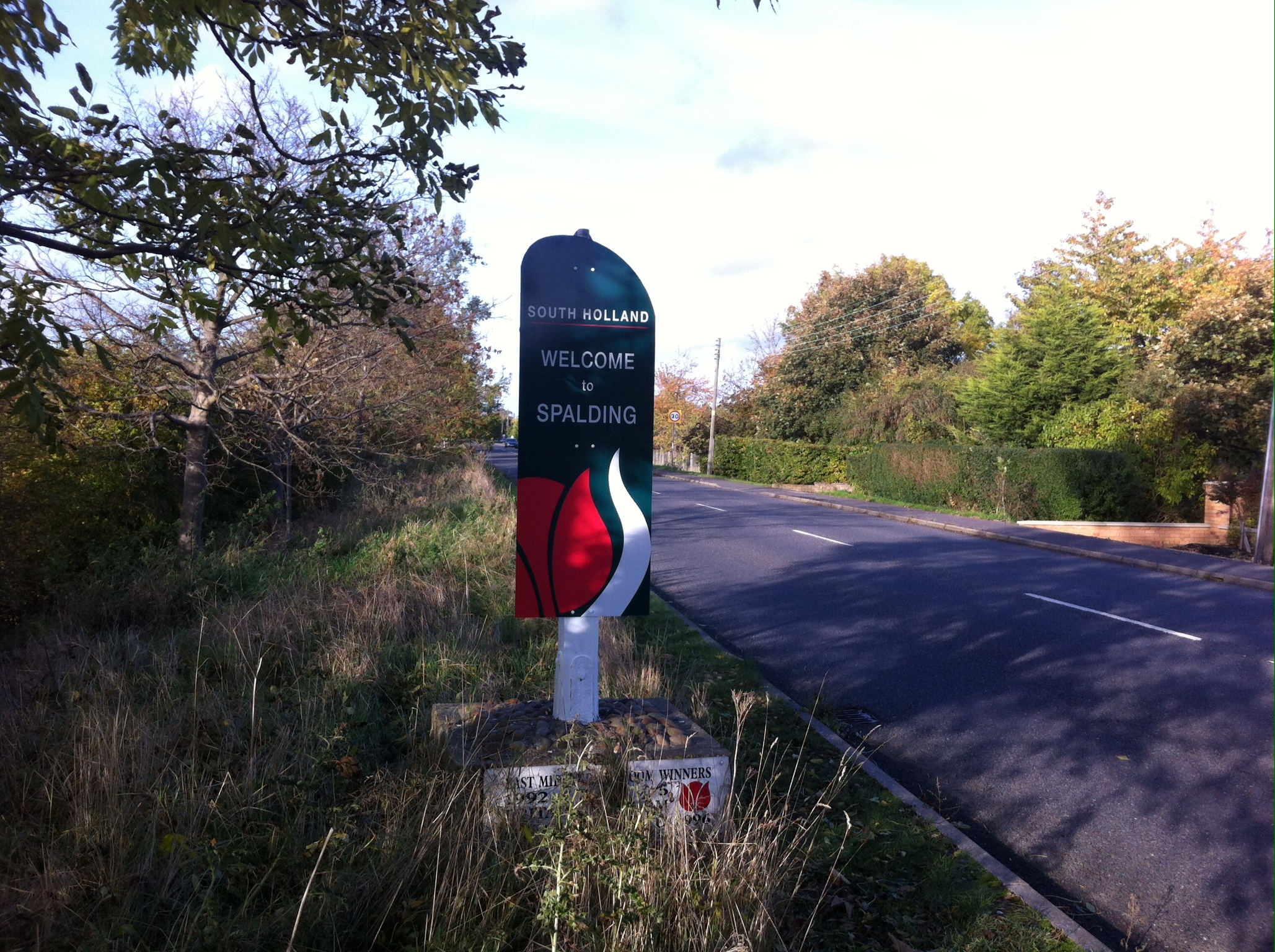
I had a bet with the blokes putting up the first one, about what the tone of the first public comment would be, regarding the new Welcome to Spalding signs. Being a fully paid up member of the cynical B’s club, I bet on it being critical, negative and tinged with an element of spite – and I was right! Pay up guys.
I suppose we should be thankful that at least somebody has not only noticed them, but has taken the time to put pen to paper, given the lack of interest displayed by many when it comes to local issues – apart from planning applications that is.
The writer of today’s letter in the Spalding Guardian, is a regular contributor to the page.  He obviously missed the postage stamp sized story on these signs, the first time around, or I would have expected to see his critical appraisal published back then.
No, the signs are not made of Perspex (a trade name for acrylic) Mr Sadd, they are aluminium, with the image printed on – durable vinyl material, designed for this use.
The signs are as temporary as you want them to be Rodney. If you can find the several thousands of pounds, probably as much as £10,000 would be my guess, to commission, design, manufacture and install something similar to the wooden signs that Spalding once had, I’m sure we would all be very pleased to see these signs replaced.
My guess is, that there isn’t anybody out there already writing the cheque for this work and that these signs will remain in place for at least as long as the embarrassing ‘lollipops’ that they replaced – come on prove me wrong for once, I dare you. That’s not an invitation to go and nick them by the way.